
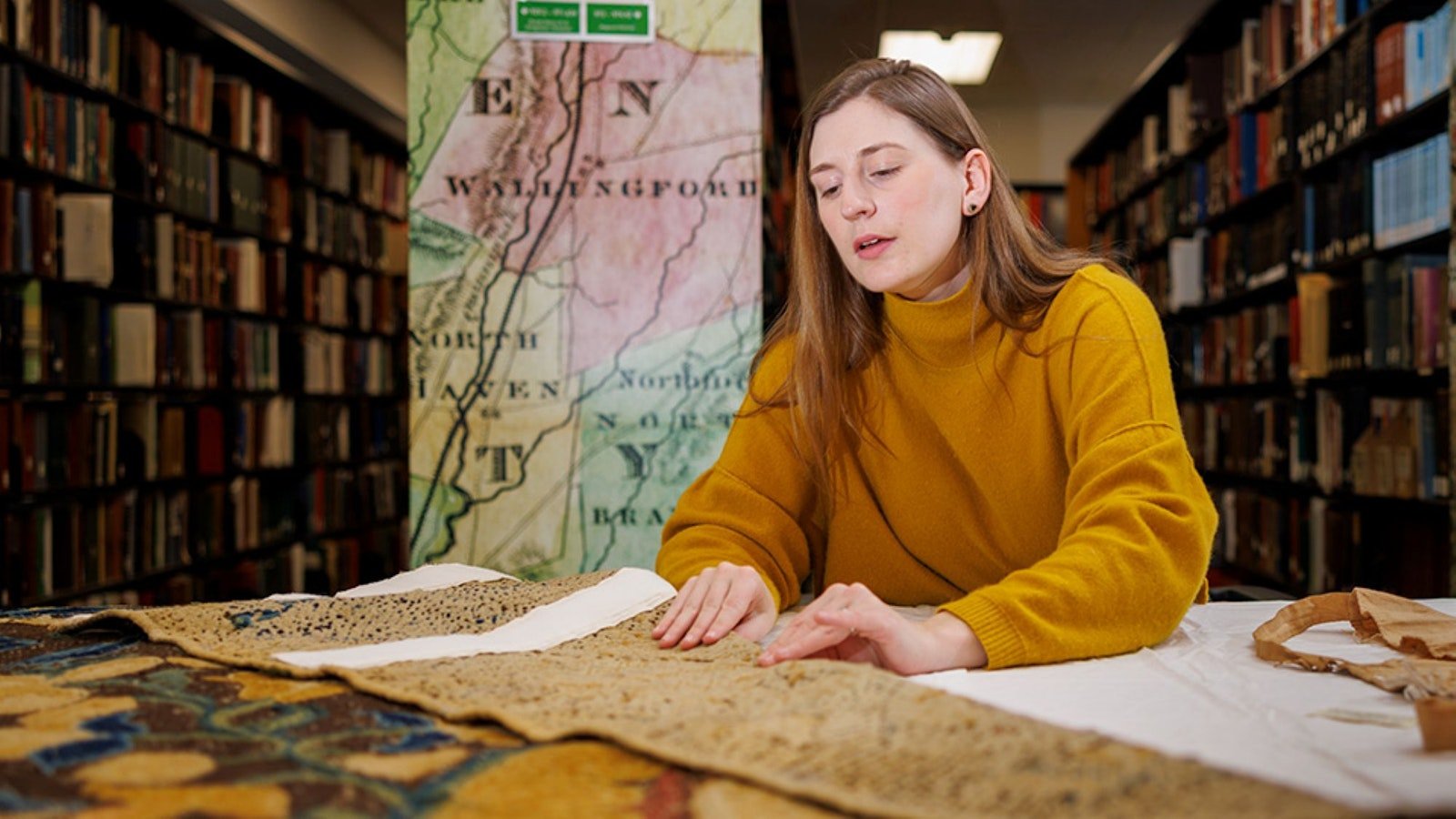
The Long Thread: Emily Whitted
PieceWork's The Long Thread series shares voices from across our community. In this interview, meet Emily Whitted, a doctoral candidate at the University of Massachusetts Amherst, studying early American history, material culture, and the history of technology. Her dissertation examines early American textile repair work. Emily holds a bachelor’s degree in English, a master’s degree in American material culture, and a public history certificate with a concentration in museum studies. She has most recently curated the exhibition American Girlhood at the Webb Deane Stevens Museum.
You are a PhD candidate in history. Tell us about your dissertation project and what excites you most about the research you’ve done over the last six years.
My dissertation project, “Darned, Patched, and Mended: Repairing Textiles in Early America” is a study of textile repair work, or mending, within homes, ships, and military camps between 1750 and 1850. My project involves studying textiles in American museum collections. This includes items that have been mended as well as historical research in paper archives. The research road has taken me to institutions all along the East Coast, and I have probably seen over a thousand repaired textiles, including articles of clothing and household items such as quilts, curtains, bed hangings, and blankets. Mends reveal important information about how textiles were cared for and used throughout their lifetime, as well as powerful labor histories of diverse men and women. I am most excited for how this project might impact the ways that mends are documented and interpreted in museums.
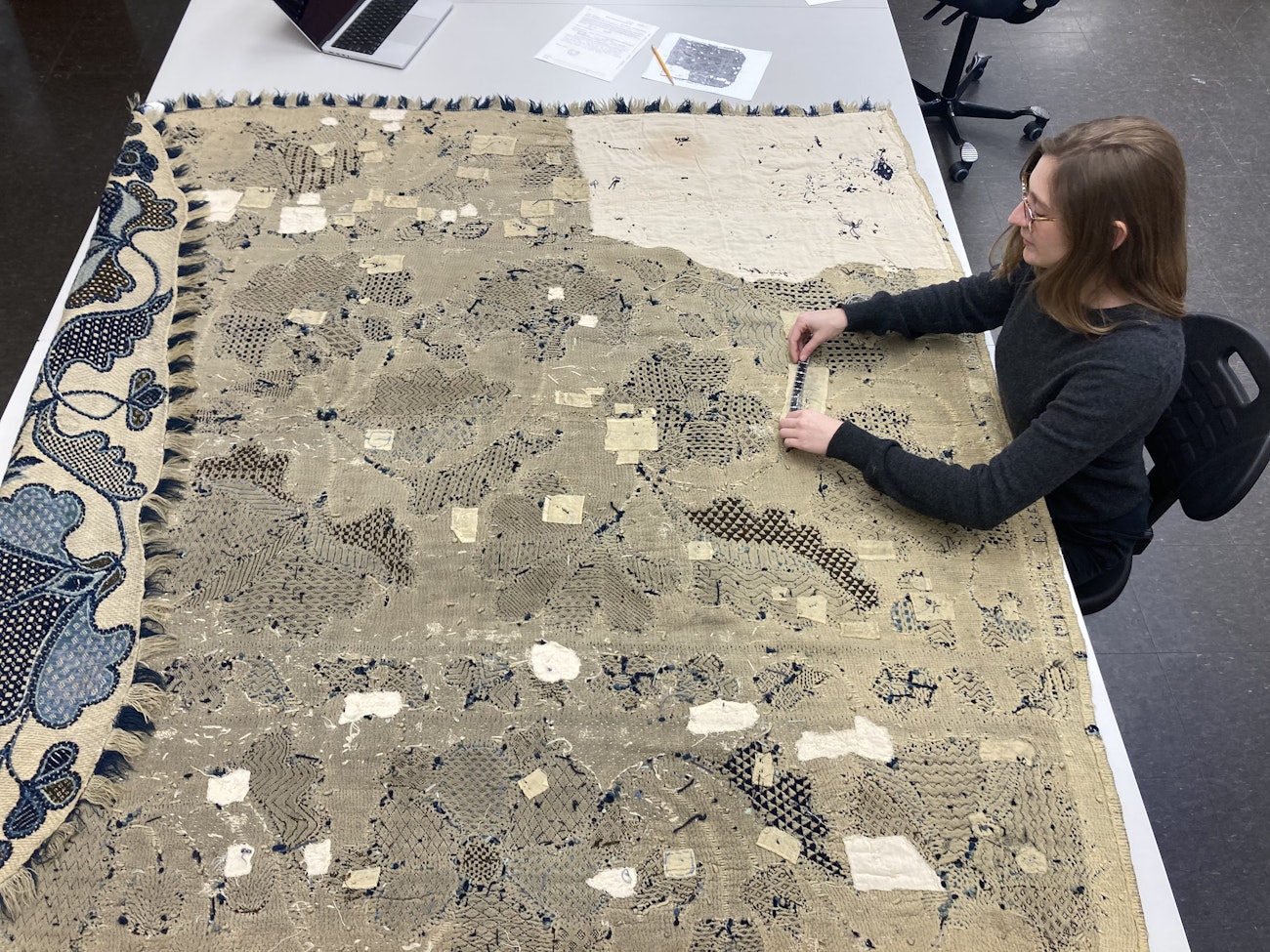
Many mends on early American textiles are well hidden. Emily documents the dozens of patches and darns on the back of an embroidered bed rug made by Mary Foot in 1778 from the Winterthur Museum’s collection. Photo courtesy of Emily J. Whitted
How did you become interested in historical textiles and textile repair and choose that course of study?
I grew up on a sheep farm in southwestern Virginia and learned to knit and sew at an early age, so one could say that textiles were all around me! I also had a strong interest in the history of women, of which textiles are a key component, and I loved reading books with historical female characters when I was growing up and in college. At the University of Richmond, I majored in English Literature and wrote an undergraduate thesis about textiles and several female characters in the novels of Victorian writer Elizabeth Gaskell. When I finished, I had the epiphany that I didn’t just want to read about textiles—I wanted to study the textiles themselves.
This jolt of clarity eventually led me to the Winterthur Program in American Material Culture at the University of Delaware. My time and training there for my master’s degree solidified my wish to work with historic objects and well as texts and inspired my pursuit of a PhD in history at UMass. When I was working on my master’s thesis on early American knit stockings, I noticed that a great number of them in museum collections had been mended, but that repairs were rarely documented—this conundrum first inspired the dissertation project!
 As part of her research on early American frame-knit stockings, Emily learned to knit on an operational nineteenth-century knitting frame at the Framework Knitter’s Museum in Ruddington, England. Photo courtesy of Emily J. Whitted
Tell us about your work as the guest curator of the American Girlhood exhibition at the Webb Deane Stevens museum. How did that opportunity arise?
American Girlhood: Needlework, Memory, and the Making of a Nation just opened at the Webb Deane Stevens Museum in Wethersfield, Connecticut. The exhibition features over 50 incredible early American samplers and embroideries stitched by young girls and women, the majority of which are loaned from public and private collections.
Knowing my academic focus on historical textiles and early American women’s history, the museum’s executive director reached out to me about the possibility of curating a needlework exhibition during the 250th anniversary of the founding of the United States. It was an exciting opportunity to highlight the lives of early American girls and women through their artistic and educational stitching as part of that national conversation.
During the exhibition’s development, I was also lucky enough to collaborate with preeminent needlework dealers Carol and Stephen Huber. They have decades of experience working with early American schoolgirl needlework, and many of the objects in the exhibition once passed through their expert hands.
You learned to knit, crochet, and sew early in life. Do you still find time to do needlework? If so, what craft do you enjoy doing most? Does your research related to textile repair influence your own making or mending?
I still do a variety of needlework, but knitting is definitely my favorite and a great form of stress relief. I also enjoy tackling a few complex projects each year to challenge my brain, and I’ve started a tradition of knitting one sweater for my birthday each year!
Working with my hands is also an important part of my research. I mend my own textiles when they are damaged, and I also try to experience different forms of historical making or consult with experts to better understand the embodied knowledge that goes into certain processes. Recently, that’s included working with the talented crew in the sail loft at Mystic Seaport Museum to understand historical techniques for sail repair and examining different reproductions of knapsacks from the American Revolution stitched by the education team at the Museum of the American Revolution. So much important information about historic making was not written down but learned through experience.
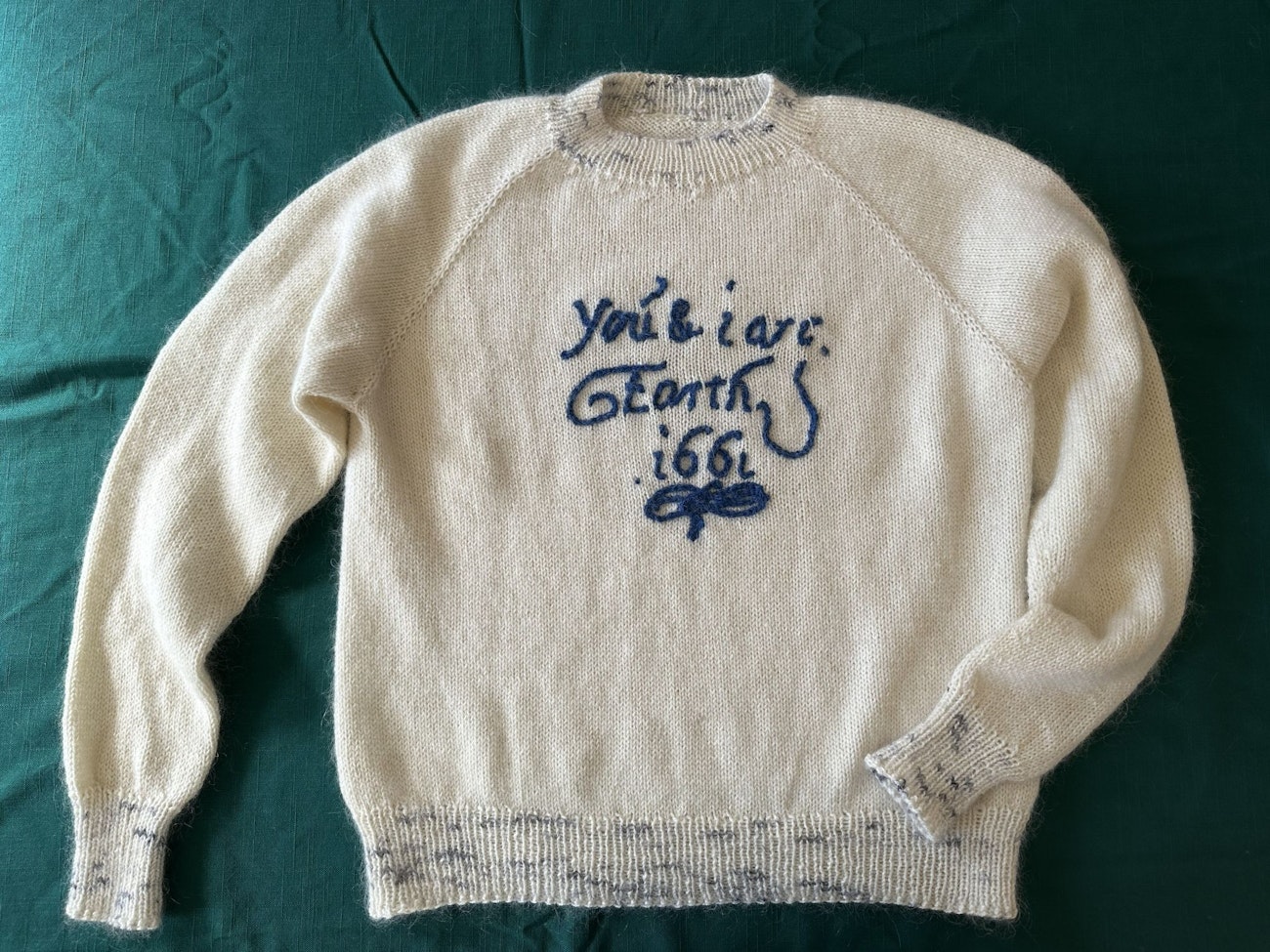
One recent sweater Emily knitted was inspired by the inscription on a seventeenth-century plate in the collection of the London Museum. Photo courtesy of Emily J. Whitted
What advice would you offer to someone hoping for a career related to historical textiles?
Decide what excites you most about textiles and what type of work you want to be doing, and see how they align. I tried a variety of different ways to center textiles in my work early in life, including a brief stint as a handknitting pattern designer, but I eventually gravitated away from making for pay and more toward the study of historical textiles. I underestimated then just how broad that field would be and how many different careers one could have!
Along with my studies and different work opportunities, I have also had to discover for myself what kind of work I wanted to be doing. Did I want to work with people, or did I mostly want to spend time with the objects? Was my work public facing, or behind the scenes? How did I feel about research and writing, versus hands-on work or object care? Did my love for textiles change if it was the focus of my daily work, rather than my life outside of work? Sometimes the right topic and the wrong forms of work can temper your passion, so evaluating what is a good fit for you and what will sustain your interest is an important step!
Enjoy more The Long Thread interviews on the PieceWork website. Do you know an amazing needle artist, historian, or someone whose story we should share with PieceWork readers? Write to us with your suggestions, so we can continue to discover and share the work of our community.
Happy stitching,
Karen