
Contents
For this month’s A Place to Come To series, highlighting remarkable textile exhibitions and collections, come along with us to the Webb Deane Stevens Museum’s new exhibition of early american needlework: American Girlhood: Needlework, Memory, and the Making of a Nation.
American Girlhood
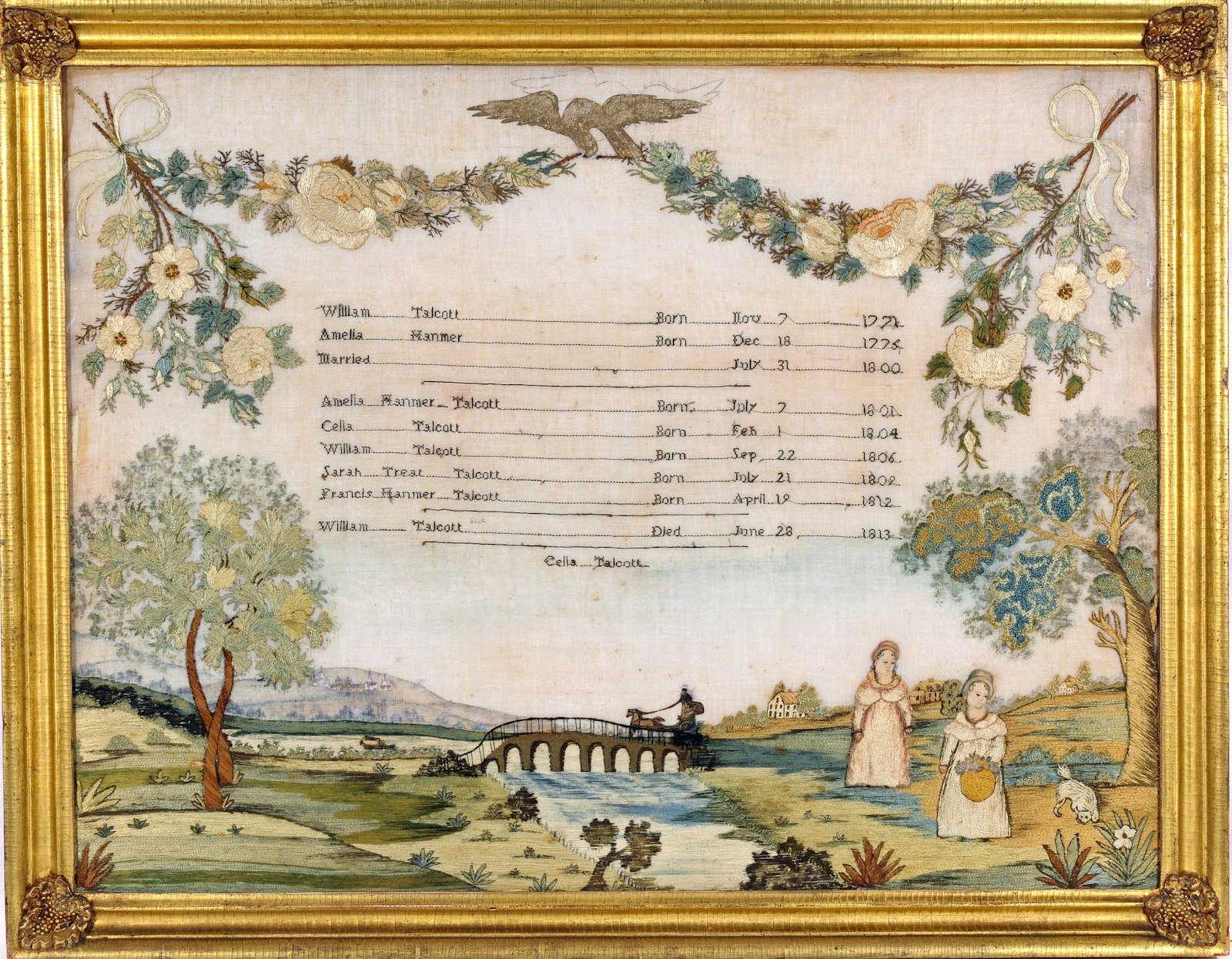
In the early United States, girls’ needlework took many forms—alphabets carefully stitched for practice, family records, memorials to loved ones, and pictorial scenes that ranged from modest to remarkably intricate. These samplers were more than exercises in skill; they were quiet assertions of identity, often embedding clues about a girl’s world—her surroundings, cultural influences, and at times even her political awareness. Guest-curated by Emily Whitted in collaboration with Stephen and Carol Huber, American Girlhood gathers an extraordinary group of 50 works from the late eighteenth through the mid-nineteenth centuries. Drawn from both museum collections and private holdings across the country, the exhibition explores not only what girls were taught to stitch, but also what they chose to express within—and sometimes beyond—those boundaries. Many of the pieces on view have rarely, if ever, been publicly displayed.
Together, these works tell the stories of American girlhood from centuries past. Girls like 11-year-old Marcy Hay who worked her sampler just two years after the Battle of Bunker Hill near Boston reduced her birthplace to ashes. Or Diantha Griswold from Wethersfield, Connecticut, who stitched a quiet memorial to the mother and brother she never knew, setting their memory against a familiar skyline just beyond her window.
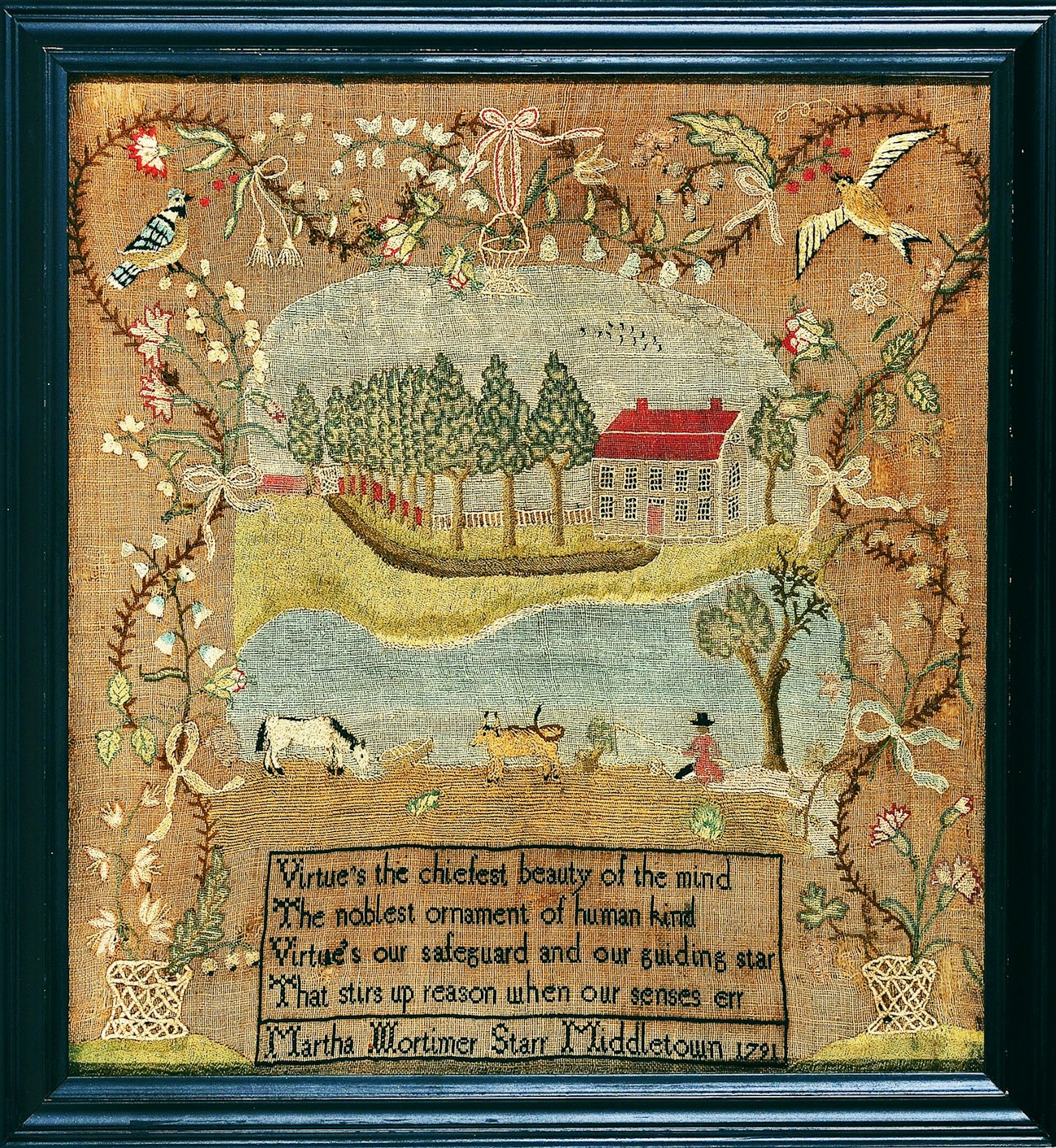
Sampler by Martha Mortimer Starr (1777–1848), about 14 years old, dated 1791, silk on linen. The verse reads: Virtue’s the chiefest beauty of the mind/ The noblest ornament of human kind/ Virtue’s our safeguard and our guiding star/ That stirs up reason when our senses err.
Black and Indigenous Girls in Needlework History
Particularly compelling are the samplers attributed to Black and Indigenous girls. Their rarity reflects not an absence of participation, but a long-standing tendency to assume unidentified makers were white. In reality, girls of color were educated in needlework across lines of race and class, even if the historical record has not always preserved their names. When these works can be confidently linked to their makers, they offer powerful and necessary expansions of the story these textiles tell.
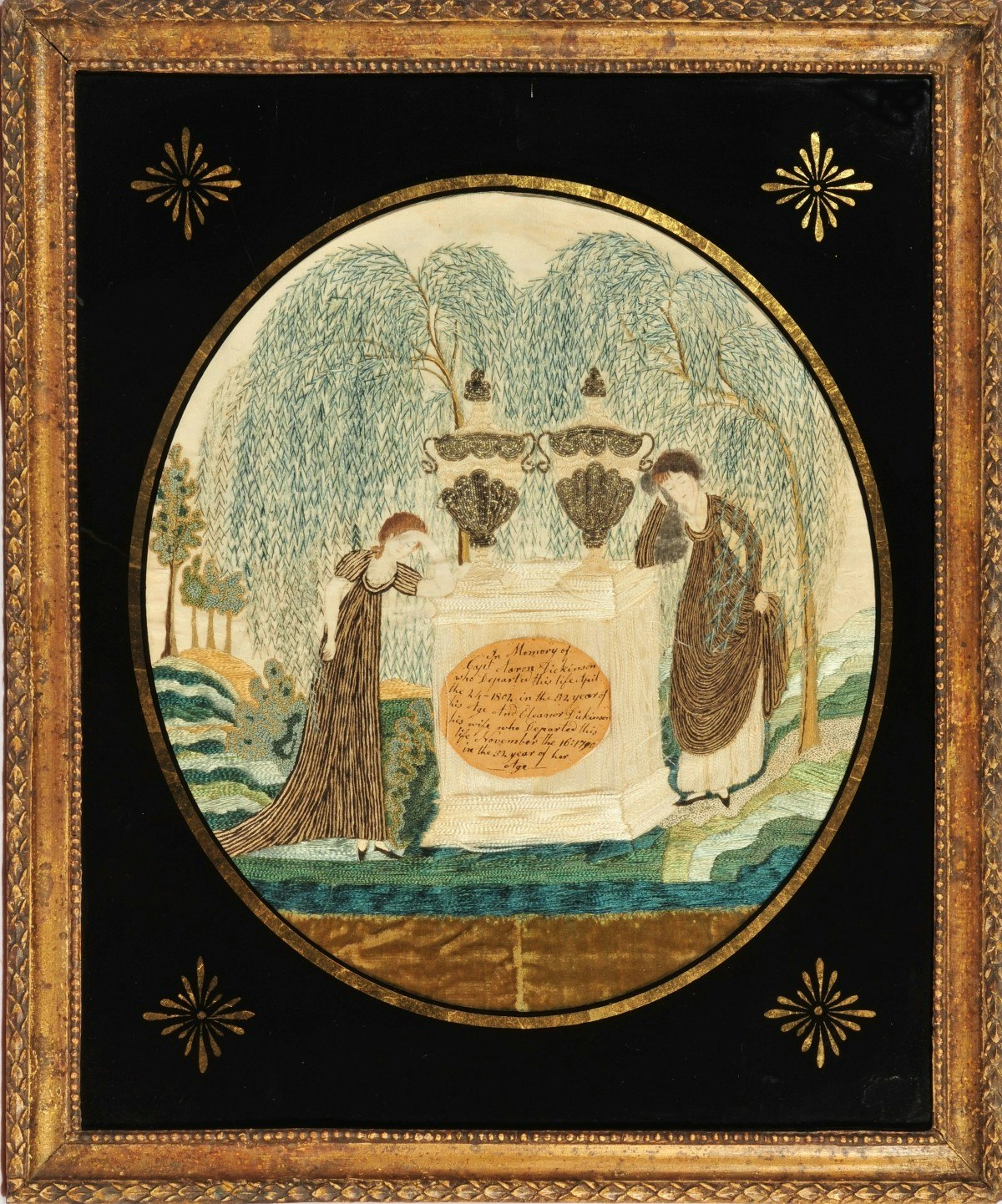
A relative of famed poet Emily Dickinson, Elizabeth Dickinson (1790-1849), stitched this silk embroidered memorial while attending Abby Wright’s School in South Hadley, Massachusetts, circa 1802. From a private collection.
The Pittsford Historical Society loaned Christeen Baker’s sampler for the exhibition, one she stitched at the Choctaw Mission School, in Mayhew, Mississippi, 1830, addressing it “To Mrs. Hammond” as proof of her education just one year before the Treaty of Dancing Rabbit Creek forced the removal of her people. Whether she survived that displacement remains unknown.
Together, these samplers show girlhood in all its variety, often more complex than tidy stitches reveal. American Girlhood: Needlework, Memory, and the Making of a Nation is on view now through December 2026.
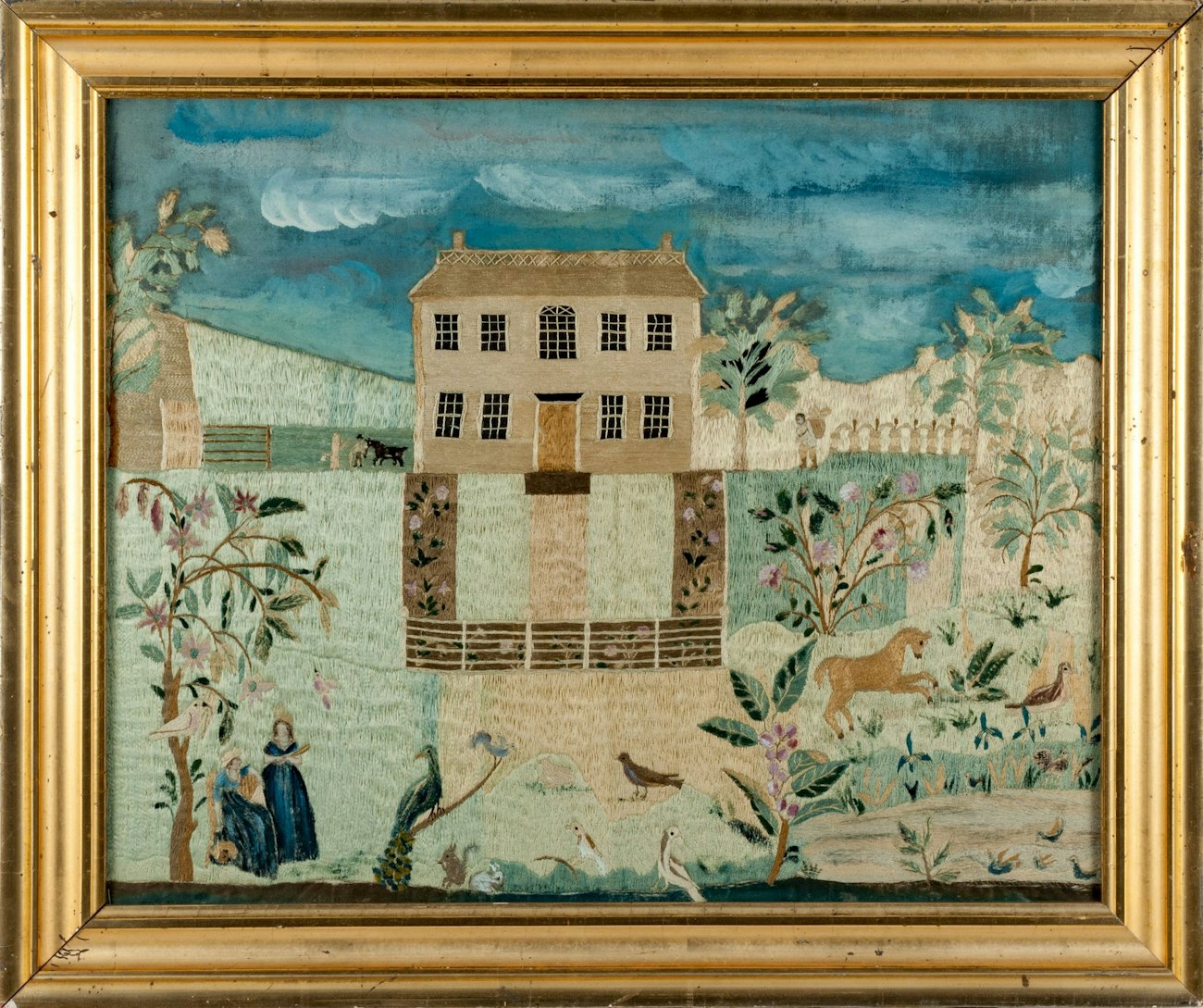
An early silk embroidery stitched by Phebe Carlton. Phebe Carlton (1767–1794) worked this needlework in her twenties (Andover, Massachusetts, circa 1790), depicting her family’s home, which was passed down in her family for generations after her death at age 27.
A Historic House Museum
The Webb Deane Stevens Museum is a historic house museum in Wethersfield, Connecticut, that preserves and interprets everyday life in early America. Owned and operated by the National Society of the Colonial Dames of America in the state of Connecticut, the museum comprises three restored eighteenth-century homes—the Joseph Webb, Silas Deane, and Isaac Stevens houses. Each house provides a view into colonial and early national history, from Revolutionary War leadership to domestic life and material culture. Together with its gardens, collections, and exhibition spaces, the museum functions as both a preserved historic site and an educational center, exploring how people lived, worked, and shaped early America.
Visit the Webb Deane Stevens’ calendar for a list of events celebrating America’s 250th anniversary, including lectures, trades fairs, and other exhibitions.
Learn about more events and activities in our Needleworker’s Resource Guide to Celebrating America’s 250th and discover generations of needlework in America in PieceWork's Spring 2026 issue.
Happy viewing, stitching, and celebrating!
Karen