
Contents
Why I Chose the Samplers Others Overlooked
After teaching myself to cross-stitch, I began to stitch antique reproduction samplers. I researched and dreamed of owning my own antique sampler. I had admired many antique samplers and needlework pieces from afar in museums, antiques fairs, and more. The samplers I admired seemed inaccessible and too precious to touch in their pristine, conserved condition.
For several years, I watched many auction sites selling antique samplers week in and week out, and I read anything I could find on the subject. Finally, I purchased my first sampler in May 2014 and the second soon after. Three questions guided my sampler search: “Did I like the sampler?” “Could I afford to pay the asking price?” “Would I be happy with this price if I found out that I had made a mistake and purchased something without any historical value?” As I spent more and more time looking at samplers, I began to gain confidence.
Unlike many people, I was completely unconcerned about the condition of the samplers I considered purchasing. In fact, the sampler could be unfinished, ripped, torn, faded, have stitches missing, colors bleeding, or any combination of these common signs of wear and age. I was unconcerned about condition for two reasons. A practical reason is that samplers in poor condition are generally not sought after by collectors, and as a result, there are more of them with lower asking prices.
A sentimental reason, however, is that I had very early in my journey begun to envision each sampler as an eighteenth- or nineteenth-century child, slightly built, in a grubby, tattered, and threadbare dress. Her hair escapes poorly kept braids, and there are no shoes to protect her feet. She is a ragamuffin child who wants to be seen and is in need of protection, love, and a new dress. So, the poor condition of the samplers was the very reason I sought—and still seek—to find and bring them into my collection. These samplers were being overlooked, discarded, and lost to history.
As I began seeking out the imperfect samplers, I found they were affordable, accessible, and showed the same depth of skills and breadth of subject matter as those precious examples I had admired from afar. My collection has grown to include 151 pieces. As I matured and developed as a collector, my understanding of the history of girls’ education—and the role of needlework in it—expanded. I learned as much as I could about common themes, techniques, and materials associated with the samplers in my collection. Samplers usually provide a great deal of information through stitched elements. For example, they may include dates of birth, death, sampler completion, names of the stitcher, teacher, school, parent(s), friend, hometown, and village or city. Through this type of information, historical context can be added. In rare cases, first-person contact with the sampler’s current owner may reveal snippets of information, but the most immediate source of information can be found in the stitches themselves. In some cases, they are easy to read and research. In others, due to stitch loss, fading, or bleeding dyes, the words and motifs become obscured.
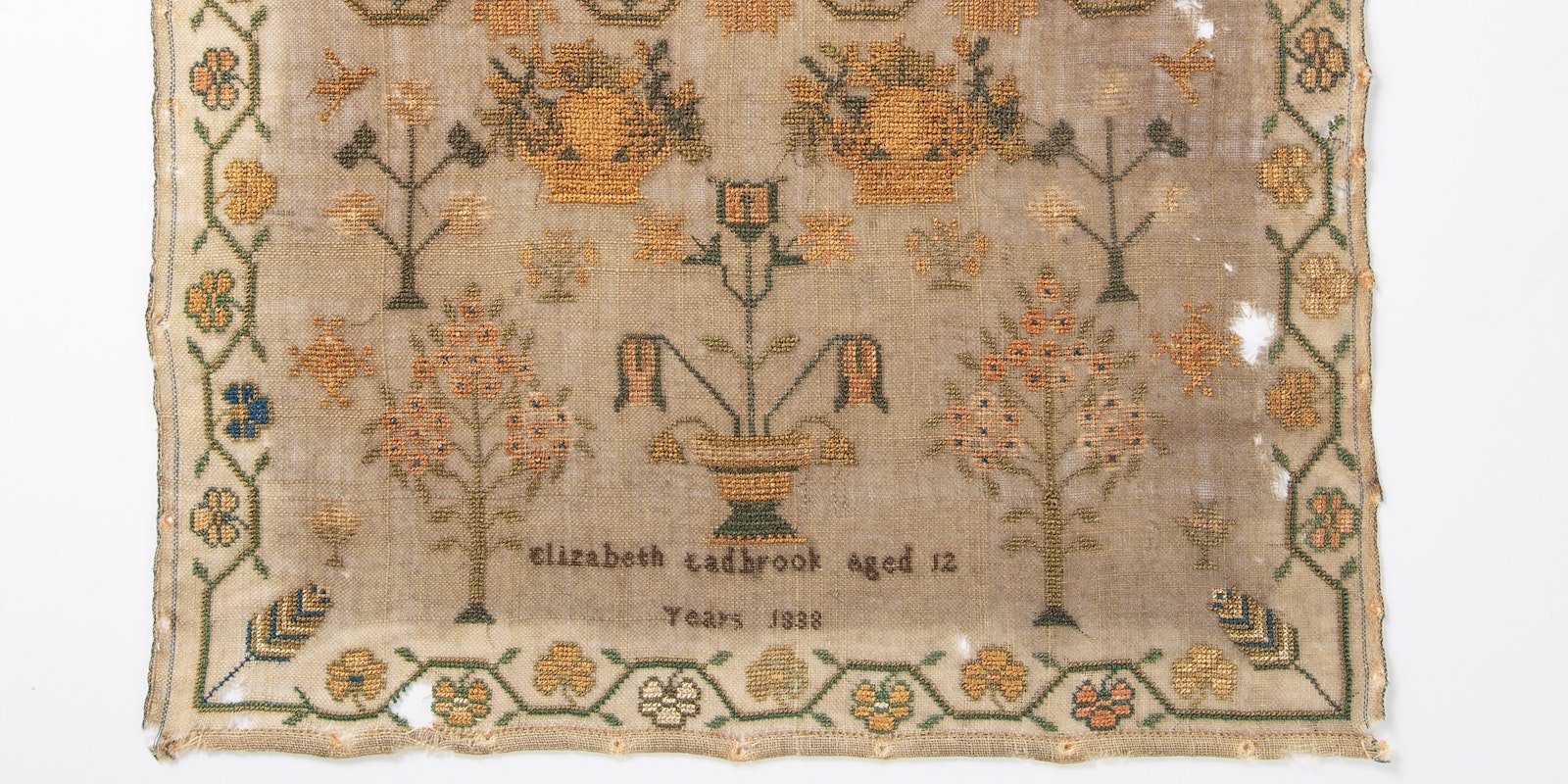
 Detail of Elizabeth Ladbrook, 1838. From the collection of the author
Elizabeth Ladbrook, 1838, Age: 12
My first sampler purchase was “Elizabeth Ladbrook, 1838.” She cost $113.16 Canadian and arrived promptly from Great Britain. Her gauze-like fabric was mostly intact but very dry and severely darkened with age. The dark, brown-black lettering had experienced significant loss and degradation. I set about deciphering what was left of the stitched passage, writing down each letter and word that was still legible.
Constrained by their LORD to embark
And venture without him to sea
The season tempestuous and dark
How grieved his disciples must be
But though he remained on the shore
He spent the night for them in prayer
They still were as safe as before
And equally under his care
This is the first verse of the hymn The Disciples at Sea written by John Newton (1725–1807). An English Anglican clergyman, Newton is remembered as a prominent supporter of abolition of the slave trade and author of the poem, “Amazing Grace.” His complicated life included forced service in the Royal Navy, time spent as the captain of slave ships, andlater, captive of the native peoples of Sierra Leone. In researching John Newton, I learned more about the chronology before and after the British Empire’s 1833 Slavery Abolition Act. This sharpened my focus and gave context to the times in which Elizabeth and her family lived.
Elizabeth was born almost two decades after Parliament’s 1807 act prohibiting the slave trade and Clergyman Newton’s death that same year. So, her sampler was completed 31 years later. We will never know if by including this passage she was speaking to and identifying with her religious practice, remarking on the perils faced by people at sea (literally or metaphorically), paying homage to Clergyman Newton or the abolition of the slave trade and our shared humanity. There are so many directions that interpretation and research can take.
A few things are made clear in the sampler: Elizabeth valued symmetry, nature, and the harmonious placement of rich color. Her skill with a needle is mostly excellent, with some carrying of threads on the back of her work and errors in stitching within the center of her crowded floral baskets. The treatment she gave in finishing the sampler top and bottom remains intact some 182 years after she completed it, as do the original manufactured finished edges on both sides of the linen.
Abagail Fukes, 1726, Age: 13
When I became aware of Abagail’s sampler in early March 2020, I was more deliberate in my collecting and focused on expanding the completion-date range, countries of origin, and technical variations. Abagail’s sampler was located in Great Britain, and the listing gave dimensions, completion date, and the contents of her verse, laid out just as it was on the sampler in 1726.
 Abagail Fukes, 1726. From the collection of the author
I added this sampler to my collection simply because of the date it had been completed. It would push my earliest dated sampler back from the 1790s to 1726. Visually, when set among my collection of samplers completed mostly in the early to mid-1800s, Abagail’s sampler stands out. The rich colors; precise, fine silk stitches; and lack of whimsical or folksy feel commonly seen a century later make this piece look more professional and exacting, less ornamental.
Death is Certain Judg
ment Sure Sin is The
Wound and Christ is
the Cure When Sitt
ing Stars Declar The
Approach of Day The
Sun Begins His Golde
n Beams Display
Rise to They work
but First Gods Help
Employ God Feaver
Thoes That Humbly
Him Adore. Abigail
Fukes finished this
in the 13 year of har
age Nov 10 The Year 1726
The Victoria & Albert Museum (V&A) explains in an article on their website, “Embroidery—a history of needlework samplers,” that the progression of samplers in the eighteenth century went from a long, narrow format to a squarer shape. This was a shift from rolled-up fabric references for stitches, alphabets, and patterns, to something destined for display within the home. While Abagail’s sampler is still relatively narrow—typical of samplers from the seventeenth century—her inclusion of a verse is not typical of band or spot samplers, generally thought to be the norm for the 1600s.
I continued searching for cultural and historical context that would have surrounded Abagail. The Oxford Reference shows us that the sampler’s completion date places it 16 years after “Thomas Newcomen creates a piston steam engine” and “machines are thrown out of the window of a Spitalfields factory, in protest against industrialization,” but well before the Industrial Revolution (1760–1830).
 Detail of Abagail Fukes, 1726. From the collection of the author
While Abagail was stitching, British society was progressing toward the industrial age. However, much of the social change that would come with it had not yet arrived. Family life and roles for men and women were defined but varied depending on socioeconomic situation. Girls of many social classes were expected to be well educated in needlework, with samplers often serving as means of practice and evidence of skill. In discussing the 2015 V&A exhibit A Stitch in Time: Home Sewing Before 1900, assistant curator Danielle Thom stated, “It’s important to remember that, legally speaking, a married woman in Britain was technically unable to call any property her own, until the first Married Women’s Property Act was passed in 1870. The legal principle of coverture meant that a wife, or feme couverte [sic], had no individual status under the law, and thus could not own property or enter into any contract independently of her husband. This also meant that the legions of women who earned money in the needle trades could not, if married, claim their wages as their own.”
Stitching the Past
I gravitate toward researching the historical context in which a sampler was created. In some ways, I prefer the personal life of the stitcher to remain hidden. I personally always feel that before I know the stitchers on an individual level, I want to know the times in which they lived. Each sampler holds the promise of a new journey as research progresses and wanders through history, technique, material, etc. I hope that, like me, you will champion a sampler and make time to stitch one or two.
Resources
- “Embroidery—a history of needlework samplers.” The Victoria and Albert Museum, vam.ac.uk/articles/embroidery-a-history-of-needlework-samplers.
- Newton, John. The Works of Rev. John Newton. New York: Robert Carter, 1844. Available at archive.org.
- Thom, Danielle. “A Stitch in Time: Home Sewing Before 1900.” V&A Blog, May 5, 2015. vam.ac.uk/blog/news/a-stitch-in-time-home-sewing-before-1900.
- “Timeline: 18th Century.” HistoryWorld, Oxford Reference, 2012. oxfordreference.com/view/10.1093/acref/9780191735615.timeline.0001.
Originally published in PieceWork Spring 2021.
Stitch Your Own Sampler
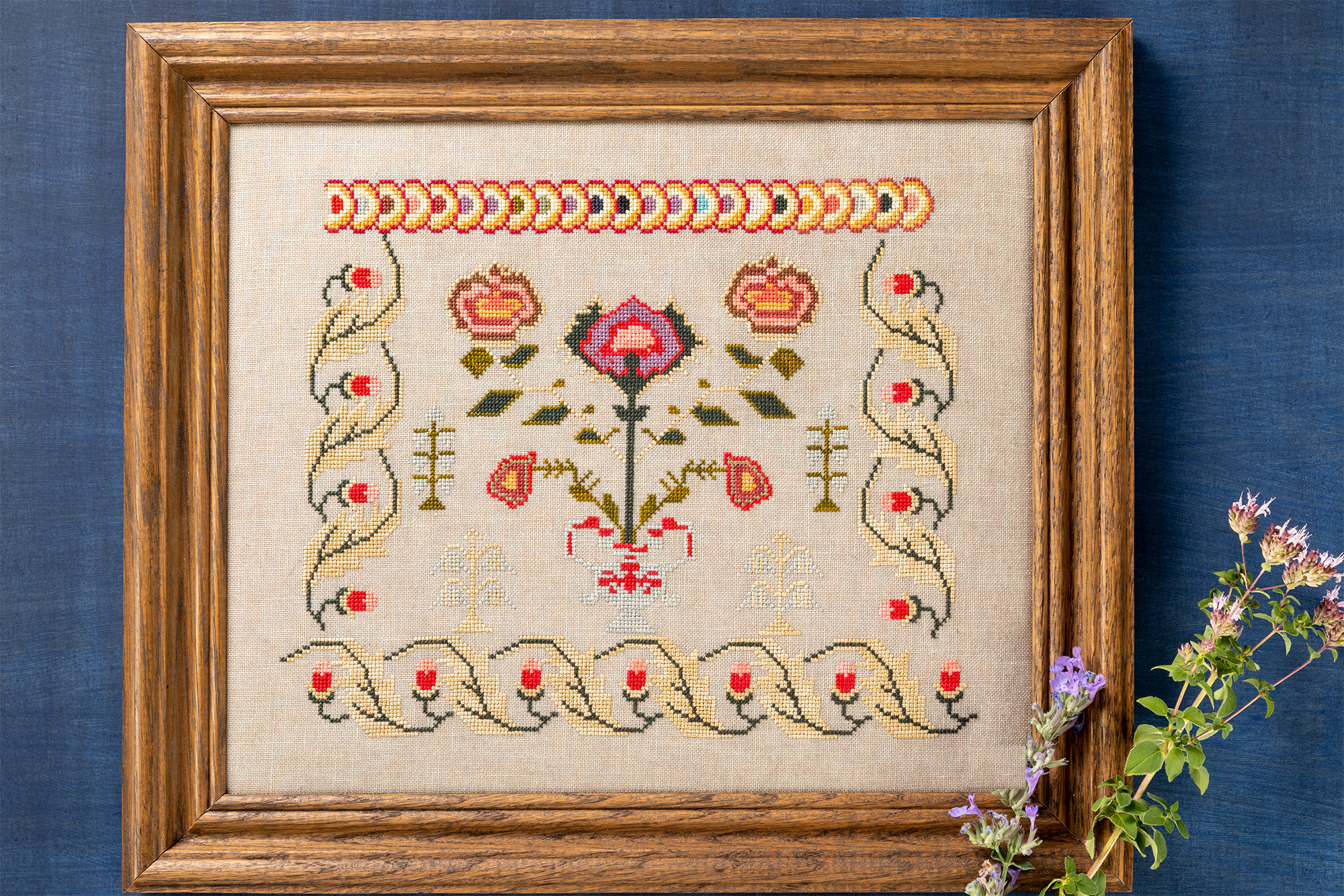
Would you like to stitch a sampler inspired by one from Lianne’s collection? All-access subscribers can log into the PieceWork library to download Leanne's pattern and instructions for her “A Schoolhouse Sampler: Like Morning Dew on a Rose."