
Fabric and thread are constants in our lives, but combined, they hold the power to create something extraordinary. In 1995, three Denver Japanese American women attended a Smithsonian touring exhibition of Early American quilts, and like quilters often do, they came away with an idea. They wanted to use quilt blocks to tell the stories of their families and communities. These quilted stories would be a way of memorializing their families’ American journeys, especially their moms and grandmoms, and all those special women who came before them and helped form them into the women they had become. They started talking about their idea throughout their communities, and the result was extraordinary.
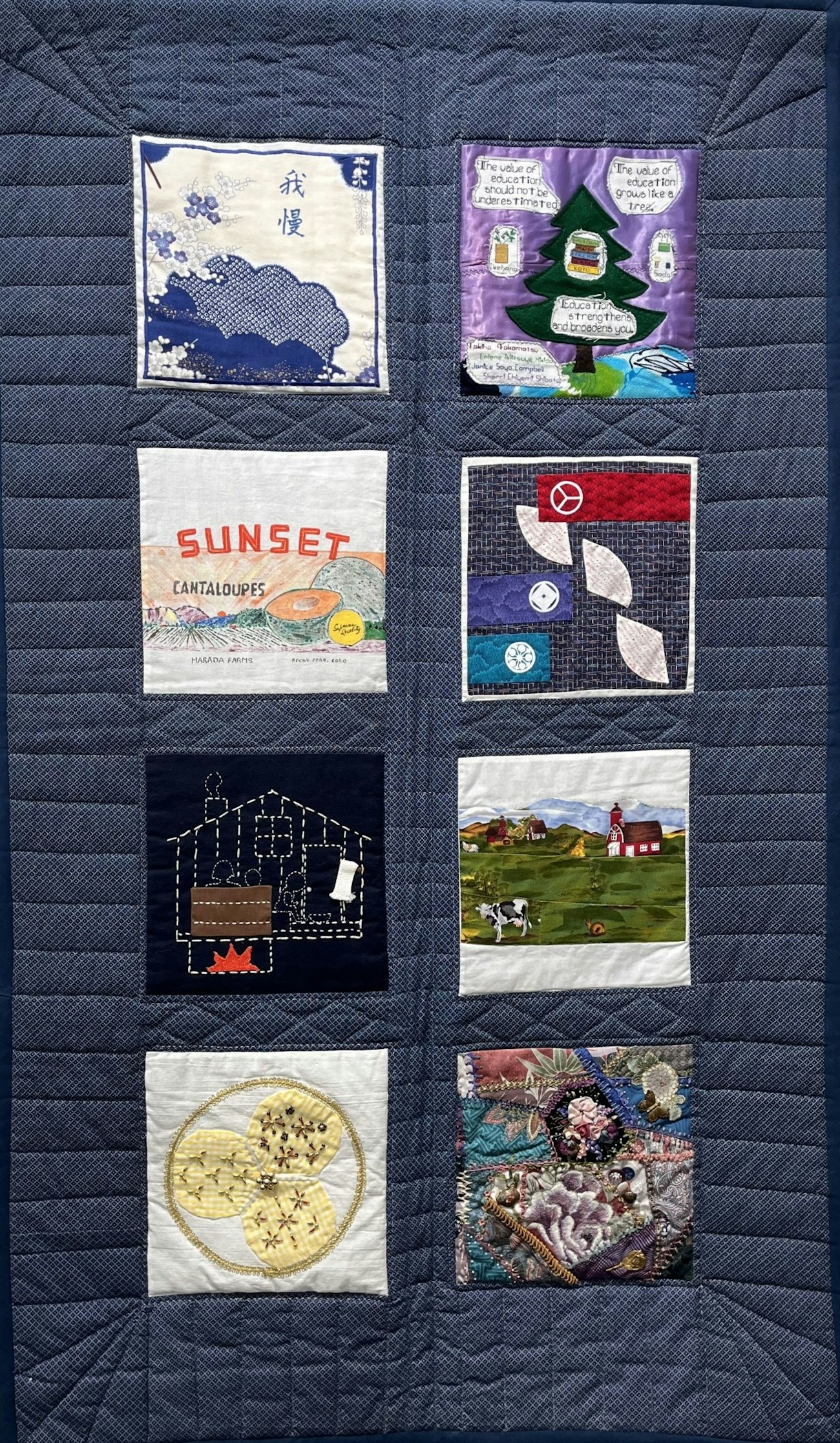
A Quilt Panel from the Japanese American Quilt Project. From top, left to right: Quilt blocks made by Pam Shinto; Janice Hikida Campbell; Teri Harada-Shoji; Susan Kiyoko Sagara; Kana Yorimoto, Chris Yorimoto Sagara, Susan Kiyoko Sagara; Nancy Tanaka Miyahara; Masa Nakamura Nishimura; Stacey Okubo Davis; Denisse Yamashita Allaire. All photos courtesy of the Rocky Mountain Quilt Museum
Quilters and nonquilters worked together to create 8-inch blocks, each telling the story of their family. Over a few months, 90 women created 9 quilts of 8 blocks each, about 2 feet by 3 feet in size, telling stories of 72 families, many including multiple generations of women. The form of the quilts resembled the Japanese scrolls traditionally displayed in a place of honor and represented the roots of all those participating. The visual simplicity of the setting allowed the details of the blocks to stand out as intended.
They displayed the quilts alongside written interpretive frames that told the story of each block. The blocks commemorated experiences of individuals, but the stories were common to many Japanese Americans affected by Executive Order 9066, issued by Franklin D. Roosevelt on February 19, 1942, which mandated the removal of Japanese Americans from the West Coast. During World War II, 120,000 Japanese immigrants and Japanese Americans were forced into internment camps spread across the lightly populated western states. Japanese Americans who were forced to relocate to these camps had to leave their homes and businesses, and many lost their property. After the war, Colorado’s governor Ralph L. Carr took an unpopular stance by inviting Japanese Americans to stay in Colorado. There were already some who were farmers and business owners in the state who had not been interned, and communities of Japanese Americans developed in several areas.
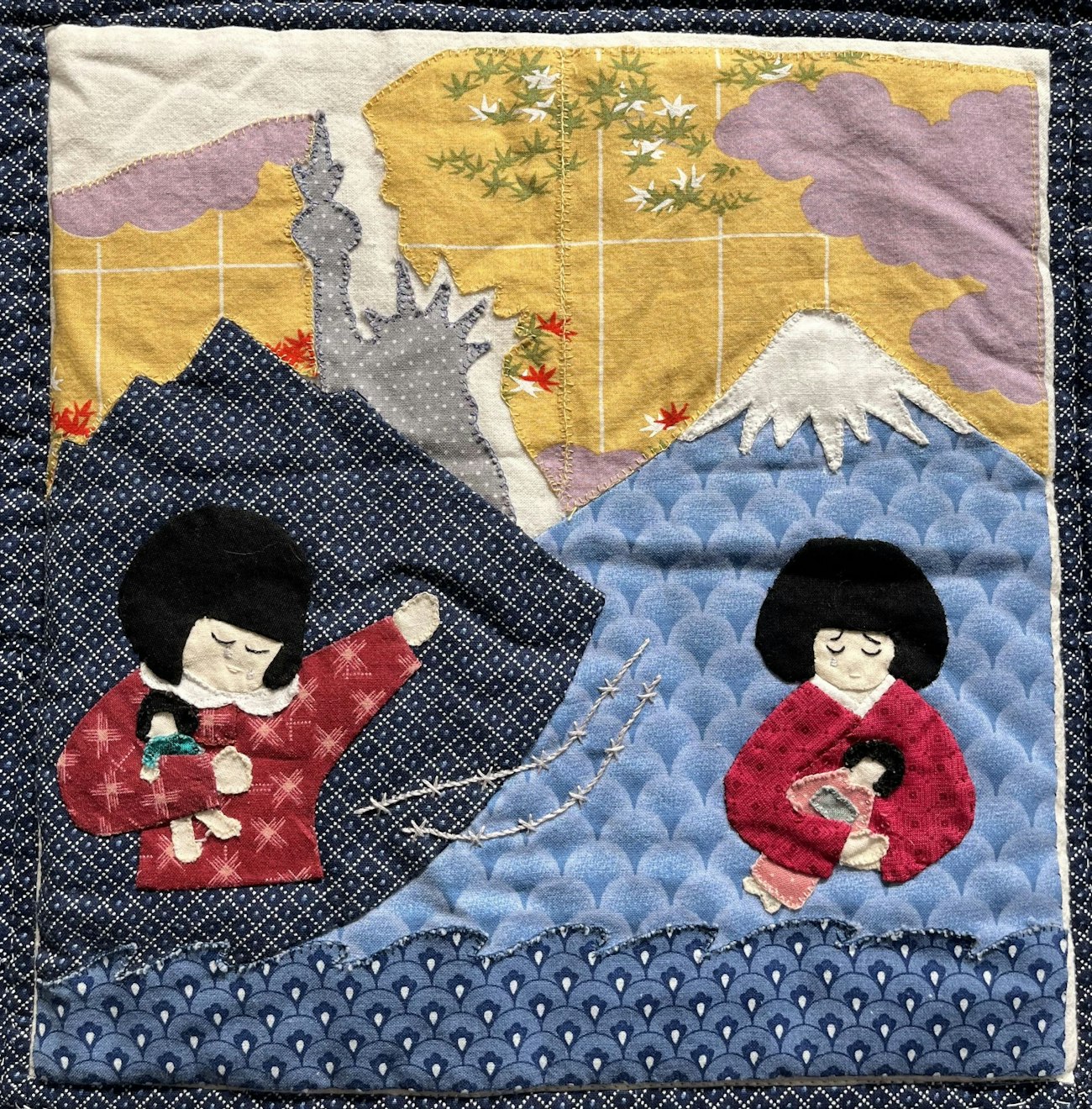
A quilt block by Carol and Nancy Miyagishima shows sisters separated by internment camps during World War II.
Fabric and Thread
The blocks’ construction methods are as varied as the women who created them. Japanese prints paired with American prints are a fitting mixture, allowing each to contribute to the quilt, as both their old and new cultures mixed to create their lives. Stitching methods such as sashiko punctuate many of the designs and bring to mind clean Japanese artistic lines as well as the concept of creating beauty by mending and conserving materials and garments. The stitches are a reminder to consider the value of everything and to always use your skills to repair, heal, and bring out beauty. The women used appliqué in many of the blocks to add fabrics, memorabilia, and photographs. They embroidered some blocks with words and images. Some of the embroidery is historical, having been stitched in the internment camps during World War II or shortly after. Some quilters used piecing on their blocks, while at least one block includes some crazy quilting. The women used dyed fabric as well as painting on fabric to bring to life images similar to Japanese paintings. They incorporated both machine sewing and handstitching to create quilting on some blocks and then quilted the borders of their settings. A few other unique methods created an appropriate balance in these extraordinary quilts, the methods never overtaking the stories.
The Stories
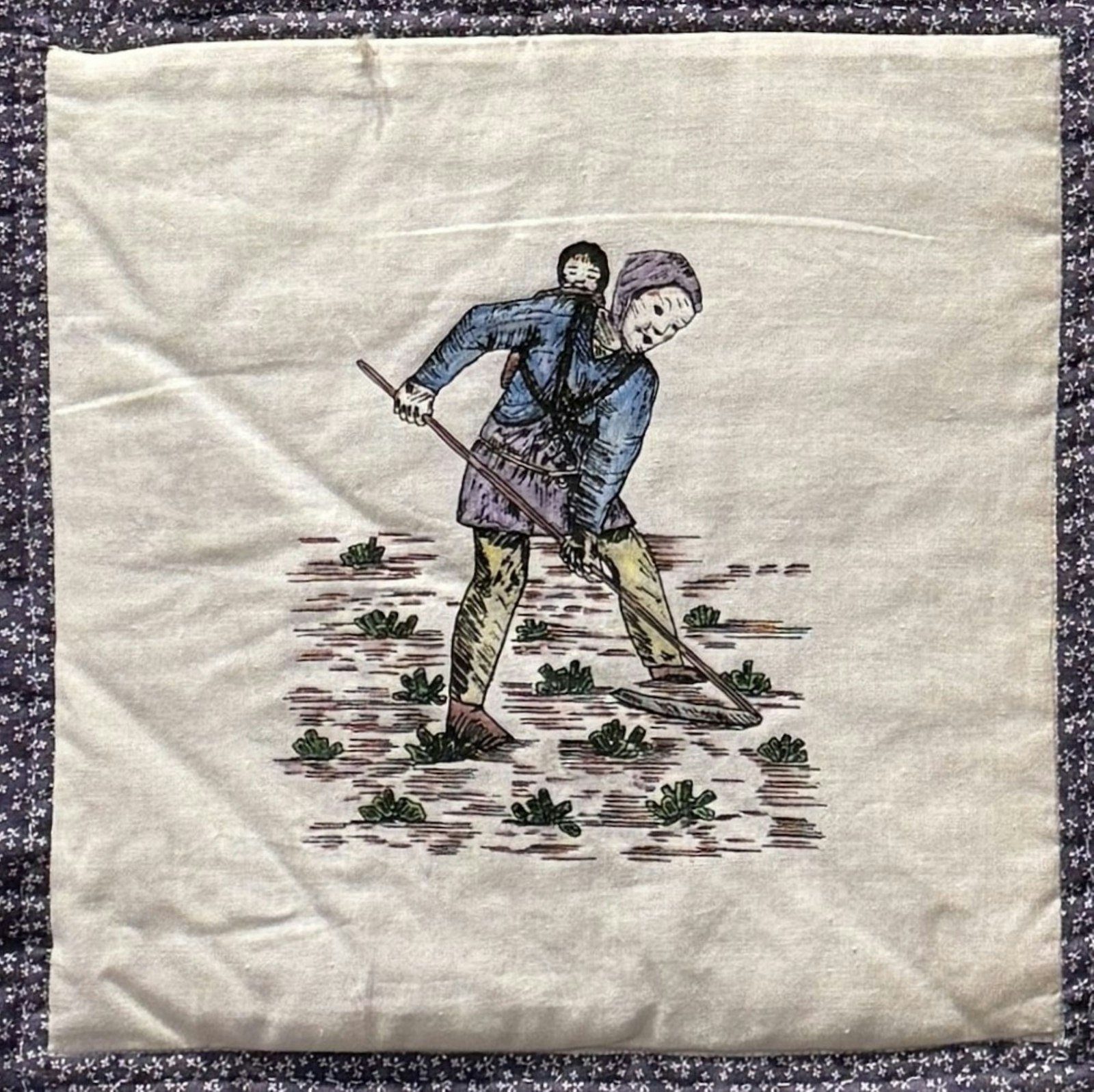
 A Quilt block by Anna Kato Murahata describes caring for her mother after a hard day's labor.
Many of the quilt blocks have emblems, logos, and other remembrances of the farms and businesses often owned and operated by multiple generations of a family. Quilter Anna Kato Murahata explains the scene on her quilt block: “After a hard day of stoop labor on the farm, Mother enjoyed relaxing by sitting in the open doorway where the cool night breeze came through and would have one of us children pound her shoulders with our clenched fist. During this time she would reminisce and tell us stories of many things. She was prematurely grey and passed away before we were mature enough to make life easier for her.”
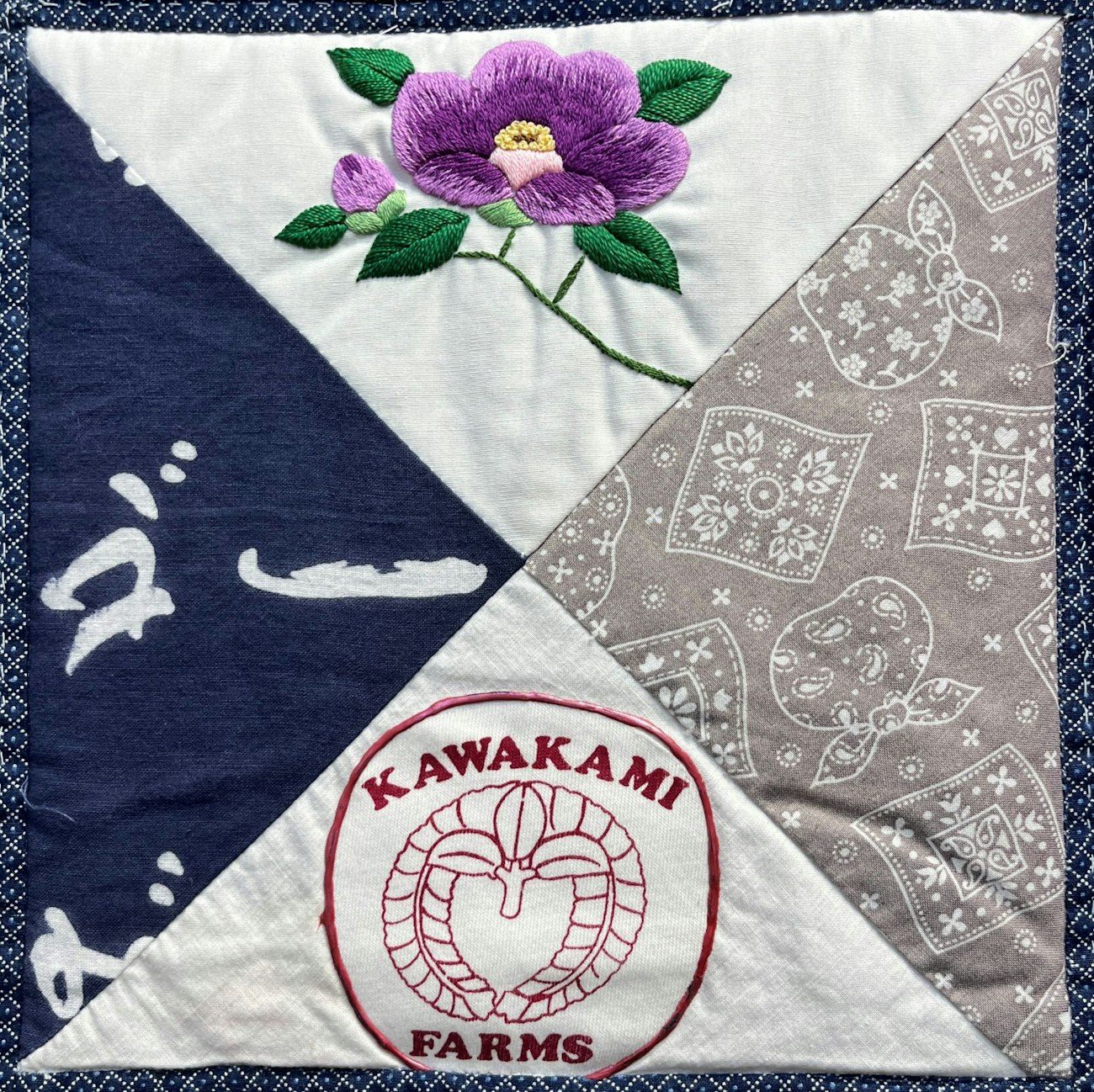
Quilt block by Shirley Kawakami Tsuchimoto
Another block celebrates several generations in Japan and America. Shirley Kawakami Tsuchimoto describes her quilt block:
The first triangle [bottom] represents the Kawakami homeland in Okayama-ken, Japan. This original fabric is made from a doorway banner that was given to our family by our Okayama relatives. The embroidery [top] was done by my late grandmother, Shikano Iritani. She did these projects during the long winter days on the family farm in Littleton, Colorado. She would create and embroider her beautiful designs to perfection. The blue handkerchief [right, faded to gray] triangle represents our Sansei (third) generation as to how Americanized we have all become. The fourth triangle [left] is the Kawakami kamon (family crest). We now have our block complete. We’ve learned American values and ways but yet have learned to appreciate our rich Japanese heritage and culture through the hard work and perseverance of our grandparents and parents.
 Denisse Yamashita Allaire’s quilt block.
Some blocks are an expression of feeling rather than memorabilia, such as Denisse Yamashita Allaire’s block “Crazy—Unity and Diversity.” She used various fabrics to create three-dimensional flowers and used buttons and beautiful embroidery stitching to hold these various pieces of irregularly shaped fabrics together to create a wonderful mixture of beauty. Denisse explains, “This crazy quilt piece depicts all the differences and similarities of fabric, prints, and creates one whole—unity—‘we’re all one.’ Within the diversity of human life there is unity. In the important aspect of life there are more likenesses than differences—the universality of human experience.”
 Quilt block by Rose Yoko Kubo Yamamoto.
Rose Yoko Kubo Yamamoto reflects a similar idea as she describes her block: “The body of the doll on this quilt block is made from Japanese yukata material. The flag material is American. This block denotes that I am one of many who have Japanese features, who is of Japanese ancestry and culture, but have been born and assimilated into the American culture, which is made up of cultures of many countries which have united into one.”
Strength and Diversity
After completing the nine quilts, the women exhibited them alongside the Smithsonian’s traveling exhibition Strength & Diversity: Japanese American Women 1885–1990, from November 1995 to January 1996 at the Arvada Center for the Arts and Humanities, in Arvada, Colorado. The Smithsonian exhibition included photographs and transcriptions of oral histories and several dozen objects that documented the journey of Japanese American women from immigration to their contemporary lives. After that joint exhibition, the quilts were kept at Simpson United Methodist Church as many of the quiltmakers were members or lived nearby the church. Years later, when the Japanese American Resource Center of Colorado (JARCC) was formed, it stored the quilts. Several years ago, JARCC decided it would be wonderful to bring the quilts out again, 30 years after their making, and form a new exhibition at the Rocky Mountain Quilt Museum.
Some JARCC members had minor roles in the original creation or remembered their mothers working on it. The organizers of this 30th-anniversary exhibition wanted to create understanding and remembrance of the life experiences of those who persevered and their generational impact on their families, as well as understanding the effects of the loss of civil rights. The original creation of this exhibit in 1995 was a multigenerational community outreach project to tell the personal histories of the participants’ families. This 30-year anniversary exhibition was intended to continue that multigenerational outreach, spreading family stories to the younger generations especially and helping them know and understand their family histories as well as bringing community together.
 Torie Yamaguchi Ito's quilt block depicts the Japanese Pavilion (1939-1940) where she represented Japan during the Golden Gate International Exposition. The lower right depicts the Gila River Relocation Center in Arizona where her family was interned during World War II.
As they began the process of relooking at the exhibition quilts and the framed stories, they realized there were things they could do to expand the impact and further preserve some of the makers’ stories about the creation of the quilts. The original exhibition had memorialized the stories only on paper, but updating them with multimedia elements would make them more readily available and researchable by more people. Then the organizers realized that some of the makers were still in the area and thought displaying videos of these women explaining the project would be fantastic. They recorded firsthand information about the creation of the project 30 years before. During the video interviews, new insights emerged, such as how the quilt project created a sense of community among participants as they shared their stories with others to decide how best to depict them on their blocks. In some cases, participants conducted research to fill in some blanks in their stories, so they learned new things about their own family histories as well.
 Quilt B: “Kamon—Japanese Family Crests.” From top, left to right: Blocks made by Carolyn Yano Takeshita; Kimiko Hoashino Yamada, kibei, Marge Yamada Taniwaki, sansei, Viki Taniwaki, yonsei; Denisse Yamashita Allaire; Haru Kinoshita Hidaka; Machiko Miyoshi Nakagawa; Rose Masamori Tazawa; Mary Funakoshi Masunaga; Tsugiko Murata.
The videos are a reminder that small initial ideas turn into significant works that affect many. A “Sunday at the Museum” panel discussion with five members of those involved in the original project was inspiring and impactful for about 75 audience members. The panelists provided photos and stories of how they became involved in the project originally and their desires for its impact, both initially and the project as it would be displayed again. Some discussed the feelings and emotions in their families about the entire situation and what they hoped others would gain from learning about this piece of history. Others were more focused on honoring their family members well. In the three months the exhibition was displayed at Rocky Mountain Quilt Museum in 2025, over two thousand people visited, read some of the stories, and watched the video interviews of the original makers.
As visitors moved from quilt to quilt in the exhibition, they felt the deep honor the block makers paid to their ancestors as well as gratitude for how their ancestors had lived and never doubted their own worthiness or abilities to contribute to their communities. The use of fabric, thread, and needle allowed women who spoke very little about the hardships and situations they had experienced to tell their stories in ways that still have an impact 30 years later. They have inspired their descendants and many others to continue the discussion. These threads of time, community, and family are strong as they continue to stitch their stories together.
Resources Japanese American Resource Center of Colorado (JARCC)
Discover more stories that celebrate needlework in America in PieceWork's Spring 2026 issue