
Contents
Enjoy this excerpt from PieceWork's Knitting Traditions, Fall 2012 issue, and get the pattern for a pair of gorgeous bead- and lace-knitted half gloves inspired by German festive dress. —PieceWork editors
Bead and Lace Knitting for Everyday and Festive Occasions
Knitting with glass seed beads was popular during the nineteenth century, particularly in northern Europe and Great Britain. Products ranged from intricately patterned bags with a bead on every stitch to basic garter-stitch wrist warmers with a few beads along the top edge. Many garter-stitch wrist warmers, however, were more elaborate, embellished with single or multicolor designs over at least the top half of the cuff; some were edged with beaded ruffles or crochet scallops. Other knitting techniques used for traditional and stylish arm and hand coverings in this period included two-color stranded knitting, ribbing, cables, traveling stitches, and lace.
Bead-adorned knitted sleeves and wrist warmers were also part of many folk and regional costumes. In Scandinavia and the Baltics, notably Lithuania, beaded garter-stitch wrist warmers were worn both for warmth and dress-up occasions; stars, stylized trees or flowers, and small geometrics were the most popular motifs. The same types of motifs appear on garter-stitch wrist warmers from Germany, but many other styles of knitting with beads were practiced there as well.
Incorporating Beads into Knitted Fabric
For all the hand and arm coverings discussed here, the beads are first strung onto the yarn and then knitted in. The easiest method of incorporating beads into a knitted fabric is to knit entirely in garter stitch, placing beads on the wrong side so that they show on the right side. Each bead sits on the strand between two knit stitches. It gets trickier with a stockinette surface: beads can sit between two purl stitches, on a slipped stitch, on a knit stitch, or on a “deep knit” strand in two-end knitting. When placed on a normal knit stitch, the bead will land on one leg or the other. In bead knitting, in which there is a bead on every stitch, the knit stitches are worked through the back loop so that the beads all sit on the right leg of the stitch and lean to the left. After a few rows, though, the entire fabric slants leftward. Plaited knitting, which reverses the direction of the slant on alternate rows by throwing the yarn over the needle, results in an over-all fabric that is balanced. Beaded knitting, in which the beads are more dispersed (i.e., every stitch does not contain a bead) among the stitches, does not result in a biased fabric.
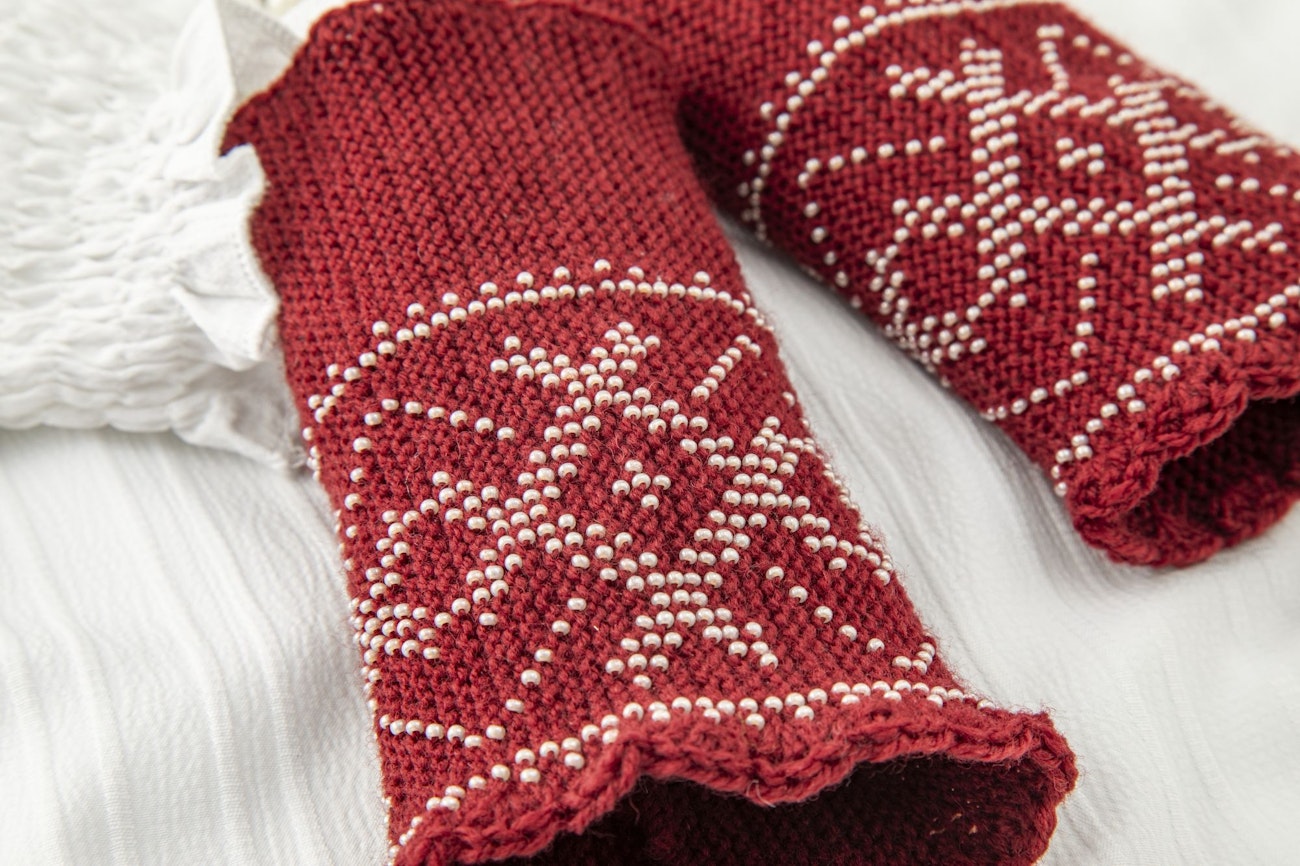
Beaded wristers warmers inspired by Lithuanian traditions. Knitted by Katrina King for PieceWork's Winter 2025 issue. Photo by Matt Graves
Although garter-stitch beaded knitting is easy to knit and relatively fast (unless you are stringing hundreds of beads for fine knitting), it is not appropriate for intricate patterns because each bead is separated by at least one knit stitch and a row of knitting. Bead knitting, with its more closely spaced beads, allows for much more detailed and picturesque designs, particularly when using fine yarns and small beads. On wrist warmers and half gloves, the weight of the beads usually limits the number that can be used. Even the smallest sizes of silver, gold, and brass beads are heavy when used in quantity.
The half gloves and the arm and wrist warmers with beaded stockinette from various regions of Germany exhibit many ingenious ways to balance pattern and weight, tradition and fashion, everyday and special occasions. Even with fine cotton or wool yarns and needles in sizes 00 to 0000 (1.75 to 1.25 mm), a plain ribbed cuff with a simply patterned bead-and-stockinette band around the hand is easy to knit, warm and lovely for everyday wear.
Church and Festive Wear
For church or festive wear, the beading patterns are more elaborate and cover more of the surface on the back of the hand. Lace and ribbing are concentrated on the cuff and hand below the thumb. Because the beads are knitted in on every round, detailed geometric or floral patterns can fit into the small space. These styles take much more concentration and planning as the beads must be strung in the opposite order (the last bead strung is the first knitted) and have to be counted out precisely.
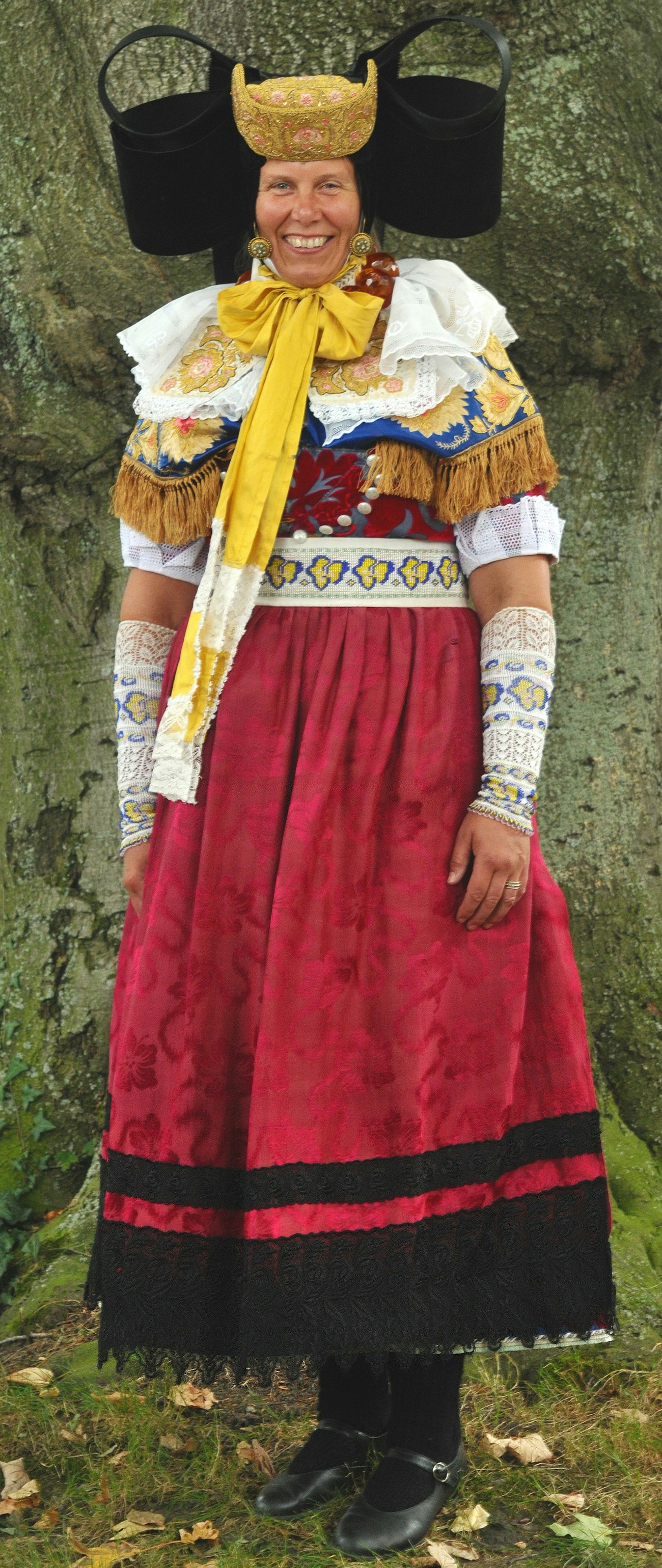
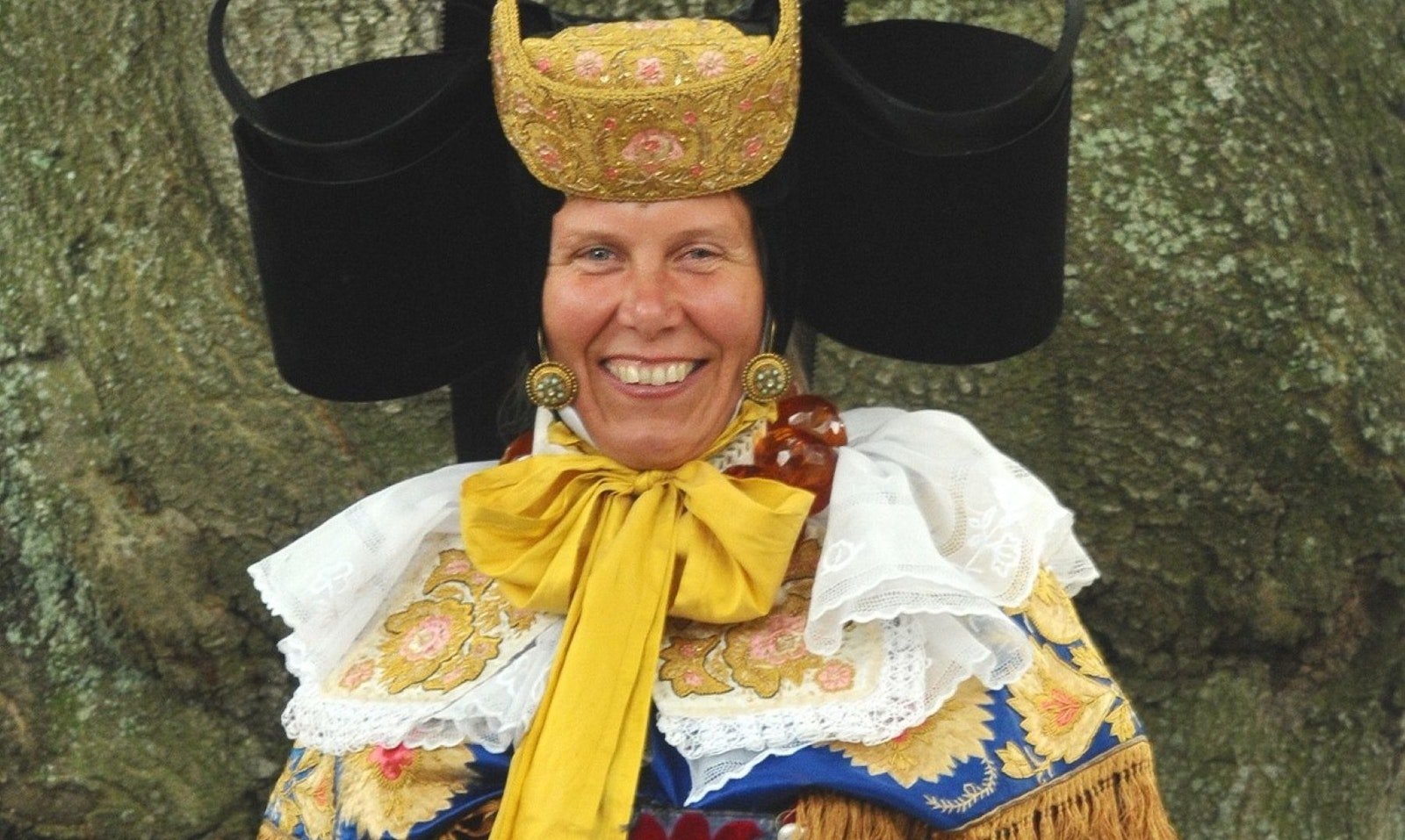
A woman in traditiona festive dress in the town Bückeburg in Lower Saxony, Germany. Her costume includes ornate knitted and beaded half gloves. © Michael Gäbler / Wikimedia Commons / CC BY-SA 3.0
The most spectacular of the festive knitting and bead traditions comes from the Schaumburg-Lippe region (now part of Lower Saxony) in northwest Germany. At least from the mid-nineteenth until the late twentieth century, as part of festive and wedding dress, girls and women wore elaborately beaded “sleeves” covering the forearm from elbow to wrist. There are examples of sleeves knitted in cable and traveling/twisted-stitch patterns, all-lace sleeves, all-beaded-knitting (although using bead-knitting techniques) sleeves, and combinations of lace and beads.
Lace and Beads
When I first looked through Editha Fischer’s book Old Folk Art Knitting, I thought that the gloves were composed of lace knitting in the round joined to sections of bead knitting worked back and forth (as for garter-stitch wrist warmers), but peering through a magnifying glass and careful reading of the pattern instructions revealed that the pieces are knitted from elbow to wrist or hand in one piece. The stitches with the beads are knitted through the back loops, and the beads lean leftward in most cases. Most of the patterns are floral and leaf designs, which Fischer describes as “flowers, garlands, and the tree of life symbolizing growth, existence, and endurance” (my translation). On some examples, lace and bead sections alternate up the arm, but occasionally the beads are worked into lace patterns.
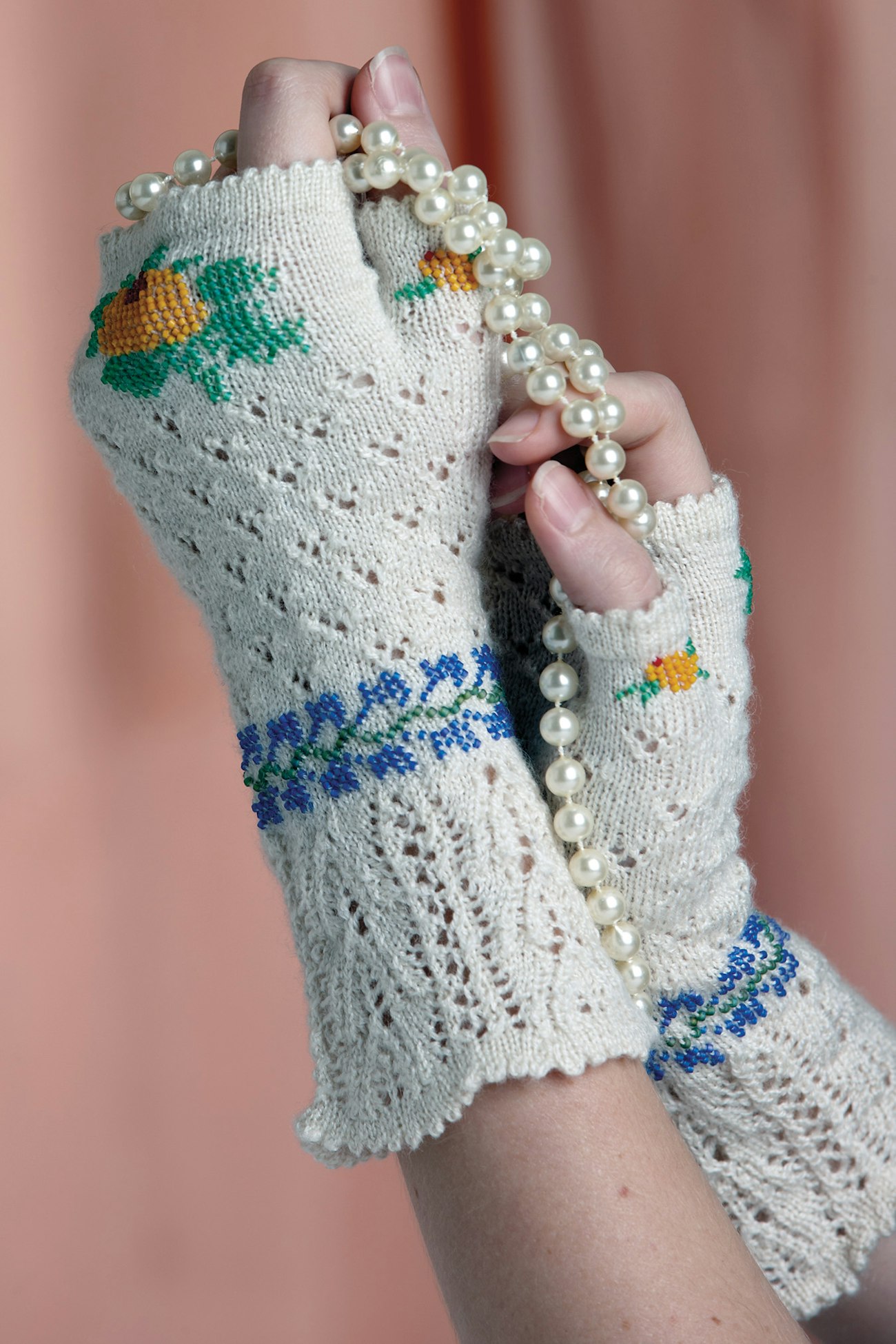
Carol Huebscher Rhoades' bead- and lace-knitted Quince and Vine Half Gloves inspired by traditional German folk costumes. Photo by Joe Coca
Although the elaborate wedding and festive costumes worn in Schaumburg-Lippe are magnificent, they are not very wearable today. The beaded wrist warmers, half gloves, and sleeves from any of the traditional European costumes, however, are easily adaptable to today’s styles and make beautiful accessories that will also carry forward traditional skills and concepts.
Resources
Fischer, Editha. Alte Volkskunst Stricken: Trachtenhandschuhe aus dem Schaumburger Land [Old Folk Art Knitting: Traditional Gloves from Schaumburg Province. Münster, Germany: Editha Fischer, 1987
—Carol
Knit Your Own Half Gloves
This All Access subscriber exclusive pattern includes Carol Huebscher Rhoades' gorgeous bead- and lace-knitted Quince and Vine Half Gloves and detailed tips for working with beads. Not a subscriber yet? Learn how to join the PieceWork community here. We look forward to having you with us!