
My First Discovery
A hand-lettered sign that read “Estate Sale” and a few cars parked near a community center here in mid-coast Maine were enough to draw me in for quick look-about on a sunny summer day. Summer is high season here for yards sales, but “Estate Sale” promised a respectable glimpse into someone else’s life. Instead, it opened a door to a chapter of American and Southeast Asian history that I had never known, one told in the work of hands using needles and thread.
Judging by the carefully arranged tables of African art, early American crockery, and antique toys, the person whose possessions were up for sale had eclectic tastes for nice things that, while lovely, just weren’t coming home with me. The pathway to the exit door, however, passed by a table with a jumble of textiles that had been well pawed through—the bureau scarves, tablecloths, and tea towels of everyday life. Sticking out of the jumble on one side, a bit of handsewn piecework caught my eye: small blue and gray triangles pieced together into a border. A little tugging revealed something extraordinary. It seemed to be a wall hanging with a complicated embroidered story arranged in rows, populated by carefully depicted characters in intriguing black costumes. It was clearly pieced and embroidered all by hand.
The Hmong story cloth Susan discovered at an estate sale in Maine. All photos by Matt Graves
I was curious enough to seek out the person tending the sale to ask if they knew anything about this textile. Sadly, the attendant had no information to offer. I would have set it down and walked away, but a voice behind me said, “I know what that is. It’s Hmong handwork from Southeast Asia. I know because I was a first-grade teacher in Providence, Rhode Island, in the 1980s when Hmong refugees came to live there, and their children came to my classroom.” She went on to say that not only our language, but also the simple amenities of American life were completely foreign to these children raised in the mountains of Laos—never mind the challenges of New England winters for children who didn’t typically wear shoes. She said, “Working with them was one of the most memorable experiences of my life teaching.”
I bought the wall hanging, which I now know is properly called a story cloth, and more properly, a Pa Ndau or Paj Ntaub in Hmong, which translates to “flower cloth.” I wanted to learn more about how the story cloth could have ended up in Maine and what it represented to the people who brought their skills and culture to their new country. I tugged on a long thread.
The Hmong Journey from Laos to a New Life
The Hmong are an ethnic group found across Southeast Asia. They originally lived in central China for thousands of years, but conflicts in the nineteenth century pushed them to migrate to the mountainous regions of Southeast Asia, including what is now Laos. Traditionally, the Hmong lived in farming villages, where daily life revolved around close-knit family and clan relationships, largely separate from the dominant cultures around them. They are animists who believe in a spirit world and the interconnections of all living things. Although the Hmong language existed for centuries, it may not have had a written form until the twentieth century. Through song; storytelling; and handsome, vivid embroidery, Hmong culture and beliefs were passed along. Like many other small, tribal communities the world over, the Hmong were not readily accepted or regarded with respect in their home countries. Persecution was not uncommon.
Detail of a Lao village from the final scene in Susan's story cloth.
By the outbreak of the Vietnam War in the 1960s, many Hmong lived in largely self-sufficient mountain villages in Laos, growing their own food, maintaining their tribal communities, and producing stunning handwork. By the late 1960s, it was apparent that the war was spreading to Laos, but the Geneva Convention prevented the United States armed forces from entering that country. Meanwhile the Hmong, with their long tradition of land ownership, were not supporters of the communist way of life offered by the North Vietnamese. This, along with their knowledge of the terrain, made them sought-after recruits to quietly aid the United States in what came to be called the “Secret War.” Hmong collaborators worked to disrupt communist supply lines along the Ho Chi Minh Trail, supply intelligence, guard radar facilities, and rescue downed US pilots. It is estimated that 60 percent of Hmong men in Laos participated in this work, and as many as 10 percent of them died as a result.
In 1975, the war in Laos ended abruptly with the fall of South Vietnam, and the American presence there was quickly evacuated, leaving behind its Hmong counterparts. It was no surprise that many Hmong were rounded up, tortured, and killed or sent to labor camps by the Viet Cong. Their villages were burned and sprayed with napalm. The lucky ones escaped to squalid refugee camps in Thailand.
A helicopter attacking a Hmong village depicted on Joyce Walsh's story cloth.
Eventually, the story of the fate of these people who had lost so much in service to the United States began to trickle out. With the help of churches and refugee resettlement groups, Hmong refugees began to arrive in the United States in the late 1970s. They settled mostly in the American Midwest and in cities such as Providence, Rhode Island, where one church took it upon itself to help the people who had already given so much to America and still remained in peril. By 1978, 30,000 Hmong had been resettled in the United States, a very long way from their villages in the mountains of Laos. By 2010, that number, including refugees and their offspring, had grown to 260,000.
Stories Remembered
This long thread brings us back to the unlikely presence of a Hmong story cloth in a jumble of textiles in mid-coast Maine. The Hmong of Laos had lost their homeland and their way of life, but they did not lose their talent for beautiful embroidered handwork. The work of their hands became a way to support themselves as well as a means of sharing their experiences and culture in their new communities.
My story cloth has a characteristic blue and gray appliquéd sawtooth border framed in blue. The triangle motif in Hmong embroidery represents mountains. The fabric colors suggest that my story cloth may have originated in a Laotian refugee camp, where the usual brightly colored fabrics used in Hmong textiles were unavailable. Missionaries provided whatever cloth they had, which were mostly in subdued tones.
Get a closer look! Click any image in the gallery below to open it in full-screen mode.
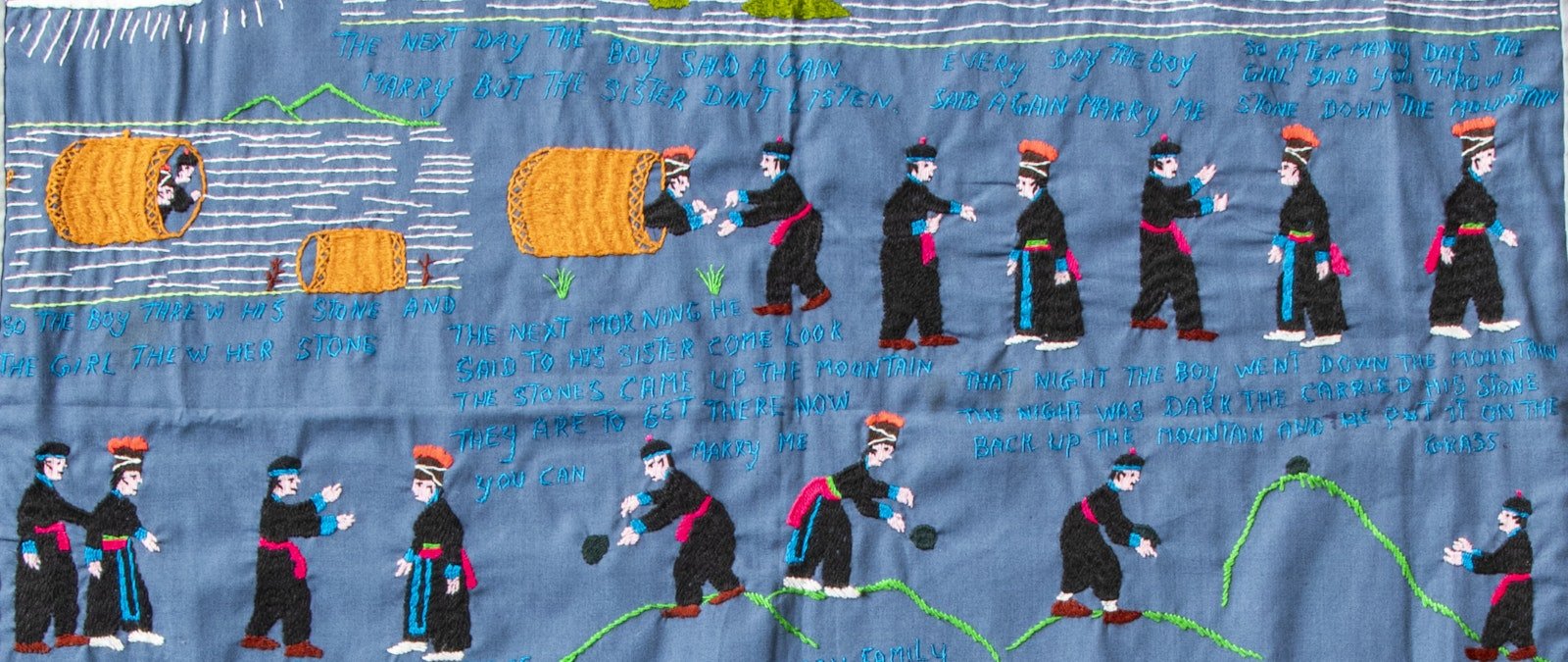
My cloth’s story is narrated in English words stitched under embroidered pictures. It seems to be a version of a Hmong creation tale that depicts a brother and sister who survived a devastating flood by floating in a large drum. When the waters receded and they emerged from the drum, they found that all other life had disappeared. As they grew older, the brother believed they needed to marry so they could create more people, but the sister refused. They sought guidance from a spiritual figure who told them to each roll a stone down a hill; if the stones landed together, the marriage should go forward. Somehow this miraculously happened, and with the girl’s acceptance of the proposal, a whole village flourished, and families suddenly had houses and livestock. The presence of English suggests that while my story cloth may have been started in Thailand, it was likely finished after Hmong resettlement here in the United States—perhaps even in Providence, which is only a few hours’ drive from the estate sale where I found it.
Joyce Walsh's Hmong story cloth.
And this brings me back to the day of the estate sale, where I only acquired my story cloth because Joyce Walsh, that fellow shopper, told me what I held in my hands. That chance encounter opened the door for me to discover this remarkable culture of embroidery and its connection to American history. I followed Joyce to her summer home nearby, where she not only warmed my heart with stories of teaching five- and six-year-old Hmong children, immigrants from Thailand refugee camps, but she also showed me her own remarkable collection of story cloths. They revealed not just folktales like my story cloth, but also the real-life story of the results of Hmong alliance with the United States all those decades ago. It was stunning to see the painstaking depictions in embroidery of the terror of the Hmong people being violently driven from their homes by guns and airstrikes, escaping from the Viet Cong across the Mekong River, and resettling in refugee camps.
Get a closer look! Click any image in the gallery below to open it in full-screen mode.
The Hmong refugees carried the work of their hands and their needles to new homes in the United States, a country they had served and sacrificed for. The story of the Hmong and their embroidery will now always be interwoven with the story of America.