
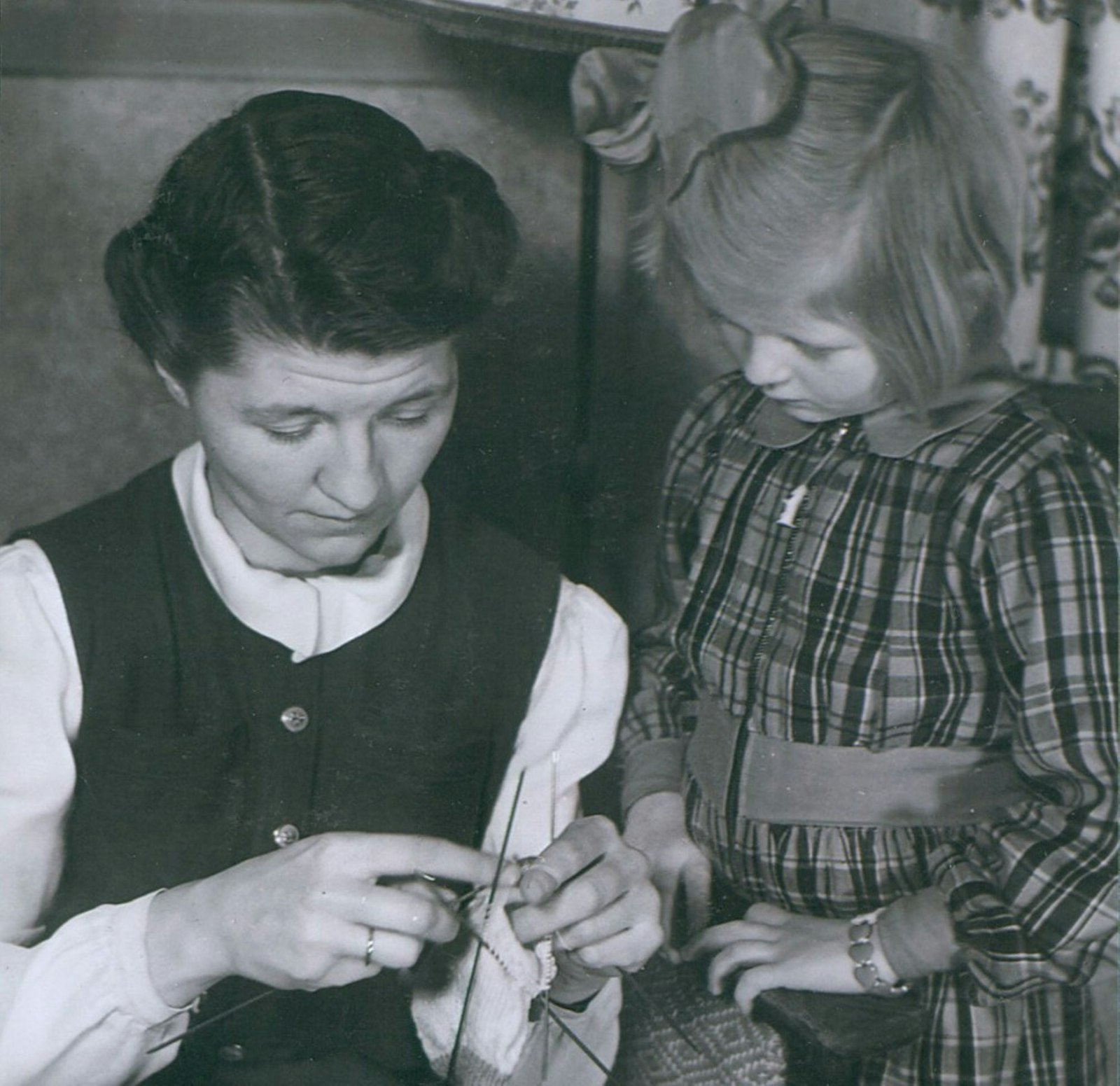
Knitting Designer and Writer
Annichen Sibbern Bøhn (1905–1978) was not only a formidable collector of traditional Norwegian knitting patterns but also an inspiration to generations of craftswomen. Annichen was the second child and first daughter of seven children born to Georg Sibbern (1877–1963) and Katherine Poulsson (1879–1963). Annichen grew up in an Oslo suburb, but her large extended family spent summers and holidays on the Oslofjord at Værne Kloster, an estate owned by the Sibbern family since the seventeenth century, or visiting each other on farms and in country cabins across Norway and Sweden. She loved archery, fishing, sailing, and skiing. Annichen loved museums and old textiles and studied interior design at university. Although she worked briefly at a knitting mill, she preferred handknitting, and wanted to encourage the tradition among her countrywomen. In 1927, while working for the Oslo Husflid, the Norwegian home arts and crafts organization, she traveled around Norway collecting knitting designs, photographing original examples, and charting their patterns.
The result was the publication in 1929 of her book Norske Strikkemønstre [Norwegian Knitting Designs] (Oslo: Gröndahl & Sön). In 1930 and 1931, Annichen sold several modern knitting patterns for women and children as well as some patterns for traditional Selbu mittens. Gröndahl & Sön also published her knitting booklets Strikke Opskrifter (1931), Nye Strikke Opskrifter (1932), as well as the English-language Norwegian Knitting Designs (1954). With Inger Fleischer, Annichen wrote Småtøi (Oslo: Gröndahl & Sön, n.d.—“1937/8?” is written in ink on the frontispiece of a copy belonging to Annichen’s daughter Lillan), a book of knitting and sewing patterns for babies and children. The models in the photographs are Annichen and Inger’s children.
Annichen’s published works had an immense impact on the direction of Norwegian knitting history. Handknitting had been at a low point due to the popularity of machine-made knitted goods. Her knitting patterns not only provided instructions but also fueled the desire for more Norwegian designs as a statement of national pride. In promoting traditional knitting designs, she also enhanced the market for handknitting businesses throughout Norway.
 Traditional Selbu-patterned knitted wool mittens and a memory book that Annichen Sibbern Bøhn’s daughters, Lillan and Sidsel, created for their grandchildren with text (in English and Norwegian) about their lives and many family photographs, including photographs of Annichen. Mittens courtesy of the author; book courtesy of Lillan Kassel. Photograph by Joe Coca
Strength in Family
In March 1931, Annichen married Ole Bøhn, a hoyes-terettsadvokat [jurist] who argued cases before the Supreme Court. Ole also had grown up in Oslo, and at Westheim, a private school for boys, he was a classmate of the future King Olav V (1903–1991). Ole, an accomplished athlete, was a nationally known skier.
The couple had two daughters, Annichen (called Lillan, born in 1933) and Sidsel (born in 1936), and a son, Ola Anders (called Andy, born in 1944). Ole loved to read and tell stories to the children; he emphasized education and equal opportunities for the girls. “He believed in our brain power and did not feel it was right to waste it,” Lillan writes. When Annichen’s family did not give Lillan the traditional boy’s gift of an air rifle at age eleven, Ole got one for the girls to share.
Annichen gave the girls yarn and needles at an early age and encouraged them to play and experiment. She praised their every effort, fostering a lifelong love of needlework in both her daughters. The children don’t know how their mother happened to write her first knitting book and get it published. “We grew up with the idea it just happened,” Lillan says, “and Mother could make anything happen. Father taught us to look at both sides of a question, and Mother taught family loyalty and commitment. We were given a strong sense of confidence, optimism, and humor, which has been a great asset in life.”
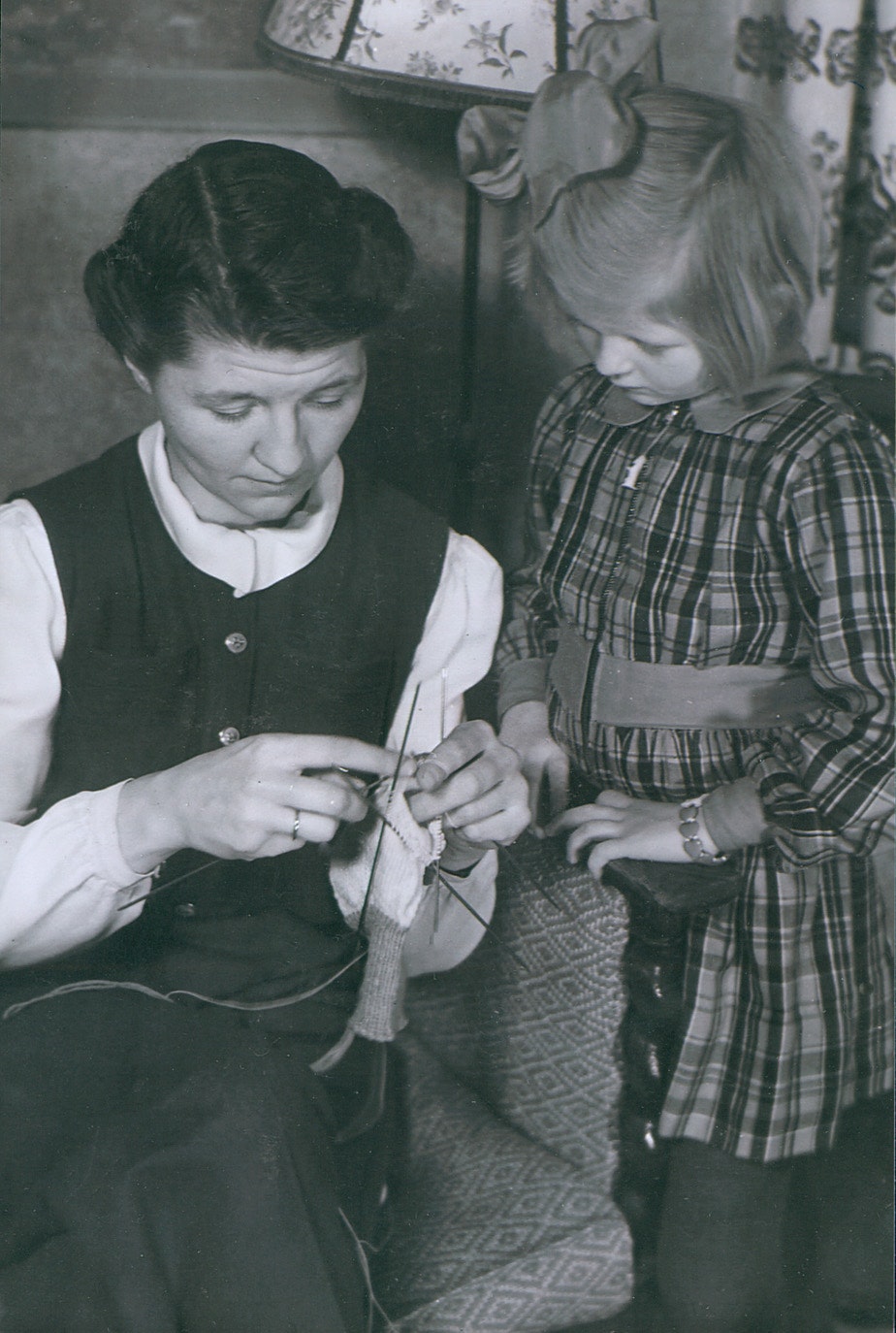
Annichen Sibbern Bøhn and her daughter Sidsel
Wartime Resistance
Invasion of Norway by the Nazis in April 1940 brought extreme challenges, which the family met with high courage. The girls stayed with relatives outside Oslo for the few months of the direct fighting; they then were able to return home. Despite food shortages, empty stores, hidden radio receivers, and bomb shelters, Annichen and Ole were able to provide some normalcy for the children, and out-of-town relatives smuggled food into the city. When word came through the neighborhood one day that a raid was imminent, Annichen hid the whole pig that she’d managed to get in a garbage can. But it was also the day for garbage pickup. As the garbage man was making off with the can, Annichen chased him down the street, saying, “There is something in there you are not supposed to see!” The garbage man said, “OK, ma’am,” put the can down, and left.
The family converted the cellar steps into a henhouse and the veranda into a rabbit hutch. During winter’s bitter cold, they brought the rabbits indoors. Ole hadn’t the heart to butcher these members of the household, which had by this time acquired names, even though food was desperately needed. During summers and holidays, while the girls stayed with relatives in the country, Annichen and Ole hid escapees in their home. Both parents worked in the Norwegian Resistance, and Ole was a member of the Militærorganisasjon, which performed sabotage against Germany, helped refugees escape to Sweden, and trained for battle behind enemy lines.
In 1941, Annichen published Gammel til Nyt (Oslo: Gröndahl & Sön), a book detailing how to make children’s clothes from discarded adult garments. Community groups around Norway paid her to come and teach classes based on her book. (It is tempting to imagine that Annichen also spread resistance information wherever she went. Her reputation as a knitting expert may have made her seem innocuous to the Nazi leadership.)
In 1942, when the Nazis began sending all Jews living in Norway to German concentration camps, Ole’s mother hid a Jewish mother and two daughters until they could be smuggled out of the country. Lillan and Sidsel used to play with the girls, who were close to them in age. After the war, Annichen and Ole helped Jewish survivors of the concentration camps to rebuild their lives.
In 1944, a member of Ole’s resistance unit was arrested, and the Bøhns were forced into hiding. The girls, then ten and eight, were sent to stay with an aunt, Annichen arrived later in the day and Ole, after dark. The plan was for Annichen, then eight months pregnant, to travel alone to the refugee camp for Norwegians at Kjesæeter, near Vingåker in Sweden. Because she couldn’t walk the distance, she rode in a horse-drawn sleigh full of hay.
 Terri Shea re-created the design for "Patterned Norwegian Stockings" from a photograph in Annichen Sibbern Bøhn's book Norwegian Knitting Designs. Photo by Joe Coca
The girls were shuttled among family members until Ole picked them up to begin their escape to Sweden. The three were supposed to meet a truck behind a factory but were too late and had to return to hiding; the group that they would have gone with was caught, and all were arrested; it was several days before Annichen learned that her family was safe. On their next attempt, Lillan recalls, “We went by covered truck a long way, then walked through the woods. It was very dark. At one point, we heard a whispered warning of a German border patrol. We all took cover in ditches and behind trees. Father looked up and saw Sidsel flat on the trail, just covering her eyes. (Then no one could see her!) He recovered her quickly. No border patrol found us. We got safely to the refugee camp.”
During the last year of the war, the family lived in Sweden. Returning to Norway soon after the Nazi occupation ended in May 1945, they lived that summer with Annichen’s parents and then returned to Oslo. Although Annichen published no new books, she gave seminars and talks in person and on the radio and was well known throughout Norway as a knitting expert. Following her death in Oslo in 1978, Lillan and Sidsel wrote and published a booklet of their mother’s knitting patterns in her memory. Annichen’s bravery and self-determination are an inspiration to us all, in our knitting and our lives.
Inspired by Annichen Bohn's knitting legacy, knitwear designer Terri Shea created "Patterned Norwegian Stockings." Download the FREE pattern for these beautiful and meaningful socks from the PieceWork library.