
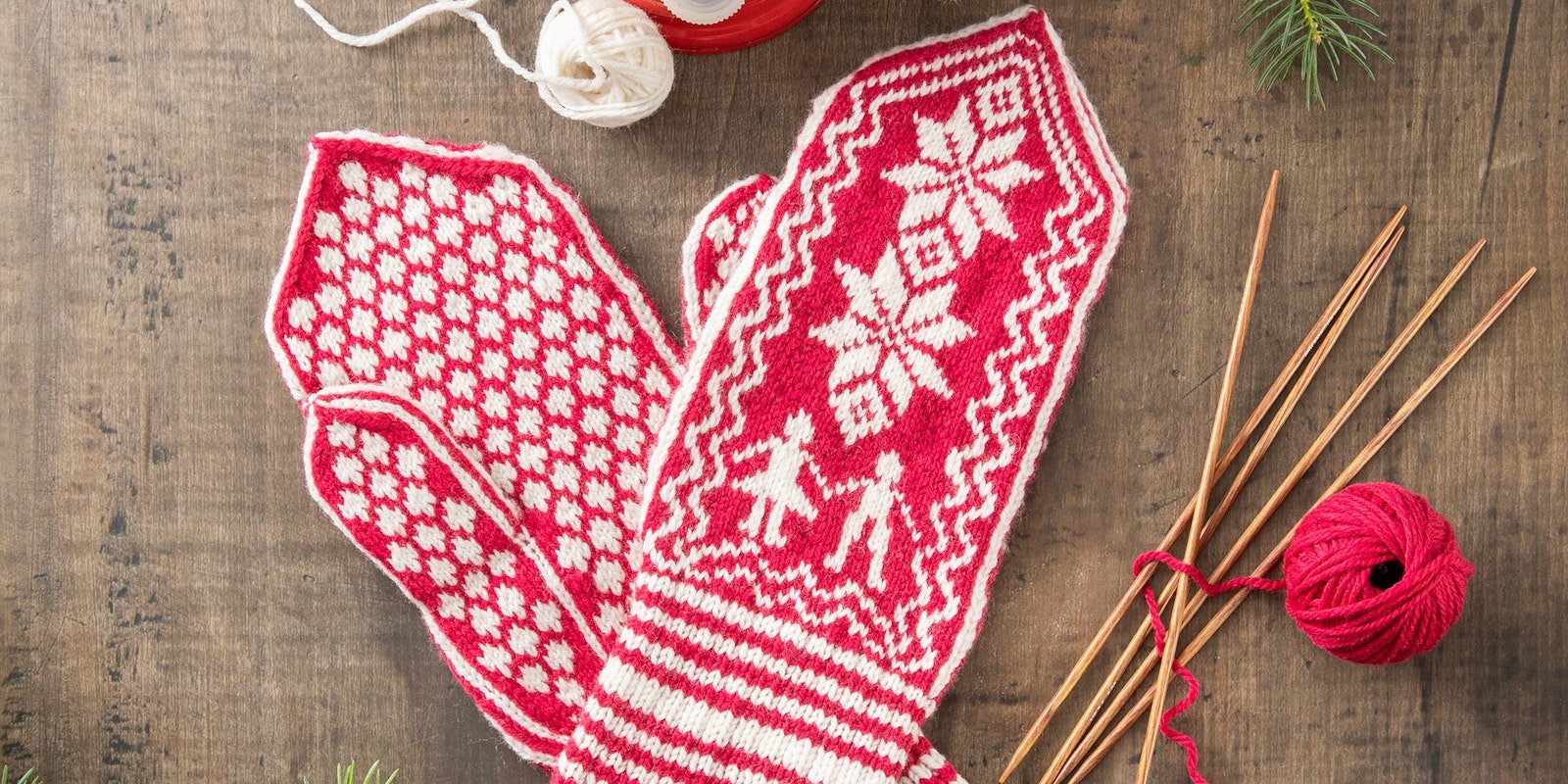
My colorwork mittens were inspired by a pair of mittens knitted by Ruby Ana Holton (1895–1977), an Iowan of Norwegian ancestry. The mittens are now in the collection of Vesterheim, the National Norwegian-American Museum and Folk Art School in Decorah, Iowa. Taking its name from the term Norwegian immigrants used to describe America to their loved ones in Norway—vesterheim, or “western home”—the museum is dedicated to telling the stories of Norwegian immigrants to the United States through its collection of historic and contemporary textiles, carved and painted Norwegian furniture and household items, and fine art. Ruby Holton’s Selbu inspired mittens are but one example of the many colorful, patterned mittens in Vesterheim’s collection.
Selbu Mittens
Traditional Selbu mittens had the following components: a gender-specific cuff; a mitten hand with the front side and palm in different patterns; a vertical side panel separating the front and palm; a tapered finish at the top of the mitten; and a thumb gusset and thumb, also with a tapered finish, placed on the palm side of the hand. According to Anne Bårdsgård, a Norwegian handcrafting expert who grew up in Selbu, there were firm rules for the cuffs of Selbu mittens: women’s mittens were worked with either a chevron cuff or a ribbed cuff, and men’s mittens featured cuffs with two-color stranded knitting and patterned panels, with a short, ribbed edging.
 Mimi’s design includes the selburose, the eight-petal rose motif.
In one popular traditional Selbu mitten design, the main pattern on the mitten front incorporated two repeats of the selburose, an eight-petal rose motif. The mitten palm was traditionally knitted in a small, repeating pattern that enhanced the mittens’ durability. Selbu mittens were usually knitted in black and white wool, with black patterning on a white background, although other colors were sometimes used. Stranded knitting produces a warmer, more weather-resistant hand covering.
The selburose, which looks like an eight-pointed star, is not unique to Norway. According to the Norwegian knitter and author Annemor Sundbø, Latvia also claims the eight-pointed star as its national symbol. The eight-pointed star also appears much earlier than Marit’s nineteenth-century mittens in early Coptic and Byzantine art.
Ruby knitted the mittens now in Vesterheim’s collection for her nephew Austin T. Helgerson (1917–2003), a lifetime member of Vesterheim. When Austin donated the mittens to Vesterheim, he advised the museum that Ruby had knitted the mittens in 1938. Although Selbu mittens are traditionally knitted in black and white wool, Ruby elected to knit Austin’s mittens in orange and black wool, the colors of Austin’s high school in Red Oak, Iowa.
 Ruby Holton’s original mittens from Vesterheim. Photo courtesy of Vesterheim Norwegian-American Museum, Decorah, Iowa.
Ruby Horton
Ruby was born on October 28, 1895, in Decorah, Iowa, the middle of three daughters of Avent Thormod Holton (circa 1859–1935) and his wife, Andrina Jacobson (1864–1935). Ruby’s father was a dairy farmer. All four of her maternal and paternal grandparents were born in Norway.
A member of Phi Beta Kappa, Ruby received Bachelor and Master of Art degrees from Oberlin College in 1919 and 1920, respectively. Ruby joined the faculty of Drake University in Des Moines, Iowa, as an assistant professor of physical education in 1924. Ultimately becoming the head of Drake’s physical education department for women, Ruby continued to teach at Drake until her retirement in 1966.
At the time she retired from Drake, Ruby lived with her two sisters in a former sorority house in Des Moines. According to an article published in the Des Moines Tribune on the occasion of Ruby’s retirement, this “rambling, roomy residence” contained Ruby’s maternal grandmother’s hope chest with “its Scandinavian decoration and autograph still discernible.” The article states that Ruby expected, in her retirement, to continue her oversight of the family dairy farm, which she and her sisters had inherited, as well as her activities with the Camp Fire Girls and her church’s social action committee.
Ruby died from a stroke at age 81 in Des Moines on May 13, 1977. She was survived by one of her sisters and two nephews.
Ruby combined her family’s Norwegian cultural heritage with what appears to have been a contemporary color choice when she knitted Austin’s mittens. I hope that PieceWork readers will share Ruby’s appreciation for Norwegian knitting. As Laurann Gilbertson, Vesterheim’s Chief Curator, notes in her introduction to Norwegian Handknits: Heirloom Designs from Vesterheim Museum: “You don’t have to be Norwegian to love Norwegian knitting . . . you just have to appreciate beauty, warmth, and a little bit of history.”
Interested in knitting Mimi’s mittens? The pattern can be found in the Winter 2023 issue of PieceWork.
Also, remember that if you are an active subscriber to PieceWork magazine, you have unlimited access to previous issues, including Winter 2023. See our help center for the step-by-step process on how to access them.
Resources
- Bårdsgård, Anne. Selbu Mittens: Discover the Rich History of a Norwegian Knitting Tradition with Over 500 Charts and 35 Classic Patterns. North Pomfret, VT: Trafalgar Square Books, 2019.
- Flanders, Sue, and Janine Kosel. Norwegian Handknits: Heirloom Designs from Vesterheim Museum. Minneapolis: Voyageur Press, 2009.
- McLaughlin, Lillian. “Ruby Holton Keeps Speaking Out: Retired, but She Sees Career in Being ‘Noisy’,” Des Moines Tribune (June 8, 1966), 28.
- Sæther, Nina Granlund. Mittens from Around Norway: Over 40 Traditional Knitting Patterns. North Pomfret, VT: Trafalgar Square Books, 2017.
- Sundbø, Annemor. Norwegian Mittens and Gloves. North Pomfret, VT: Trafalgar Square Books, 2010.