
Contents
When Tattoo artist Ksu Arrow first approached us about sharing her work as a tattoo artist who specializes in tattoos of embroidery, we were curious about the historical connection between embroidery and tattoos. Our PieceWork editorial office conversation was lively as we debated the merits of featuring embroidery-style tattooing. It was communications student Elseya Ligon who pointed out to us that in many Indigenous and tribal communities, tattooing and textile arts developed alongside one another as important forms of visual expression and cultural communication. Both embroidery and tattooing share a long-standing capacity to translate texture, identity, and meaning into visual art.
So here is Ksu Arrow, writing about her own path into embroidery tattooing that reflects this concept of experimentation and image making that needleworkers may appreciate. And she shares the poignant stories of a few of her clients and the embroidery they chose to honor. —PieceWork editors
A Play of Texture
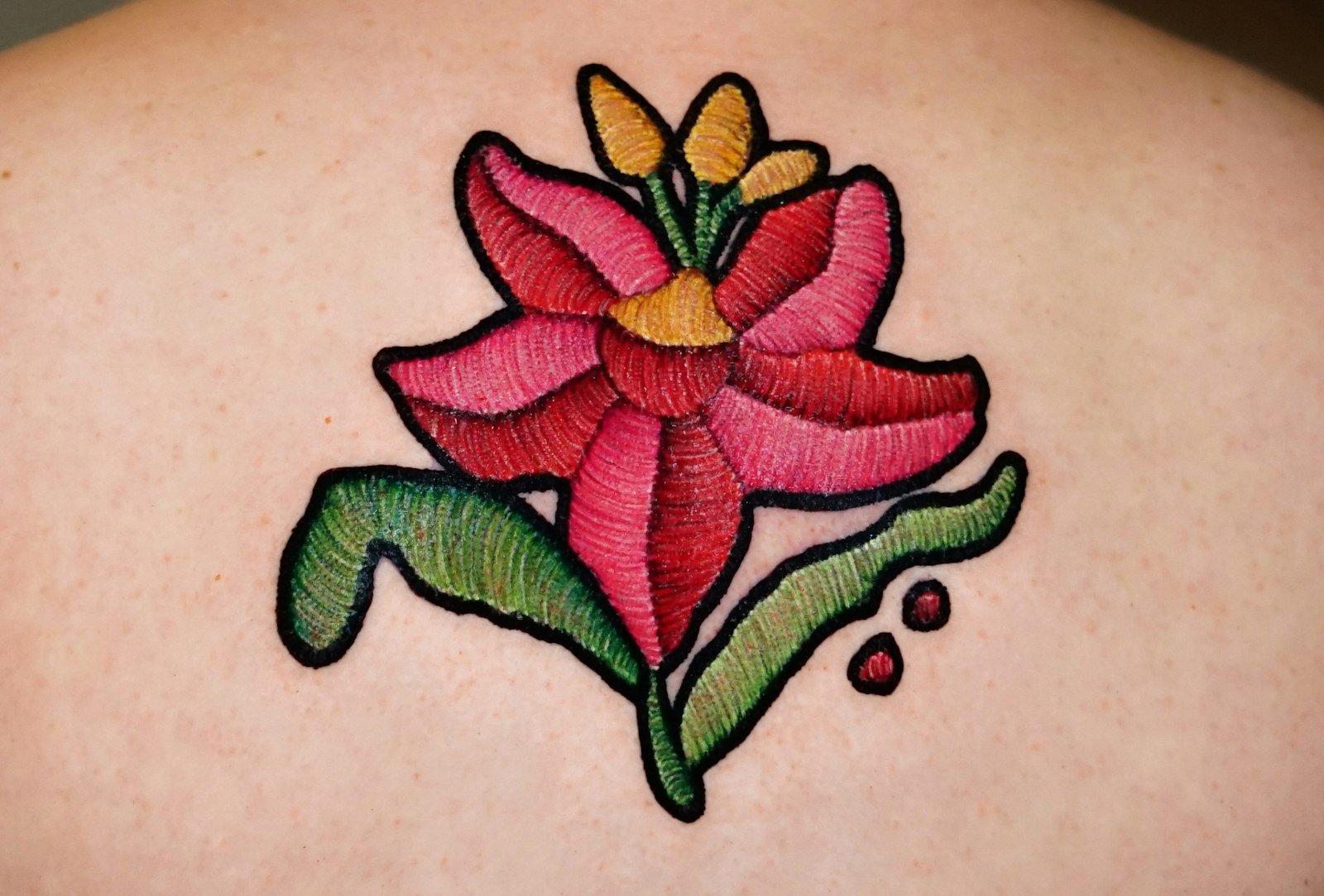
Artists are artists in any medium. Tattooing is image making, and the impulse to re-create texture and visual depth on skin is no different from what painters do on canvas or embroiderers do on fabric. The history of embroidery-style tattooing is difficult to pin down. I know that artists were already experimenting with embroidery inspired tattoos in the 1990s. The style itself isn’t fundamentally different from other forms of illusionistic tattooing—it’s a play of texture created through linework, color, layering, and placement. Earlier decades simply didn’t have the tools or pigments to make the effect convincing. As in any artistic field, tattoo technology evolves, and modern equipment has made these techniques far more achievable.
My own experience with embroidery tattooing began in 2018 in Mexico City. A client arrived with an idea I had never encountered before. Partway through the appointment, she pulled out her grandmother’s blanket and asked me to re-create one of the embroidered flowers as a tattoo. I had no idea how to approach it. Online searches turned up almost nothing, so I studied the embroidery itself, thinking through how its texture could translate onto skin. My art degree probably helped—I was already used to analyzing texture and adapting it across different materials—so skin felt like another surface rather than an entirely new challenge.
The tattoo turned out well. A posted photo of the tattoo went unexpectedly viral, and from that point people started contacting me specifically to tattoo embroidery important to them.
Tattoo Embroidery Stories
Here are some of my favorite embroidered stories shared by my clients.
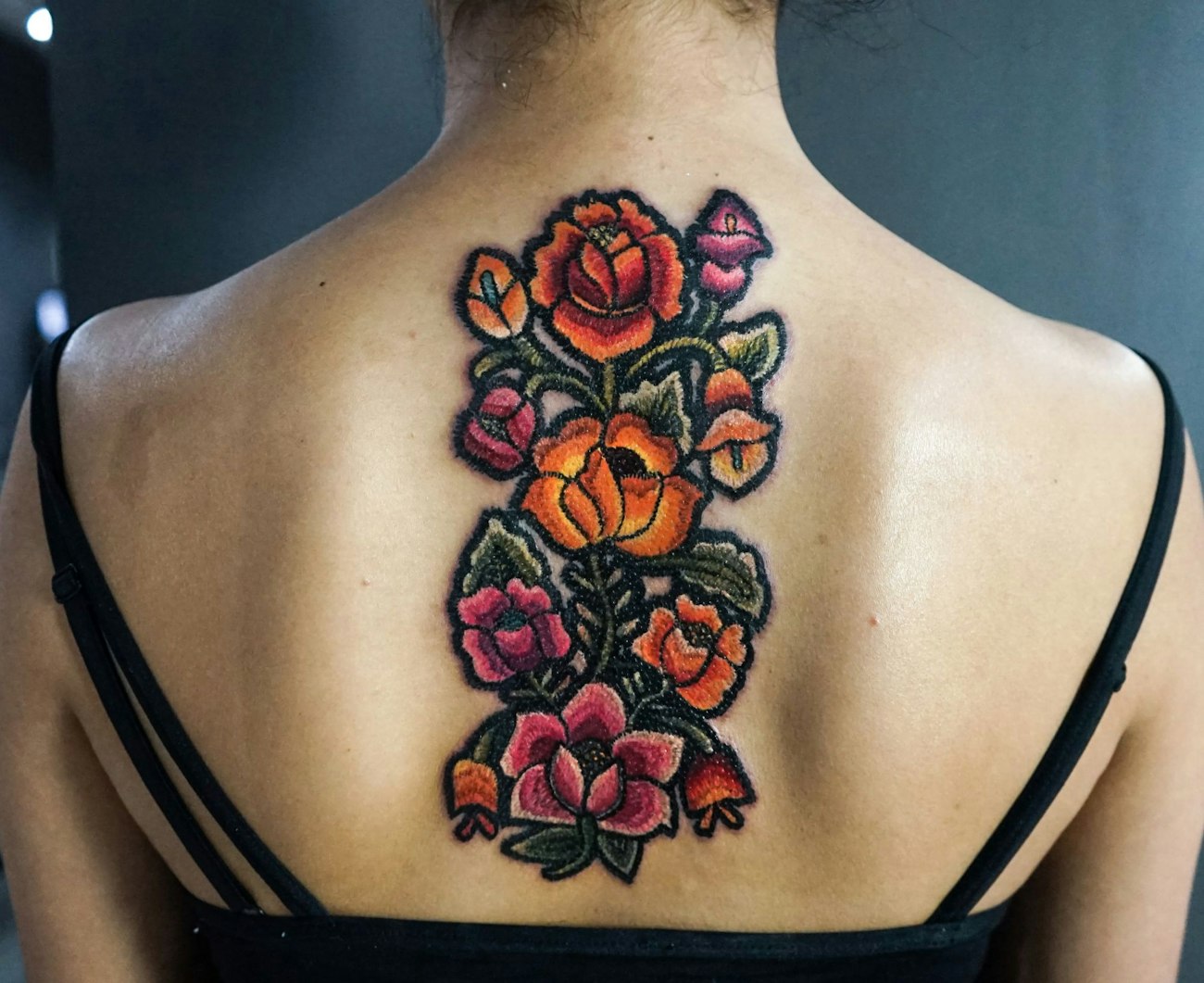
Irma Tello's tattoo inspired by traditional Oaxacan embroidery.
Honoring Oaxacan Roots
IRMA TELLO
My tattoo design was inspired by my first Tehuana attire, embroidered by hand in San Blas Atempa, Oaxaca, by the embroidery artisan Magdalena Montes in 1998 (when I was 8 years old). I was born and raised in Oaxaca, Mexico, and have a deep appreciation for Oaxacan culture and traditions. I wanted to have something “embroidered” on my skin that symbolized that heritage.
That concept remained in my mind for several years while I searched for a tattoo artist capable of recreating the appearance of embroidery on skin. At the time, embroidery-style tattoos were not widely known, so the search continued for many years. Eventually, a cousin shared a social media post featuring Ksu, who had visited Mexico and created a small embroidered flower tattoo for a client. That post inspired me to contact Ksu and pursue my goal. The rest is history. I got my tattoo in 2019, together with my mom (she got a small flower).
During the whole process, Ksu was very careful with the details of the tattoo. At the beginning, she was meticulous about the placement of the tattoo and making sure it was well positioned in the center of my back. It was a very long session (nine hours), but we had several breaks and it was easy to manage. My mom had a short session the day after, and we are both really happy with the results. I think of my tattoo as a way to reflect and honor my Oaxacan roots.
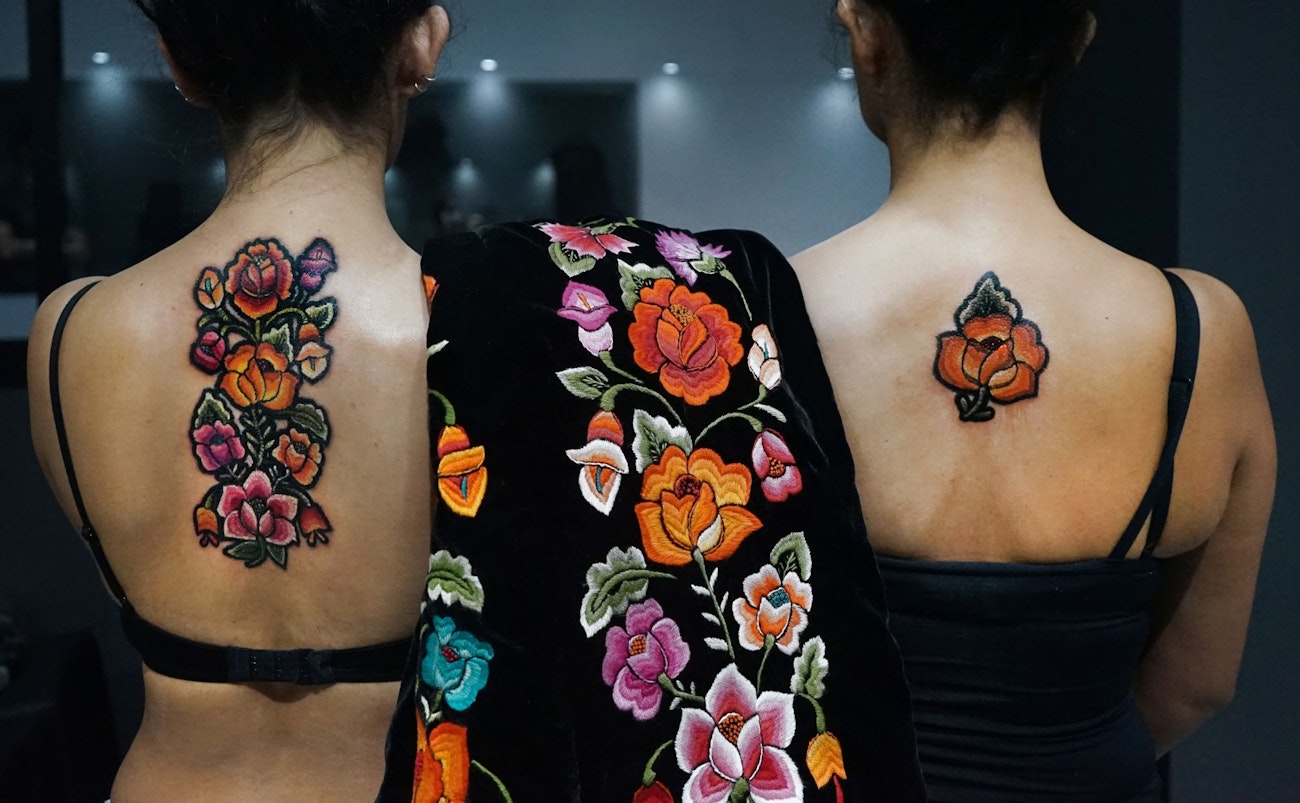
Irma Tello and her mother pose with their tattoos and the Tehuana rebozo that was the inspiration.
Honoring Family
BREE NEFF
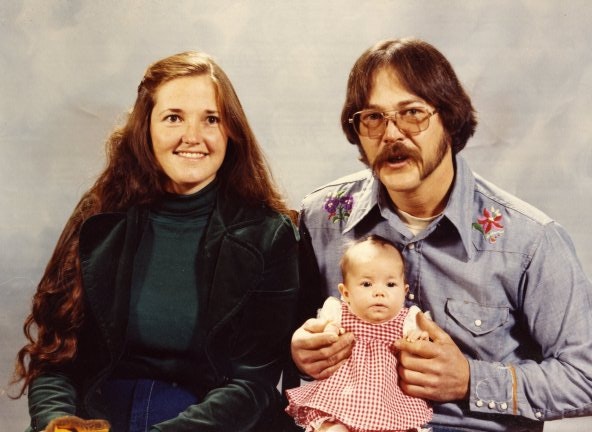
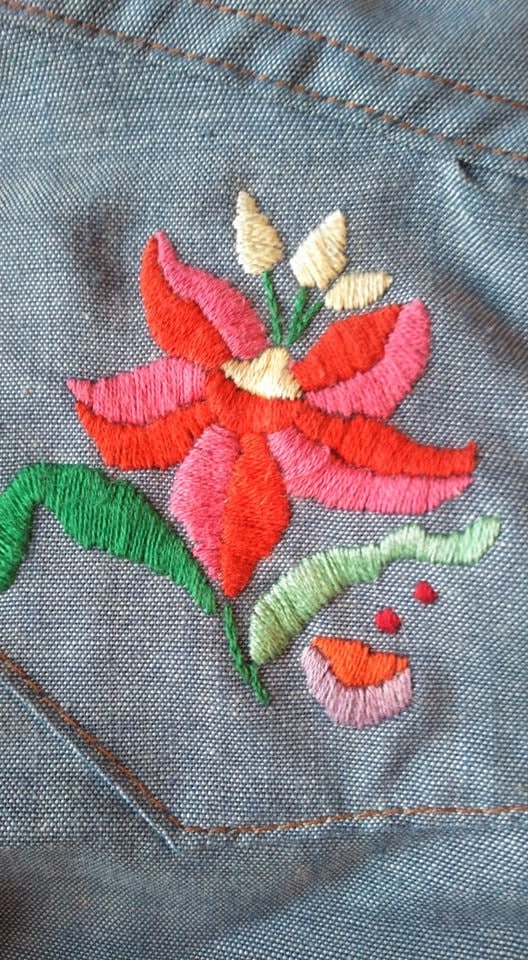
Bree as an infant with her mother and her father, who is wearing the shirt her mother embroidered for him and a detail of the flower she chose for her tattoo. Photos courtesy of Bree Neff
This piece is meant to honor my mom and dad, who died in 2012 and 2015. It is based on an embroidered shirt my mom made for my dad in the late 1970s. He wore it for years, and my younger sister has the shirt now. The tattoo is a physical reminder that my parents are always with me. I struggled to figure out how to memorialize them, and I am so grateful to Ksu for creating this emotionally connective art for me.
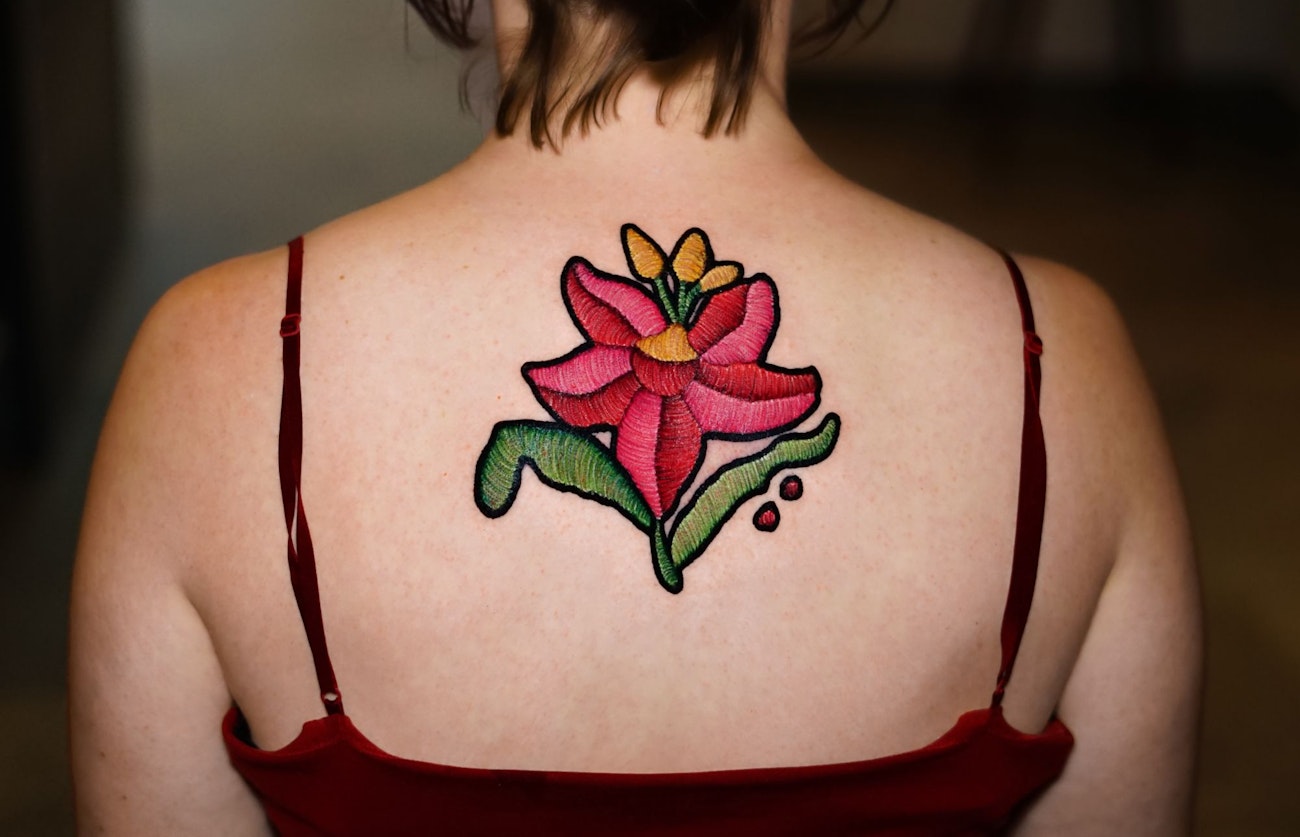
Bree’s tattoo of a single flower that matches the embroidery on her father’s shirt.
Honoring Ukrainian Heritage
DEBBIE
When my husband and I were still dating, we loved sharing our cultures with each other. Since we were living in Taiwan at the time, it was easy for me to introduce him to Taiwanese foods and traditions. But because he’s from Ukraine, it was harder for him to share authentic Ukrainian culture with me.
One day, though, he showed me his vyshyvanka and told me the story behind it. In Ukraine (and other Slavic countries), it’s common to wear these traditional embroidered shirts. I learned that the embroidery patterns aren’t just decorative—they’re believed to symbolize protection from evil, almost like armor or a talisman worn on the body.
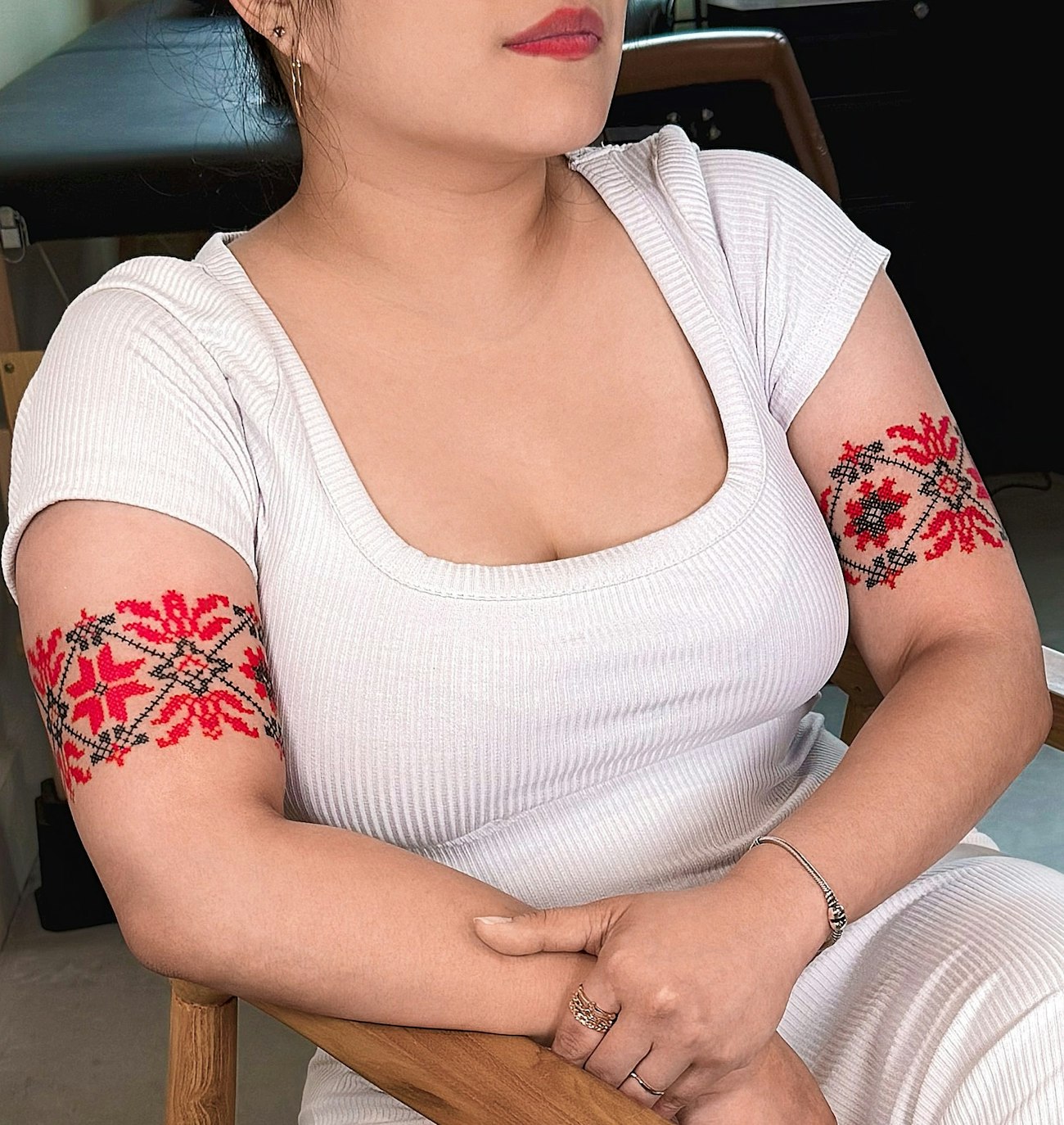
Debbie with traditional motifs from a vyshyvanka tattooed on her arms.
After hearing that, I had an idea: What if I tattooed the pattern on my arms, in the same placement where the embroidery would be on a vyshyvanka? It would be like having “permanent protection.” At the time, I couldn’t find a tattoo artist confident enough to recreate the intricate embroidery style, so the idea stayed a dream.
Not long after, we got married—and the idea only grew stronger. Now that we’ve built a life together, it felt natural to carry a piece of my husband’s heritage with me in such a personal way. Finally, in 2025—eight years after the idea first sparked—I made it happen. And honestly, it’s my favorite tattoo.
From Needle & Thread to Needle & Ink
What draws people to this style, I think, is that embroidery already carries something personal before it even becomes a tattoo. It’s tied to family, culture, memory, and identity—and it exists in some form in nearly every culture in the world. Many clients bring me family patterns, traditional designs, or pieces their parents or grandparents made by hand; they ask me to translate those designs onto skin—preserving not just the visual texture, but also the meaning behind it. I have now also tattooed Armenian rug designs, Mongolian motifs, tatted and quilted pieces, and a crocheted granny square. Ironically, I don't embroider myself. My mother and grandmother both spent their lives sewing and embroidering. I grew up surrounded by embroidery, but as a child I found it too slow. Somehow I ended up “stitching” through drawing. Maybe I was simply meant to re-create embroidery rather than make it.