Mapping America, One Stitch at a Time
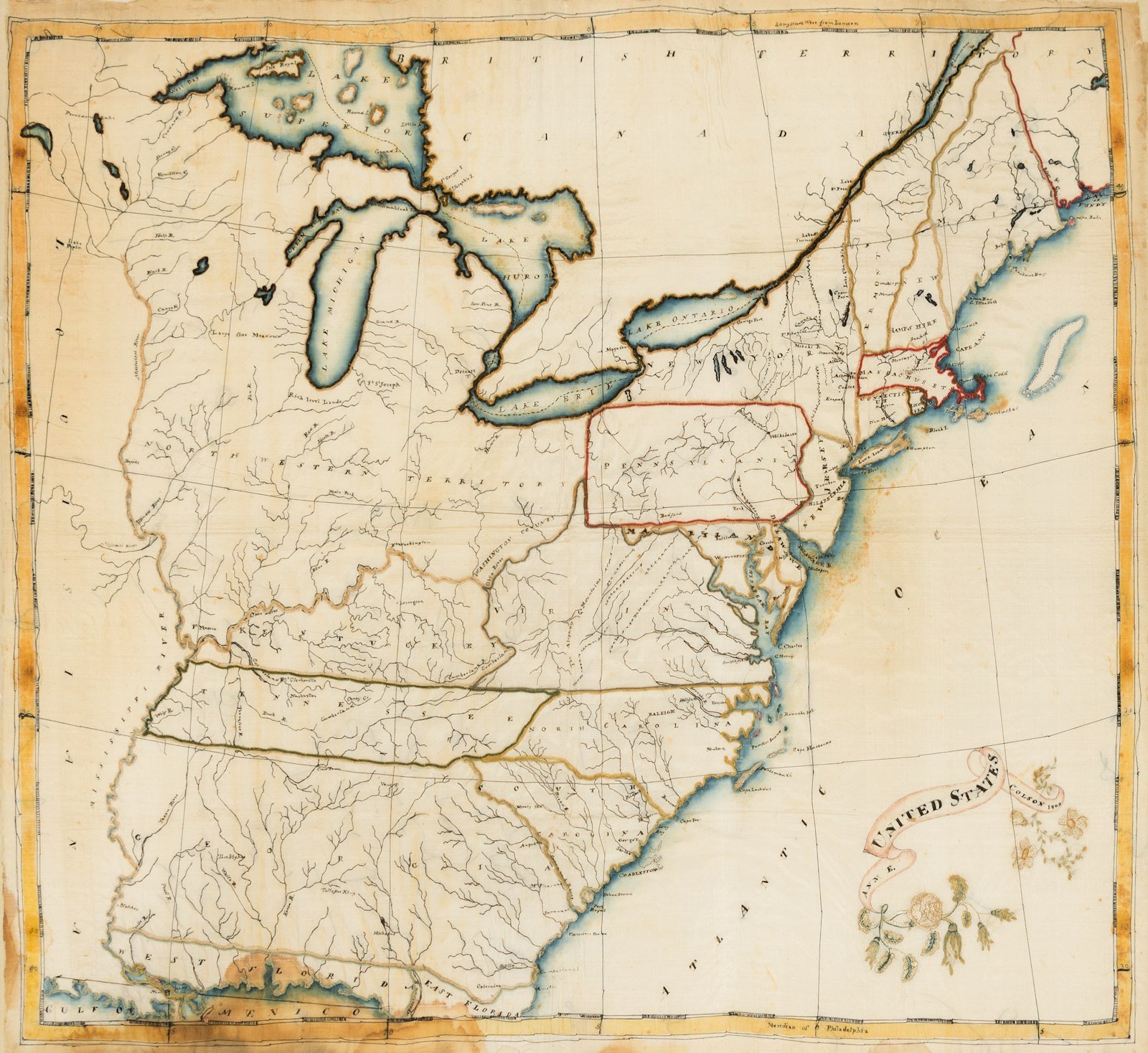
In the first decades after independence, American girls learned the contours of their country by stitching them. At boarding schools, girls transformed printed maps into vivid embroidered visions of a young and still-forming nation.
In the first decades after independence, American girls learned the contours of their country by stitching them. At boarding schools, girls transformed printed maps into vivid embroidered visions of a young and still-forming nation. <a href="https://pieceworkmagazine.com/mapping-america-one-stitch-at-a-time/">Continue reading.</a>
https://pieceworkmagazine.com/cdn-cgi/image/format=auto/https://www.datocms-assets.com/75076/1772122855-02-ann-coulson.tif?auto=format&w=900
Embroidered map of the United States made in 1809 by Ann E. Colson (1789–1867) at the Boarding School for Female Education at Pleasant Valley, Dutchess County, New York. Photo courtesy of the Colonial Williamsburg Foundation (2019-70)
As part of America’s semiquincentennial in 2026, we are highlighting needlework-related projects, exhibitions, and insightful historical articles that contribute to the celebration. This week we feature a story about girls’ education through embroidery in the years following the American Revolution.
Soon after the United States gained independence, much of its geography remained unfamiliar to its citizens. As schools sought to cultivate geographic literacy, girls were taught not only to read maps but also to make them—sometimes with needle and thread.
Dr. Lynne Anderson is the founder and president of the Sampler Consortium and director of the Sampler Archive Project. She and her colleague Stacy Whittaker share their research about girls’ education in “Mapping America, One Stitch at a Time.” These stitched maps offer more than geographic information. They reveal how young women engaged intellectually and artistically with a new nation, mapping America one careful stitch at a time.
Please enjoy Lynne and Stacy’s article “Mapping America, One Stitch at a Time,” available as a free download in the PieceWork library.
If you would enjoy learning more about needlework in America, you’ll want to check out our Spring 2026 issue: Celebrate American Needlework.
Enjoy,
Karen
Lynne Anderson retired from a long career as a University of Oregon professor of education in 2017. Lynne is the founder and president of the Sampler Consortium, an international membership organization, and director of the Sampler Archive Project. She is also a sampler collector and researcher, exhibition curator, and author.