
I recently visited the exhibition An Ocean in a Drop at the Indigo Art Museum in Ahmedabad, India. The world’s first institution solely dedicated to indigo, the Indigo Art Museum was conceived and founded by Shri Sanjay Lalbhai and operates under the Arvind Indigo Foundation. The desire to promote indigo in its purest form—across contemporary art objects and textiles—gave rise to a museum where artists, designers, and master craftspeople from around the world can present their creative pursuits.
An Ocean in a Drop
The current exhibition, An Ocean in a Drop, is the result of the museum’s artist-in-residence program, bringing together works by national and international artists. Each piece emerges from the artists’ creative processes, culminating in remarkable installations, wall panels, and dyed textiles.
Indigo dye, known for its brilliant tonal gradations of blue, has traveled across continents, cultures, and centuries. The earliest evidence of indigo dates back to around 4200 BCE, with one of the oldest confirmed examples discovered at Huaca Prieta in Peru. Indigo became one of the most valued colors in the world. In India, it is deeply embedded in textile craft traditions and continues to sustain artisan communities. The calm and stillness of blue carry stories of movement, resistance, and transformation.
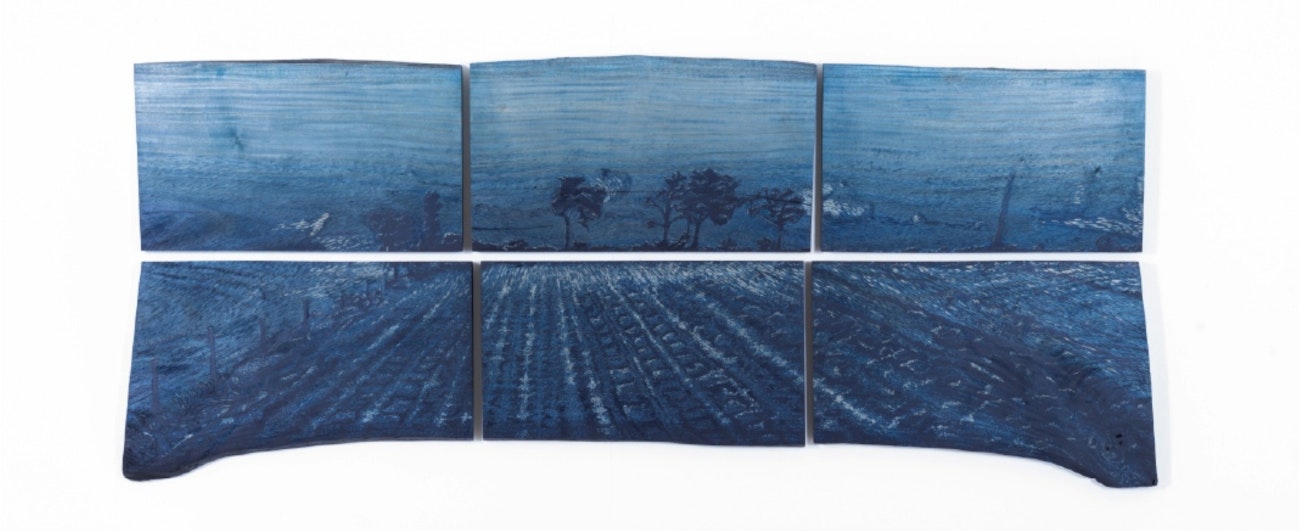
Monsoon, woodcut on fabric with natural indigo dye by artist Aasha Keshwala.
The exhibition’s title struck me as poetic, and I imagined walls filled with shades of blue. But as I stepped inside the museum, I realized the exhibition was not only about color; it also revealed the artists’ thought processes, techniques, materials, transformations, dedication, and skill. I was immediately drawn to the range of materials used. The installations were not confined to fabric but extended across zinc plates, leather, wood, cotton cord, framed canvas, linen, paper, and more. Each medium told its own story, yet all were connected through shifting, layered blues. I experienced the single color of indigo in seemingly infinite ways.
Indigo as a Living Medium
The museum’s residency program brought together artists from across the globe. International participants included Maximilian Rödel (Germany), Buaisou (a collective of indigo artisans based in Tokushima, Japan), and Isha Pimpalkhare (Germany). Rödel’s work comprised seven mounted wall paintings using indigo, Indian madder, and alkanet root. The paintings seemed to dissolve boundaries, evoking a sense of unity and quiet intimacy.
From Buaisou’s practice emerged works of remarkable precision, rooted in a process that felt both meditative and exacting. Rope, made from twisted yarns, appeared as a recurring element, interpreted in different ways across their pieces. Stencils, crafted with rice paste on both sides, met the indigo bath like a hidden language waiting to surface. When revealed, the designs shimmered in contrast—a quiet interplay between restraint and saturation. The central work in this hall was a large noren curtain made of ramie, patterned in gradations of indigo.
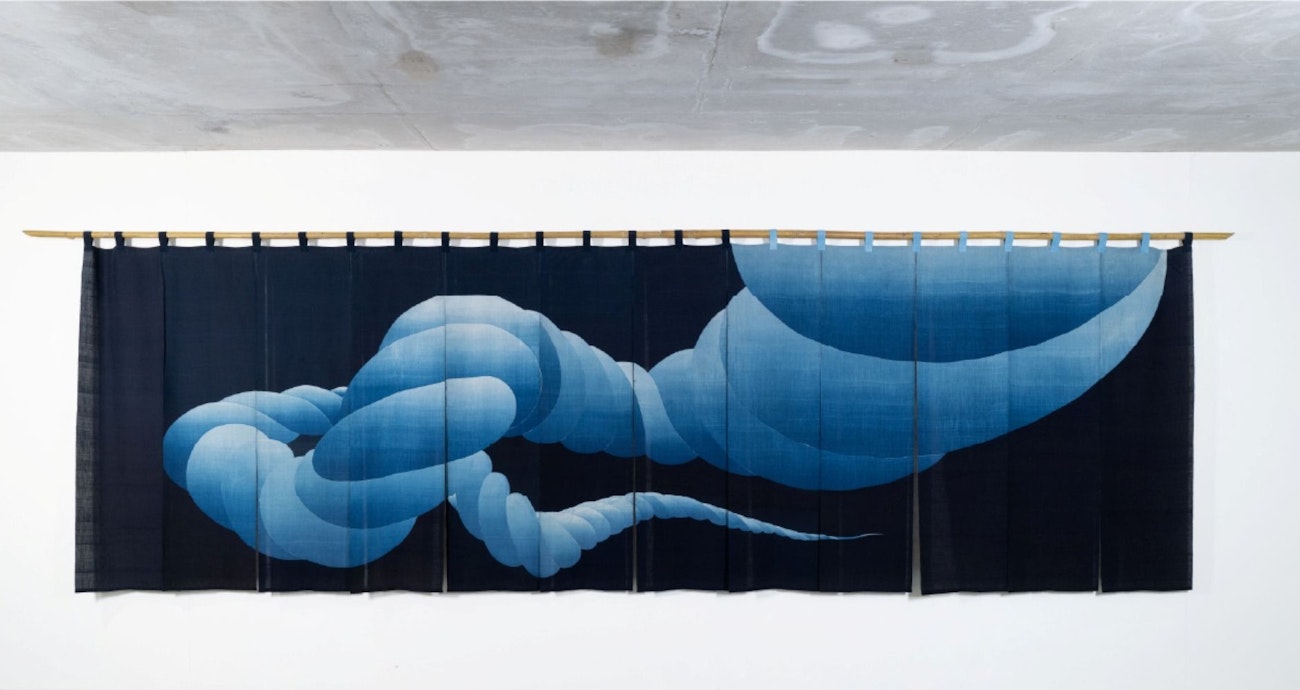
A ramie noren curtain created by the Japanese indigo artisan cooperative Buaisou
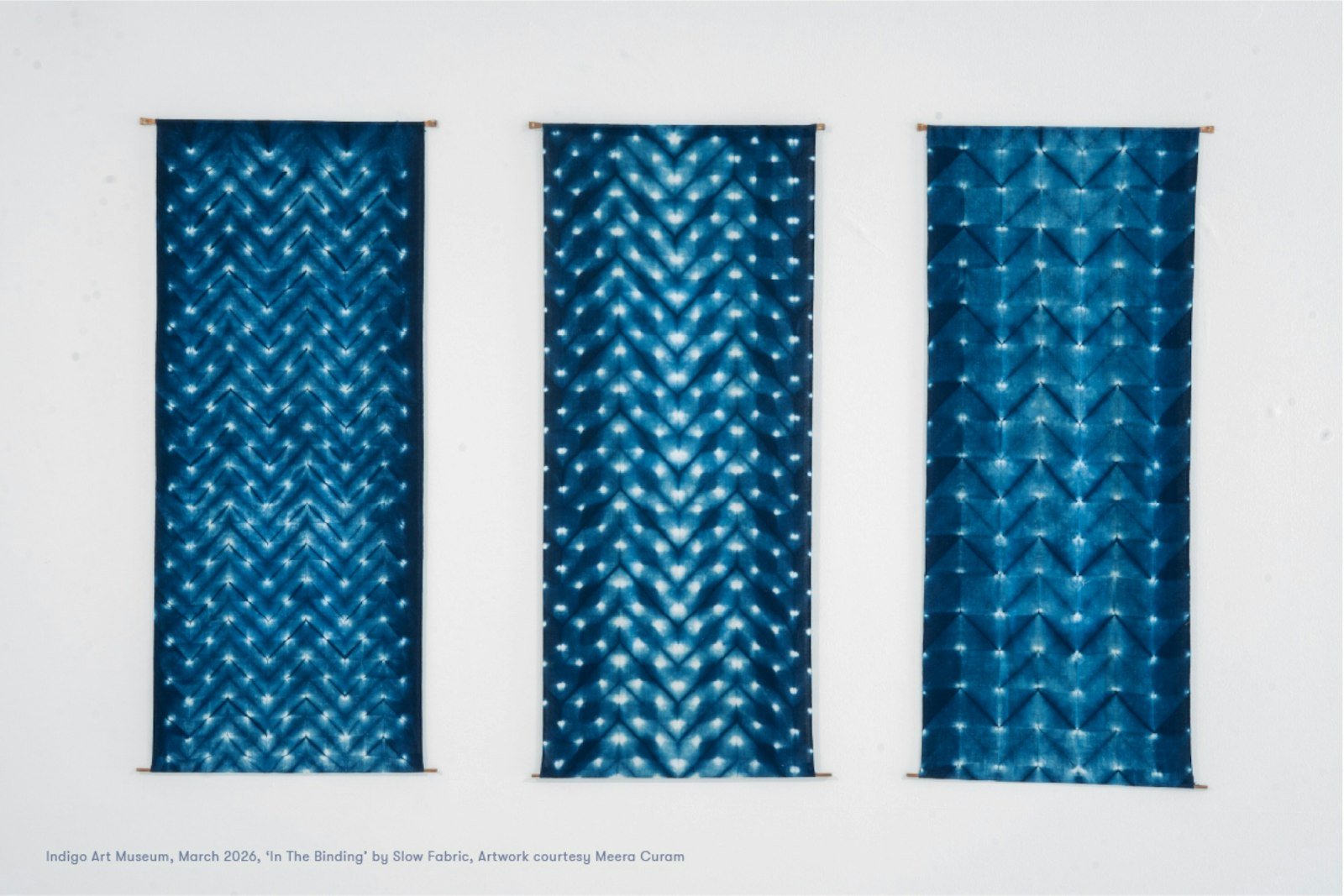
Slow Fabric, a textile studio and design practice from Shiga, Japan, employed traditional Japanese shibori techniques to create works reminiscent of natural landscapes. Through careful pleating, binding, and dyeing, intricate patterns emerged across the surface. In In The Binding, these layered interventions in cotton resulted in refined textures and tonal depth, reflecting both precision and sensitivity to material.
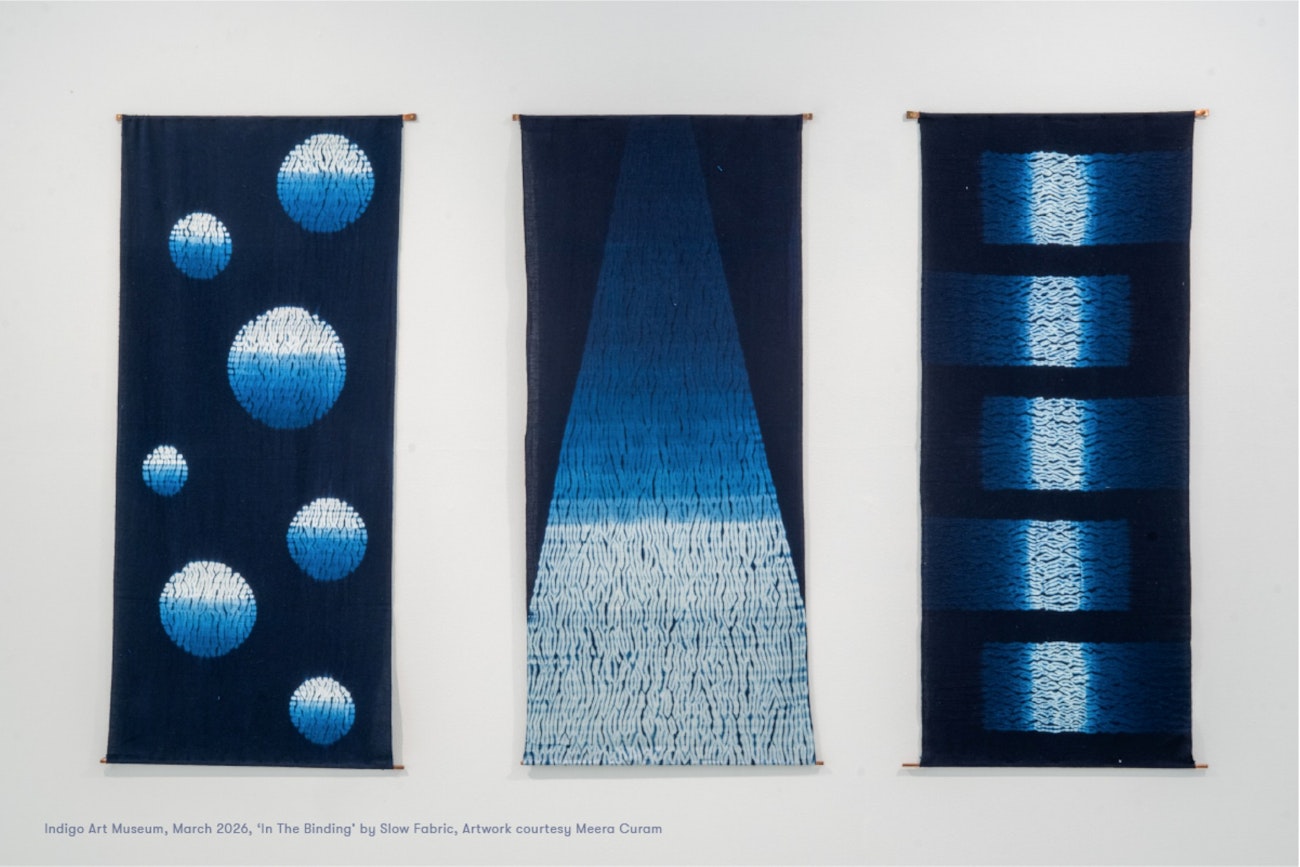
In The Binding; Slow Fabric, Shiga, Japan.
Another work that drew my attention was by Isha Pimpalkhare, who used the devoré technique of lacemaking to create installation pieces in varied tints, shades, and tones of indigo. Devoré is an age-old process in which blended fabrics (typically cotton and polyester) are treated with acid to dissolve the cellulosic fibers, leaving behind polyester. Portions of the fabric seemed to disappear into transparency; what remained felt both delicate and intentional. The work occupied a compelling space between art and design. Having long taught the devoré technique to fashion and textile design students, I found it especially inspiring to see it transformed into such inventive contemporary expressions.
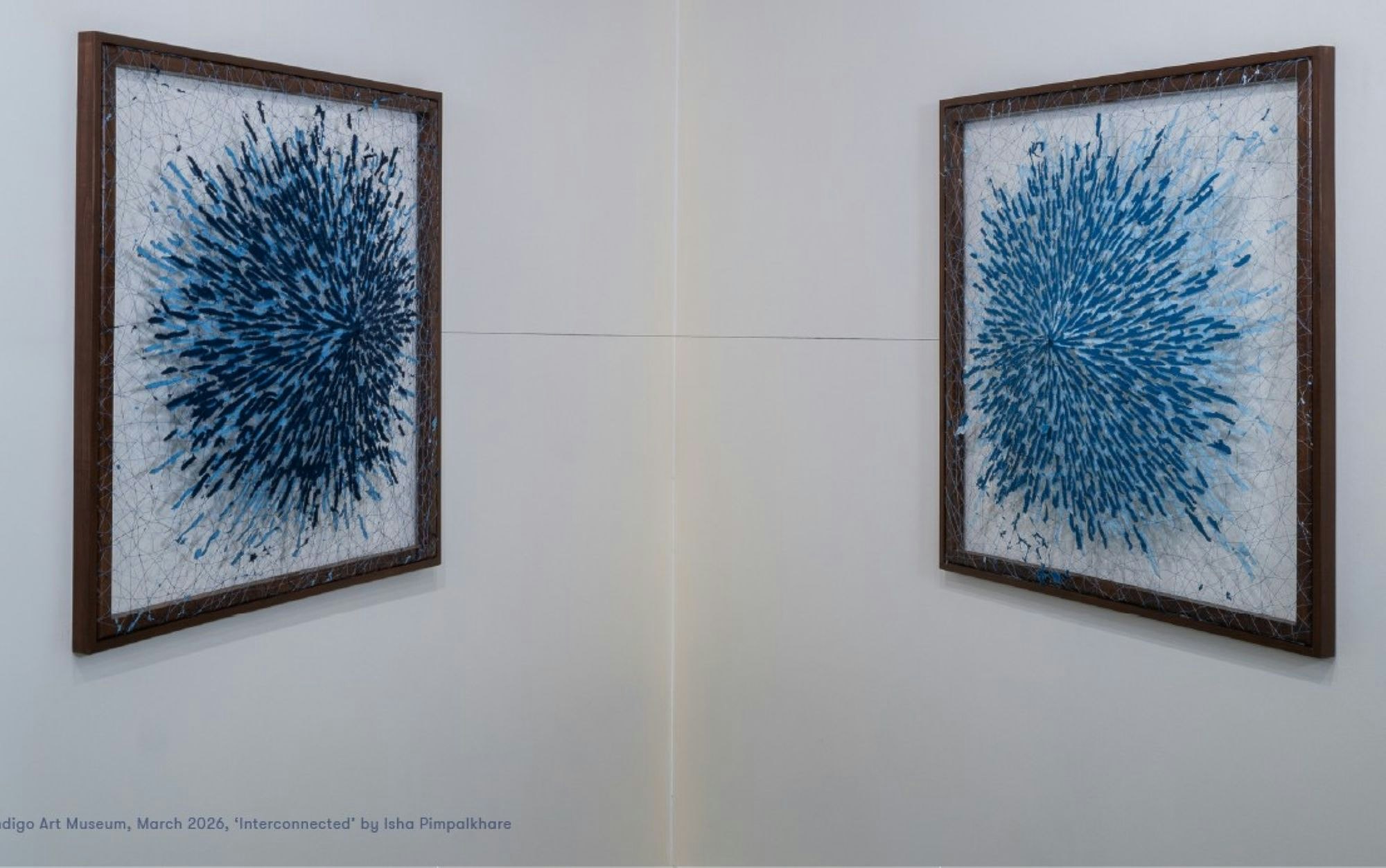
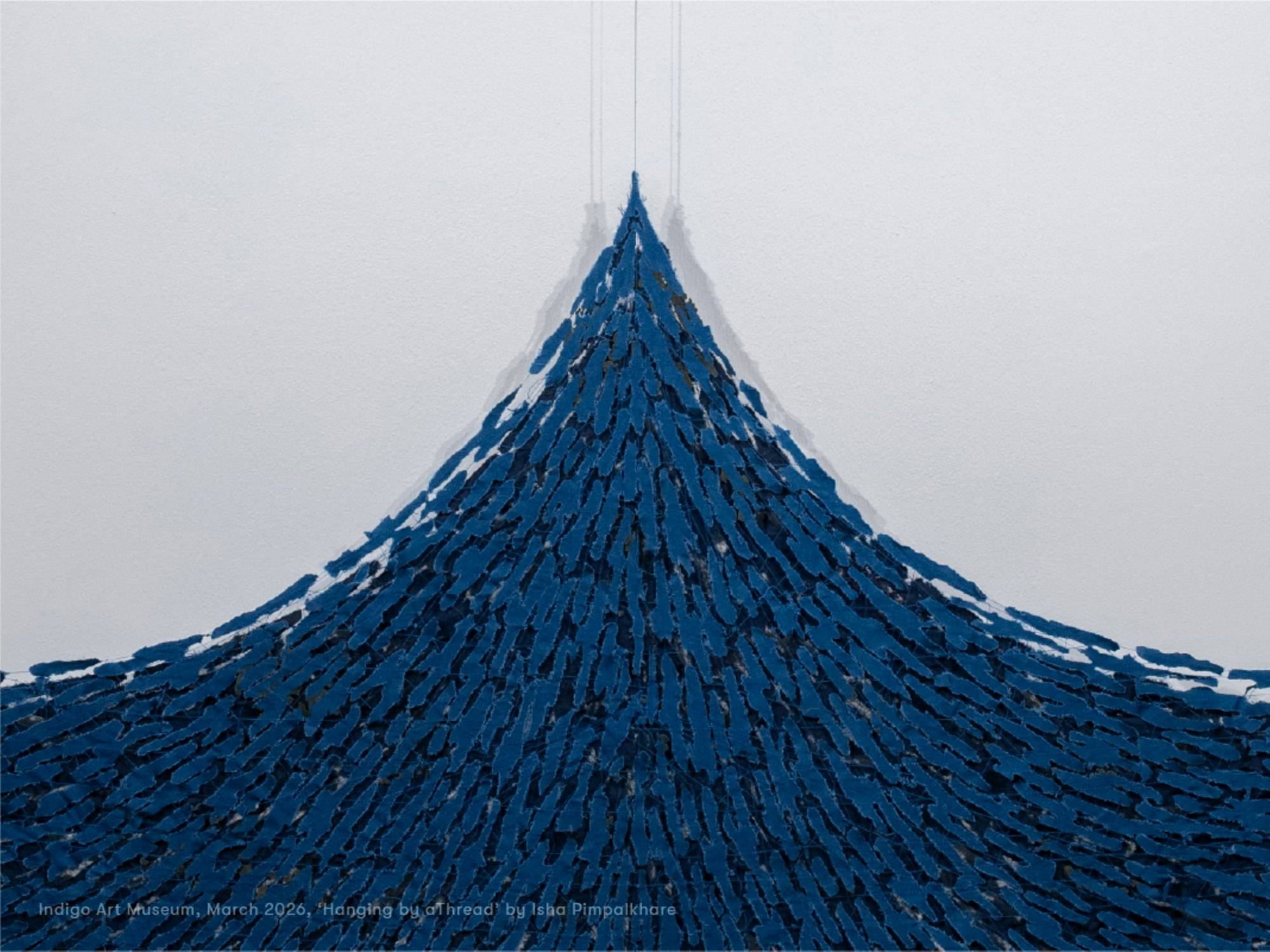
Installation of the devoré technique; Isha Pimpalkhare. Click on the image to see more detail.
The Language of Indigo
The exhibit expands out from the galleries of the Indigo Museum to its parent museum, Kasturbhai Lalbhai Museum next door. Entering the first section of the main museum, I was immediately drawn to the work of Madhukar Mucharla. His installation titled Place and People featured twelve leather puppets dyed in indigo and crafted using traditional chappal-making techniques. Each piece of leather was sewn, knotted, plaited, and tied to depict scenes of everyday life—figures engaged in routines familiar from streets and villages. The softened leather draped naturally, forming clothing-like textures—trousers, saris, blouses—and lending the puppets a lifelike presence.
Equally compelling was Mucharla’s installation Light of Hope: seven rawhide houses dyed in indigo, inspired by visits to informal settlements and the stories of displacement encountered there. Fine strips and shapes of leather were folded, joined, and stitched using traditional techniques to form clusters of three-dimensional houses. These miniature settlements conveyed both realism and empathy, capturing the resilience and rhythm of life within such communities.
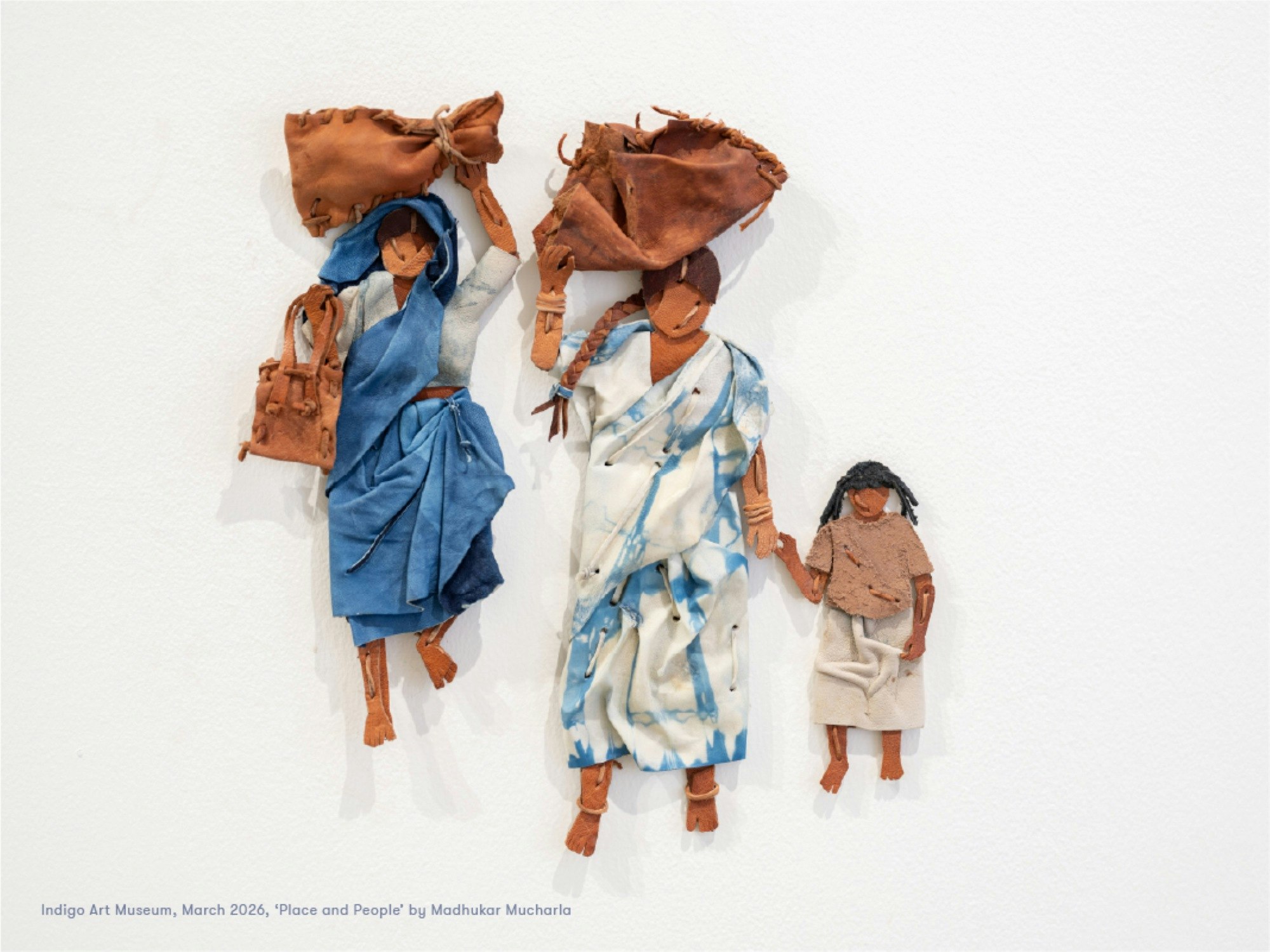
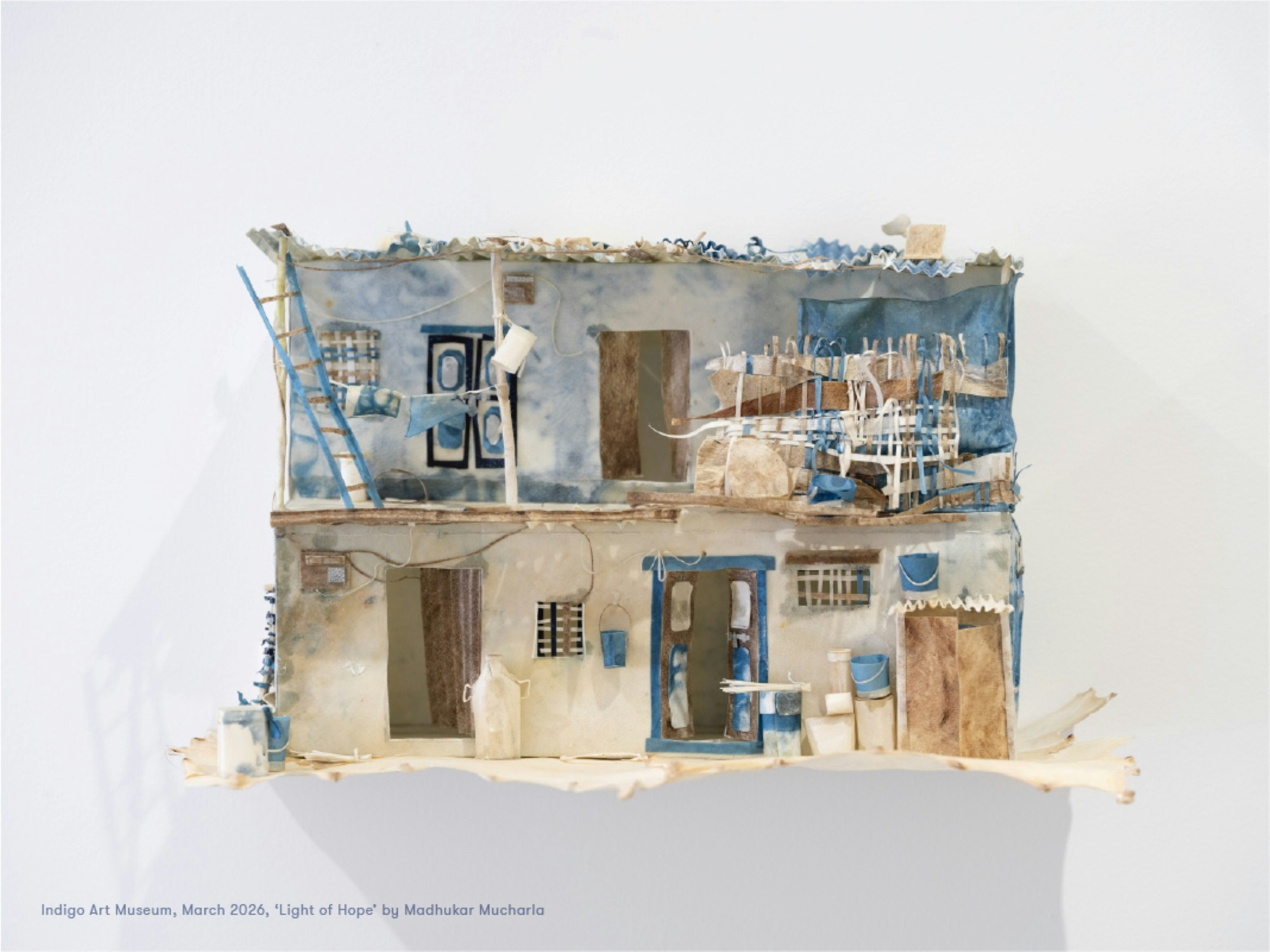
Place and People: leather puppets; detail from Light of Hope: rawhide houses; Madhukar Mucharla, Hyderabad, India. Click on the image to see more detail.
Aasha Keshwala of Porbandar, India, explores the monsoon through the tactile language of woodcut and dye. Hand-carved wooden blocks create large-scale prints that establish a dynamic visual framework evoking the drama of rain. These prints are then repeatedly dyed in indigo, gradually building layers of color and texture. Tones bleed into one another, horizons blur, and surfaces deepen into contemplative blues where sky and land seem to merge.
Mayank Parmar’s Songs from Indigo Fields reflects agricultural landscapes, capturing the vitality of indigo plants. Another striking work was Untitled by Widi Pangestu Sugiono (Indonesia), woven in a plain weave resembling a mesh. Each piece unfolds through subtle shifts in tone and texture: What first appears coarse gradually softens into a refined visual rhythm.
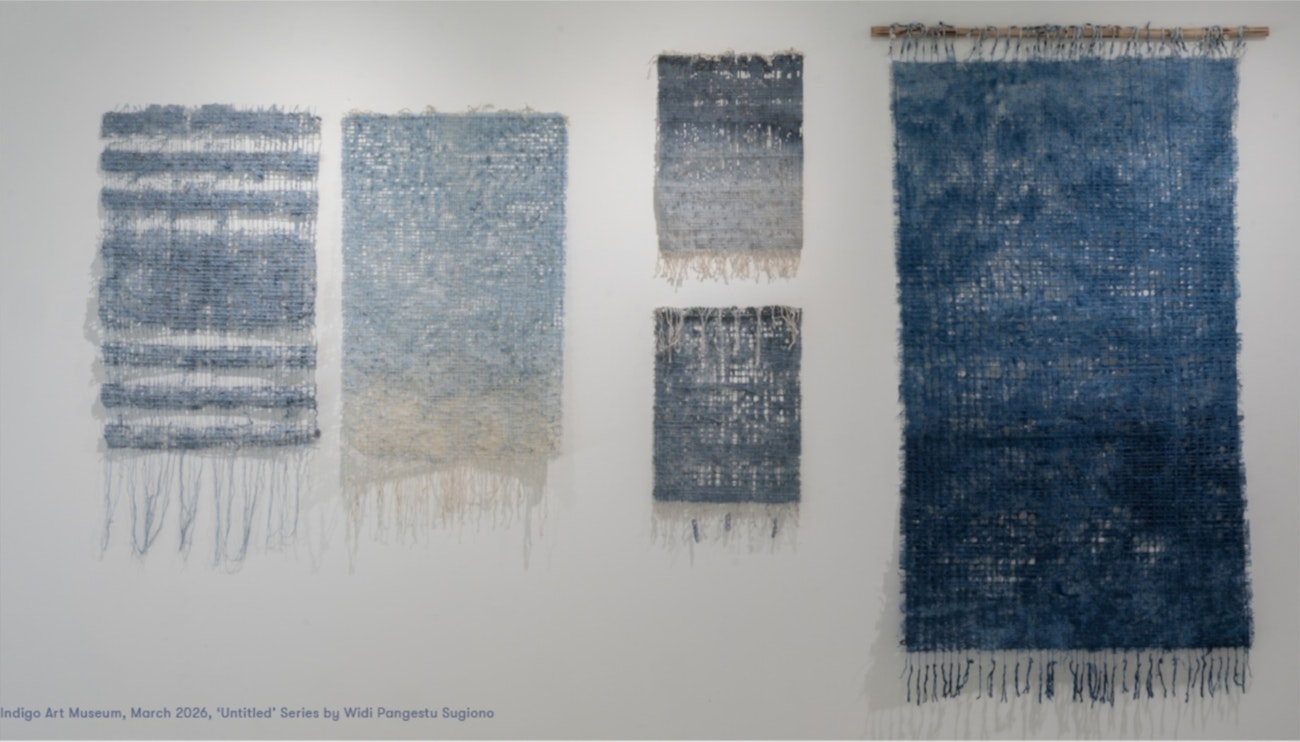
Untitled; Widi Pangestu Sugiono.
Blue Without Shore by Sandipan Paul (Howrah, India) combines cotton cloth, indigo dye, and etching on paper to produce nuanced tonal effects. His practice spans woodcut, linocut, etching, and experimental printmaking, through which he translates emotion into carefully structured visual compositions.
As I moved through the exhibition, each artwork felt like a drop—distinct in depth and character, yet inseparable from the vast ocean it belongs to. Each piece carried its own story, and through the shared language of indigo, they collectively pointed toward a larger, interconnected whole. An Ocean in a Drop ultimately revealed the limitless possibilities of indigo as a medium of expression.
This is my personal reflection on the exhibition and not an official collaboration with or endorsement by the museum.
A heartfelt thank you to the Indigo Art Museum for graciously allowing me to document this exhibition. Their generosity made it possible to experience, reflect on, and celebrate the subtle, timeless beauty of indigo as a living medium.