

Contents
Ida May Allen did not have an easy childhood. She was born on August 26, 1863, in the midst of the upheavals of the Civil War and almost four months after the divorce of her parents, Wealthy Ann Allen and Robert Franklin. Although it is possible that Wealthy Allen, just twenty, may have lived for a time with relatives, she soon was forced to make her way as best she could, burdened with her baby, Ida May, and her two-year-old daughter, Addie Audre.
Dressmakers of Cherry Street: How Three Women Stitched a Life from Hardship
There is no further record of Wealthy or her little family until she appears in the 1870 U.S. Federal Census living in Addison, Michigan, as a housekeeper in the household of an apparently widowed farmer with two small children, ages four years and three months, as well as a ten-year old boy. Because Wealthy is listed not as wife but as “keeping house,” she likely was paid a small sum to manage the household for the young farmer, or perhaps she managed it and minded his children in return for room and board for herself and her daughters. In this census, both of her daughters, Addie, age ten, and Ida, age eight, both born in Michigan, are listed as living with their mother and going to school. Evidently, despite the terms of a divorce decree that gave sole custody of Addie to Robert Franklin, Wealthy managed to keep both of her daughters with her.
Ida May’s name next appears in the 1880 U.S. Federal Census in Almont, Lapeer County, Michigan. In this census, she is seventeen, living on Cherry Street with her mother, age forty-six, whose name was recorded erroneously by the census taker as “Bertha,” and her older sister, age nineteen, was recorded as “Andre Addie.” All three women reported their occupation as dressmaker. Alone in the world, initially living in poverty, they succeeded in a demanding profession, creating beautiful garments and stunning needlework as their sole livelihood. Ample evidence of the needle skills of all three women is preserved in the pieces that have survived and been handed down in the family. Examples of flawless tatting, fine silk embroidery, and exquisite crochet demonstrate that their talents far exceeded simple sewing and mending.
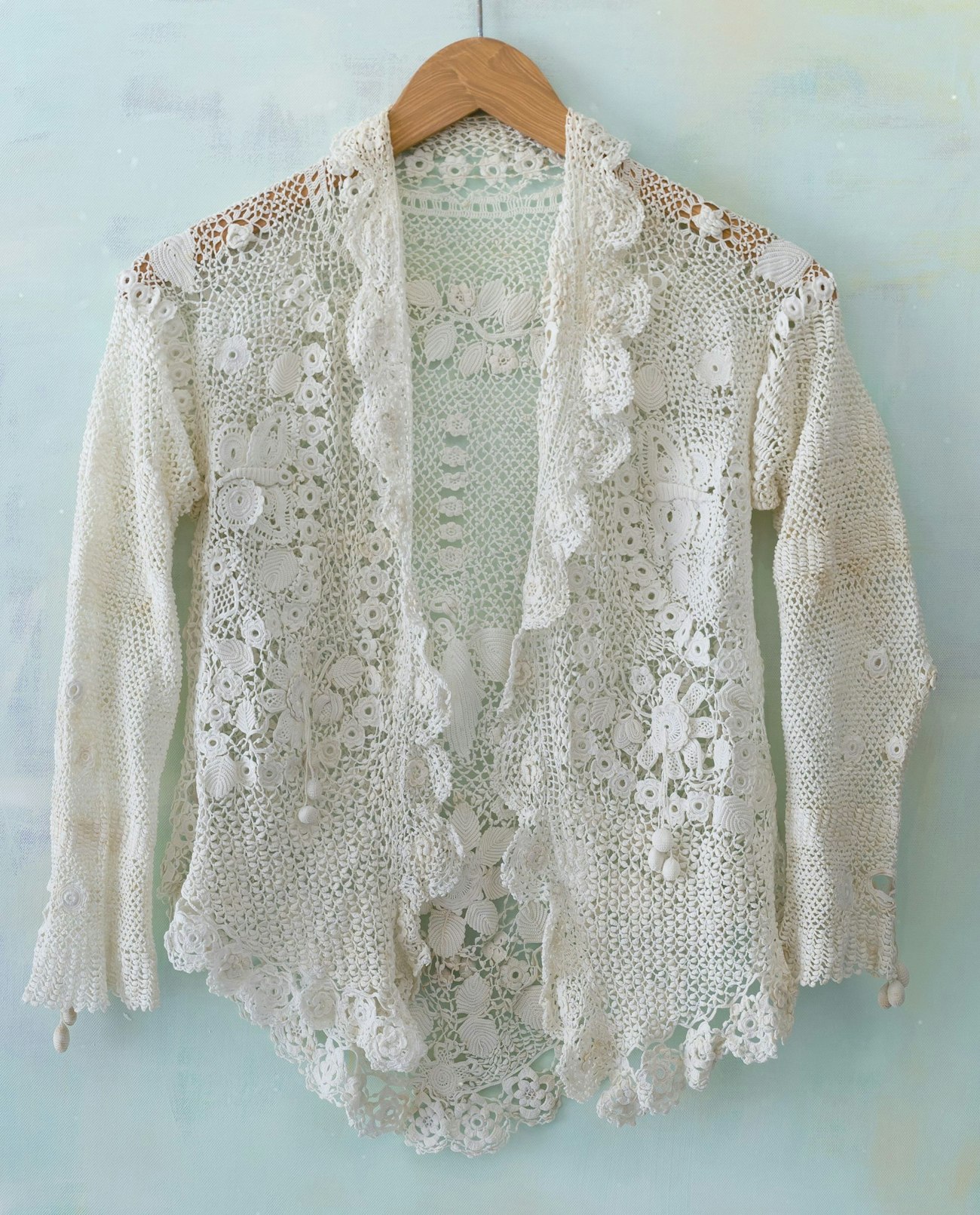
Ida May Allen’s wedding jacket. Irish crochet. United States. Circa 1881.
An Exquisite Crochet Lace Jacket
Most precious of all their work is a cotton lace wedding jacket, a brilliant design executed in the finest Irish crochet. Although we have been unable to find a commercial pattern resembling this garment, one may exist. But we believe that Ida May, very likely with the help of her sister, Addie, may have designed it herself. Family lore on this point is unclear. Nor do we know precisely how many hours and days the project required; given the time constraints of her profession, perhaps more than a year was devoted to its construction. In any case, the wedding jacket remains a remarkable feat of needlework and its design a genuine work of art.
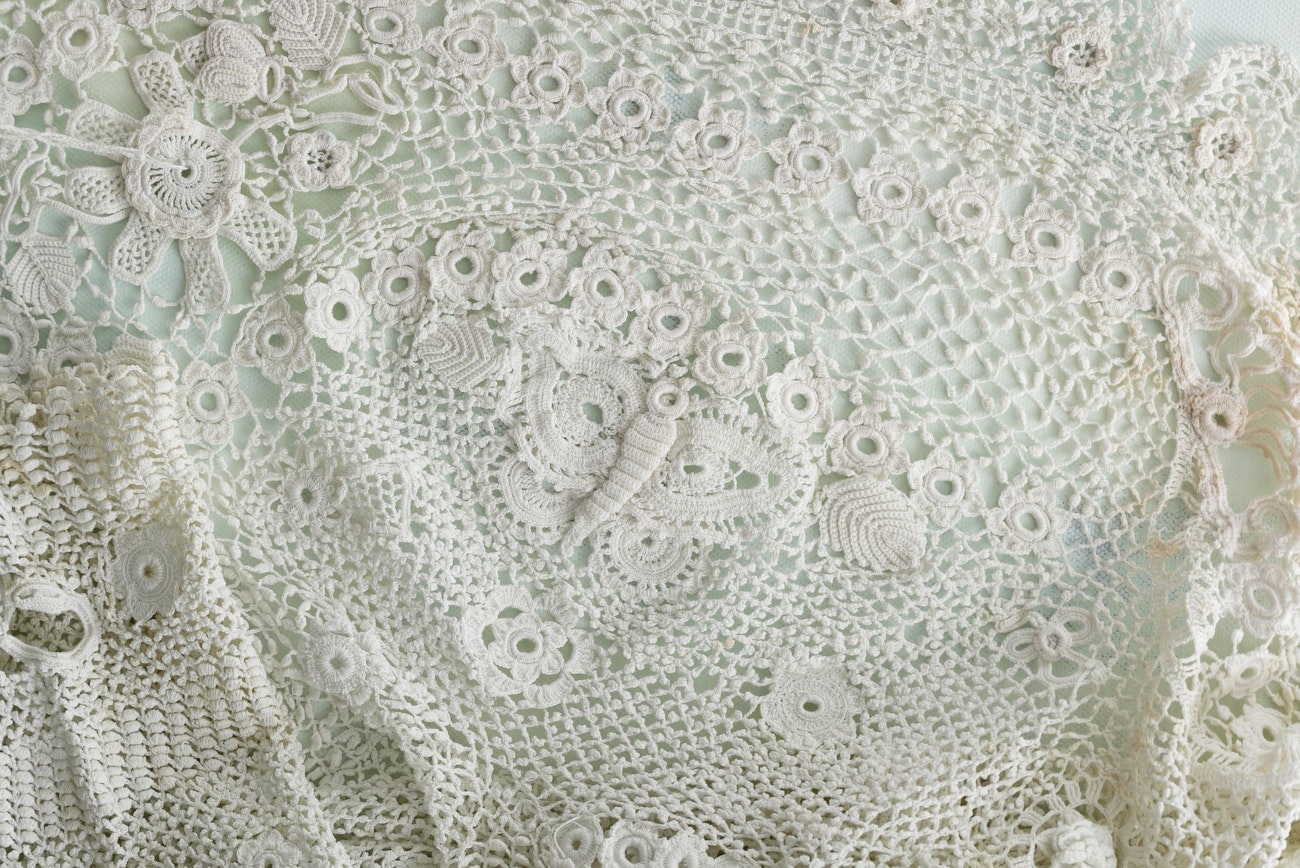
Delicate details make up various motifs including flowers, leaves, and a butterfly.
On April 24, 1881, Ida May, presumably wearing her beautiful jacket, married Joseph Jr. Simons, a master carriage maker. To our great regret, no wedding photograph of Ida May in her jacket has survived.
Read the complete article and see more photos of Ida May and her jacket in the May/June 2016 issue of PieceWork.
Explore more Irish crochet projects in the PieceWork library: Irish Crochet Cuffs, A Bouquet of Irish Crochet Roses, and Irish Crochet Buttons
This article was originally published October 17, 2017; updated March 12, 2026