
Contents
Phoebe Henning (1904–1997) contended with more than her share of life’s obstacles, yet she overcame them with grace and through art, namely her own oil paintings. Additionally, she was deeply committed to the exploration of folk fiber traditions whose beauty her artist’s eye immediately appreciated.
Tragedy struck in her childhood: Phoebe was only two years old when her mother, Anna Sorg Henning, died, and her large, extended family in the Pittsburgh area stepped up and helped care for her (see note 1). Born into a German-speaking family, Phoebe learned English only upon starting school. When she was five or six, she contracted scarlet fever. Her memories of that time included her quarantine, the relocation of her elder brother and sister to their grandparents’ home, and the fumigation of her belongings. Phoebe’s recovery was slow, but when she regained her health, her family discovered that the fever had left her mostly deaf. At the time, the primary method for her to compensate for this loss was to learn to lipread, which she did, and she was able to graduate from Peabody High School in 1922.
 Phoebe Henning Rugh in a photo dated May 1939 shortly after her wedding. Photo courtesy of her daughter, Pat Mahan
By the time Phoebe finished high school, she recognized her artistic abilities and that she needed to develop her skills further. She enrolled in the Carnegie Institute of Technology (later to become Carnegie Mellon University) in Pittsburgh as a fine arts major. Once again, poor health featuring fevers, earaches, and possibly mumps plagued her, but she persisted and graduated after five years in 1927. The later illnesses may have further damaged what little hearing she had retained after her bout of scarlet fever. Although she was a skilled lipreader, Phoebe learned the hard way that no one would hire a deaf woman, and her family persuaded her into remaining at home and taking care of her aging father, William Henning. His passing in 1934 allowed Phoebe to seize fresh opportunities and launch herself into a new life.
Another important event occurred in 1934: Phoebe received her first hearing aid, which she described as a “a three-piece complicated five-pound battery affair.” She wore hearing aids for the remainder of her life. No longer responsible for her father’s care, Phoebe moved out of the family home, also in 1934. What she did between moving out of the family home and traveling to Europe is not entirely clear, but her decision to study art in Europe had unexpected results.
A Missed Mentor and a New World of Folk Art
Phoebe had planned to study under Maria (also spelled Marya) Werten (1888–1949), a prolific painter, graphic artist, and designer at the International School of Art in Zakopane, Poland. Born in Warsaw, Werten collaborated with Cora Elma Pratt, the school’s founder, from 1932 to 1937. Werten alternated between directing the school and making frequent and extended trips to the United States to lecture, teach, and promote Polish art, before settling permanently in Los Angeles beginning in 1939 (see note 2). Pratt (1888–1977) was an artist and visionary. She established multiple branches of her International School of Art in Europe, Mexico, the United States, and South America, the first of which she founded in Zakopane in 1928. Pratt promoted and collected examples of traditional folk arts throughout the world, and she bequeathed approximately 2,500 objects to the Richard and Carole Cocks Art Museum of Miami University in Ohio. Pratt further organized folk art tours in Europe and the Americas. Phoebe planned to join this art institution that was founded and directed by extraordinarily talented and dynamic women. This demonstrated her own ambitions and courage as she leapt into the unknown, heading to Poland in 1936, the year Germany reoccupied the Rhineland and Jesse Owens won multiple gold medals at the Berlin Olympics.
Unfortunately, Werten was away on one of her American trips when Phoebe arrived to enroll at the International School in Poland, causing Phoebe’s art school plans to fall through. This was simply another problem Phoebe turned into a different opportunity. Perhaps influenced by the International School’s recognition of folk arts as genuine art, as well as the concept of Pratt’s folk-art tours, Phoebe began her own European adventure starting with Poland, including a visit to a local lacemaking school in Zakopane. She traveled mostly on her own, although a friend accompanied her through Scandinavia. For six weeks, Phoebe explored Poland, Germany, Romania, France, the Netherlands, and other places, but her surviving passport was damaged in a 1972 house flood that obscured the admissions stamps, so the complete list and corresponding dates are now unknown. Her personal exploration of diverse textile and artistic traditions across cultures inspired her, and Phoebe’s artistic background fostered her recognition of their intrinsic beauty. She embarked on her next adventure upon returning home to Pittsburgh.
The Peasant Shop
Phoebe transformed her aborted art school venture into an import business based on contacts she made while exploring Europe. “The Peasant Shop,” appears in Pittsburgh’s city directories between 1936 and 1938 (see note 3). One surviving undated advertisement lists the variety of products available in the shop, and the graphic border is one of Phoebe’s own designs. Textiles feature prominently among the offerings, including woven tapestries, knitted items, handwoven pieces, and embroidery.
Click on each image to see more!
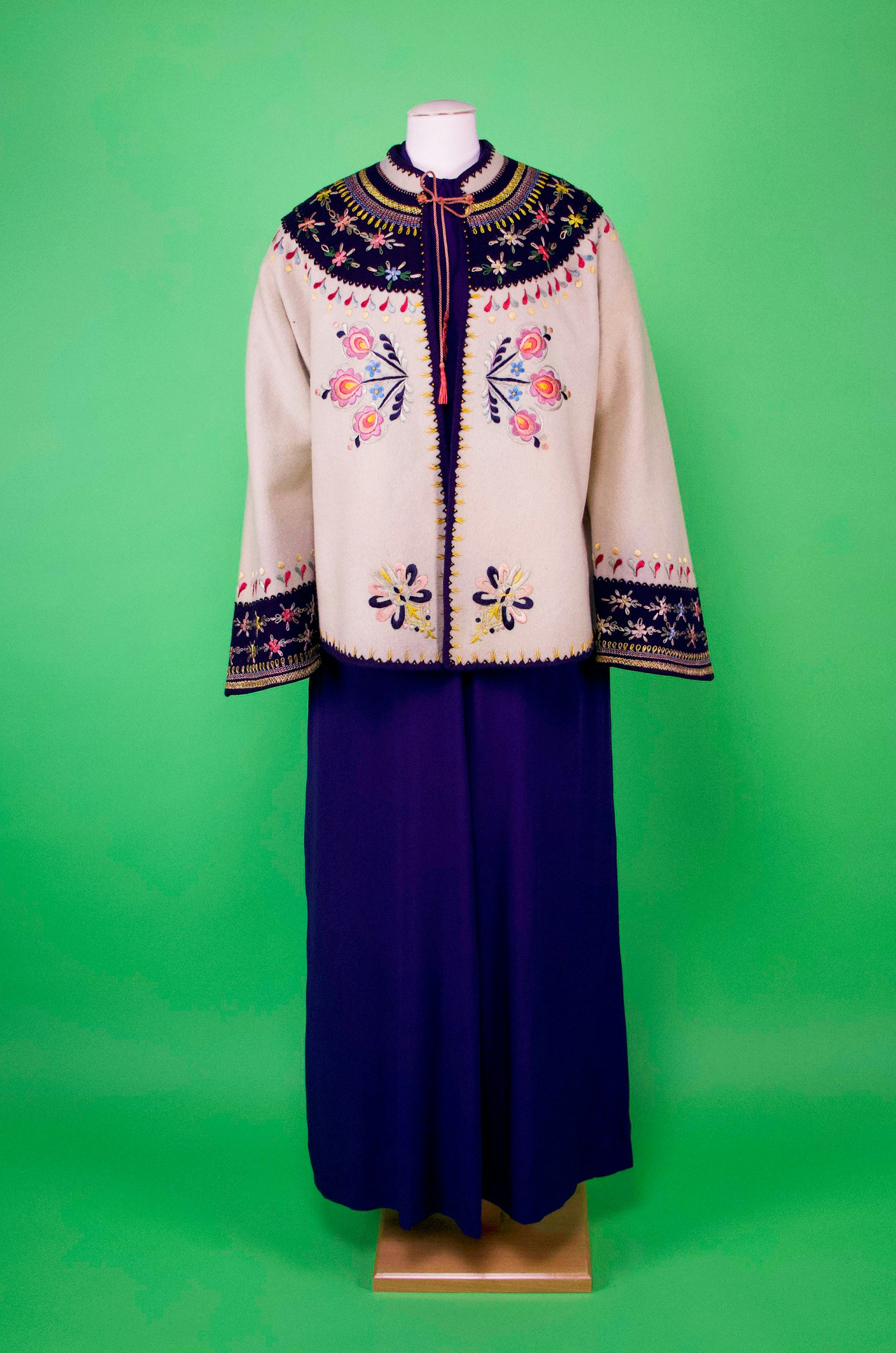
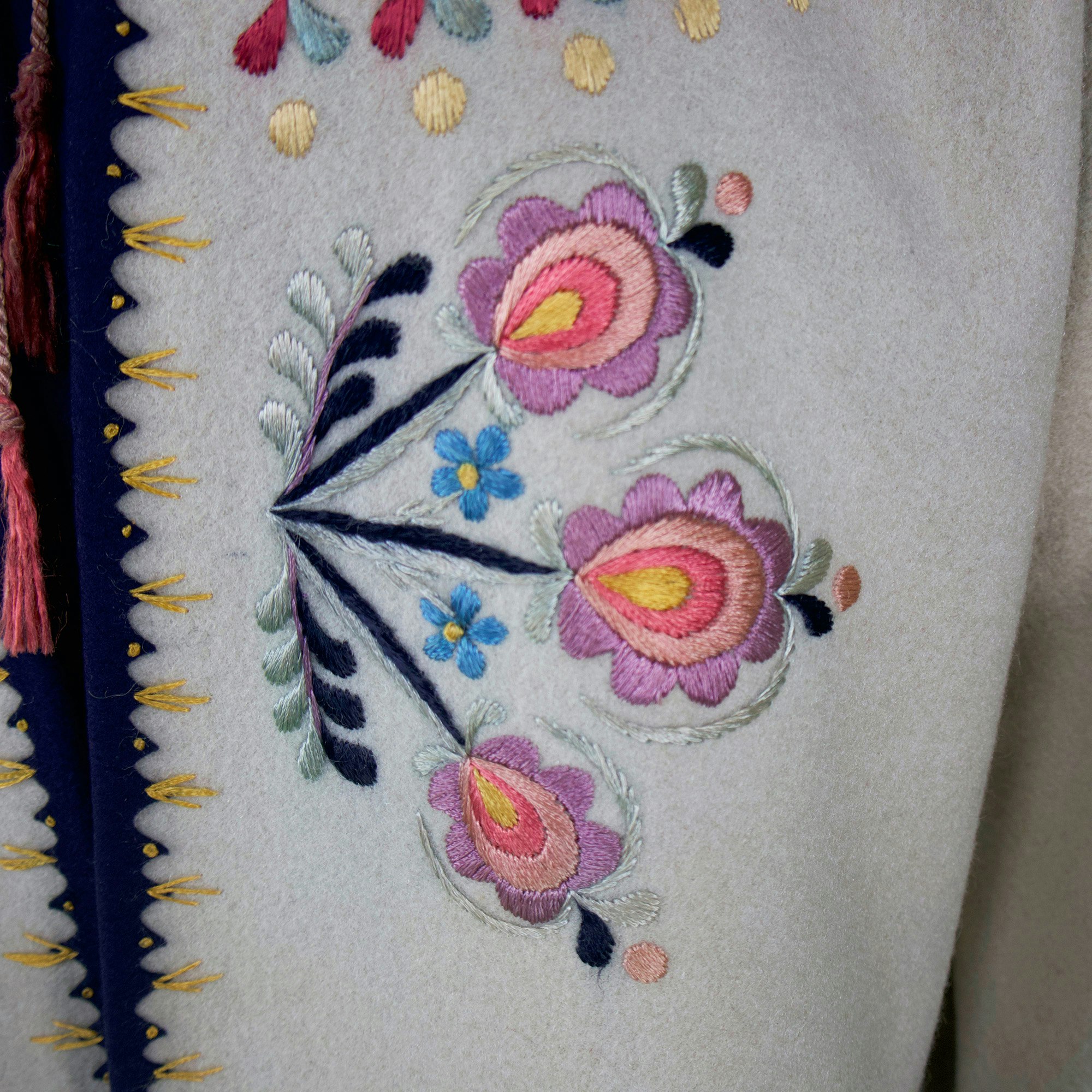
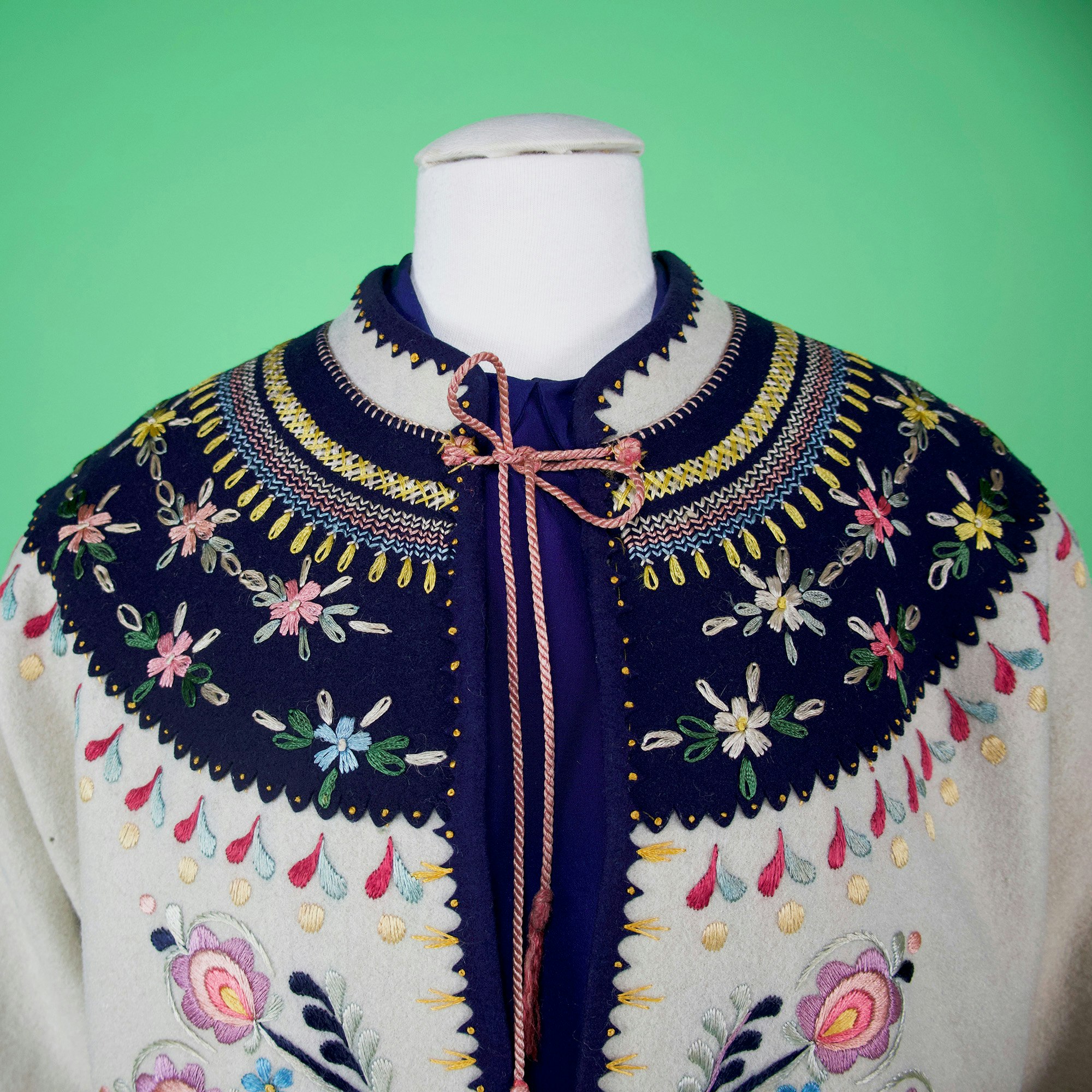
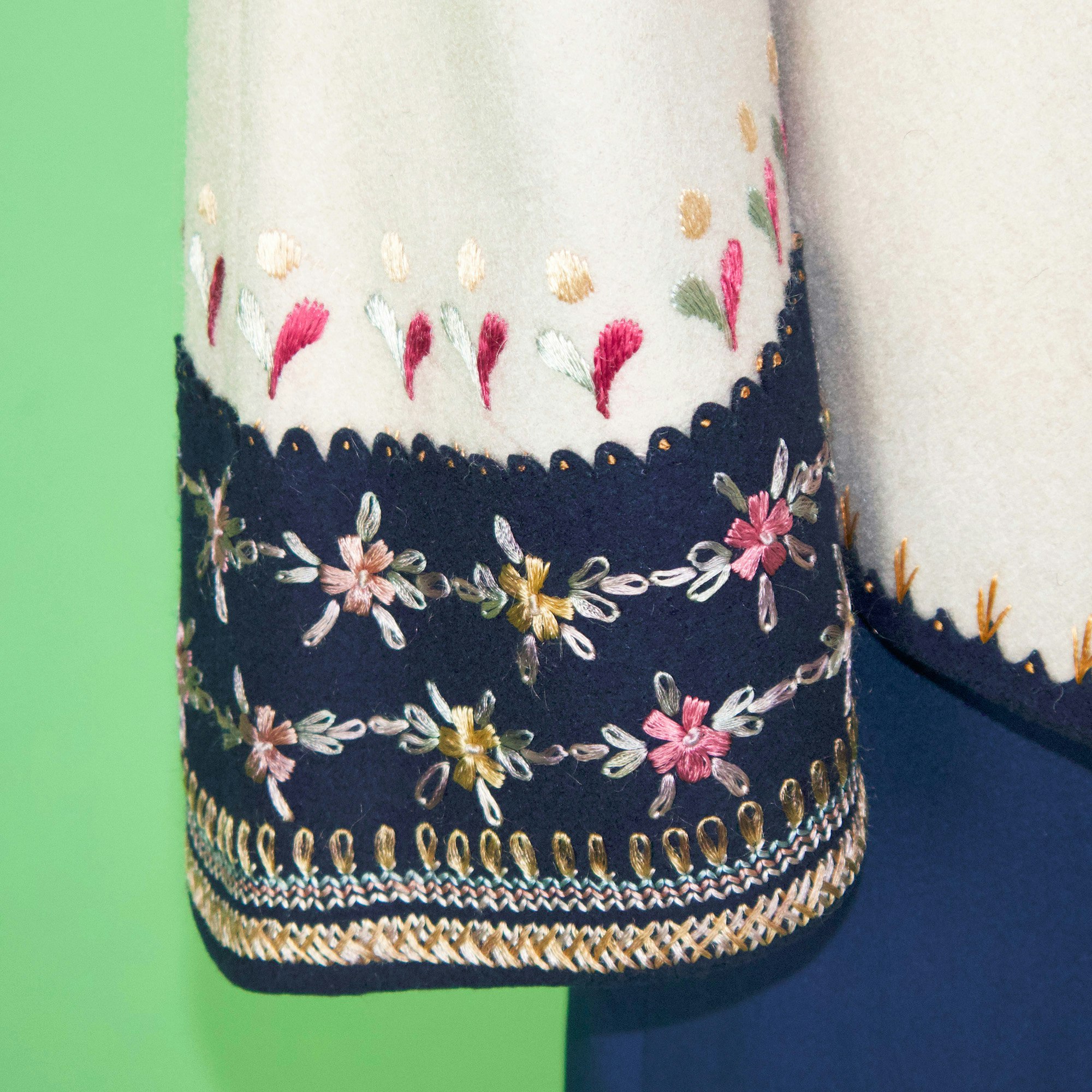
Phoebe also dressed the part for special occasions at the shop, especially during the Christmas season. One of her 1936 acquisitions was an embroidered Polish coat, called a cucha, worn by Górale men in the remote southern Podhale region. Traditionally, these coats were made of brown or white wool and colorfully embroidered, also with wool (see note 4). Too small to wear the adult-sized coats, Phoebe purchased a boy’s size for herself that features shaped blue wool felt appliqué embroidered with rayon floss using lazy daisy, blanket, satin, and straight stitches, as well as French knots. Upon her return, she collaborated with a local dressmaker, Miss Vilma of Braddock, on a custom-designed evening gown of blue silk to wear with the jacket. On other occasions, Phoebe wore traditional Swedish or Finnish ensembles, and she integrated hand-embroidered Romanian blouses into her wardrobe.
Click on each image to see more!
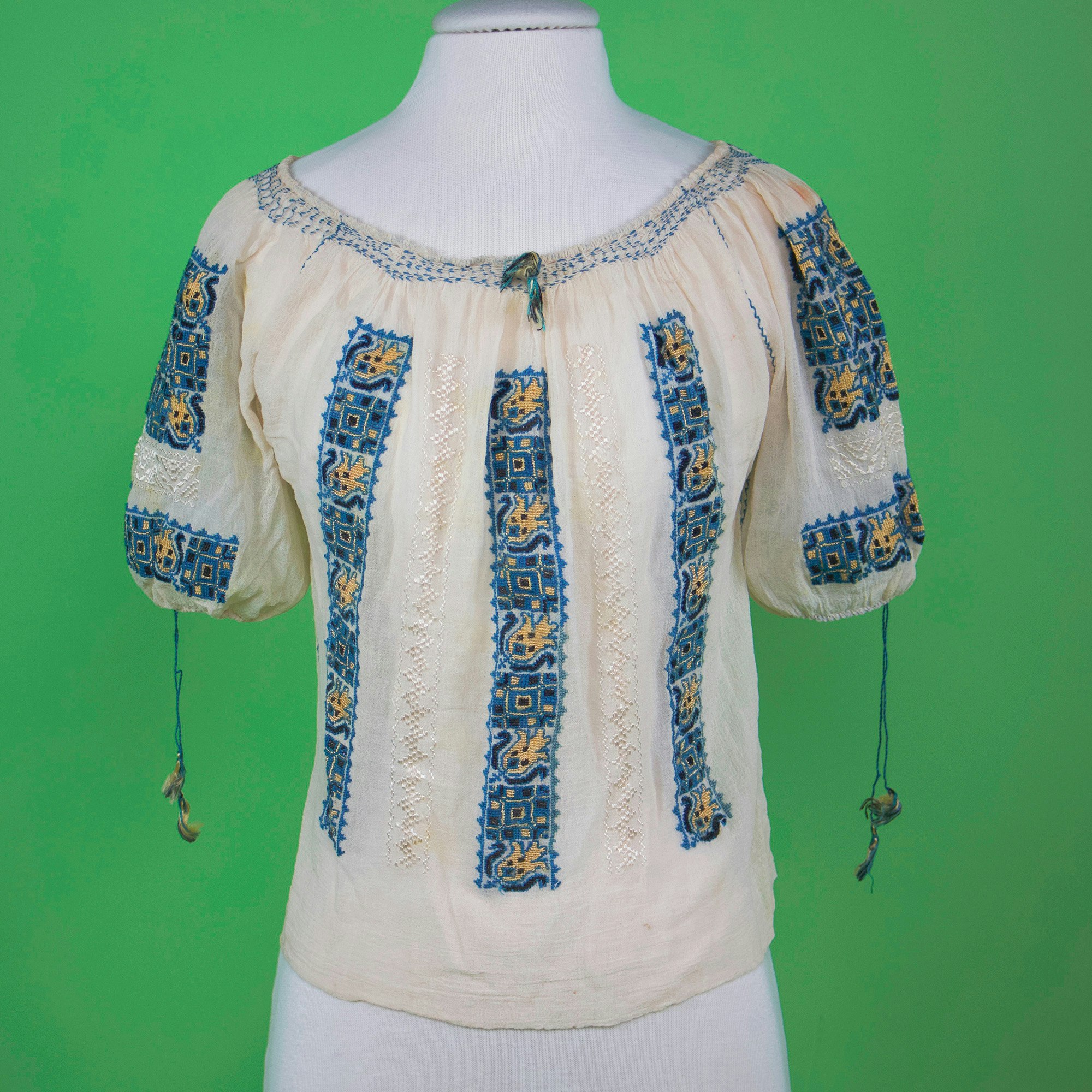
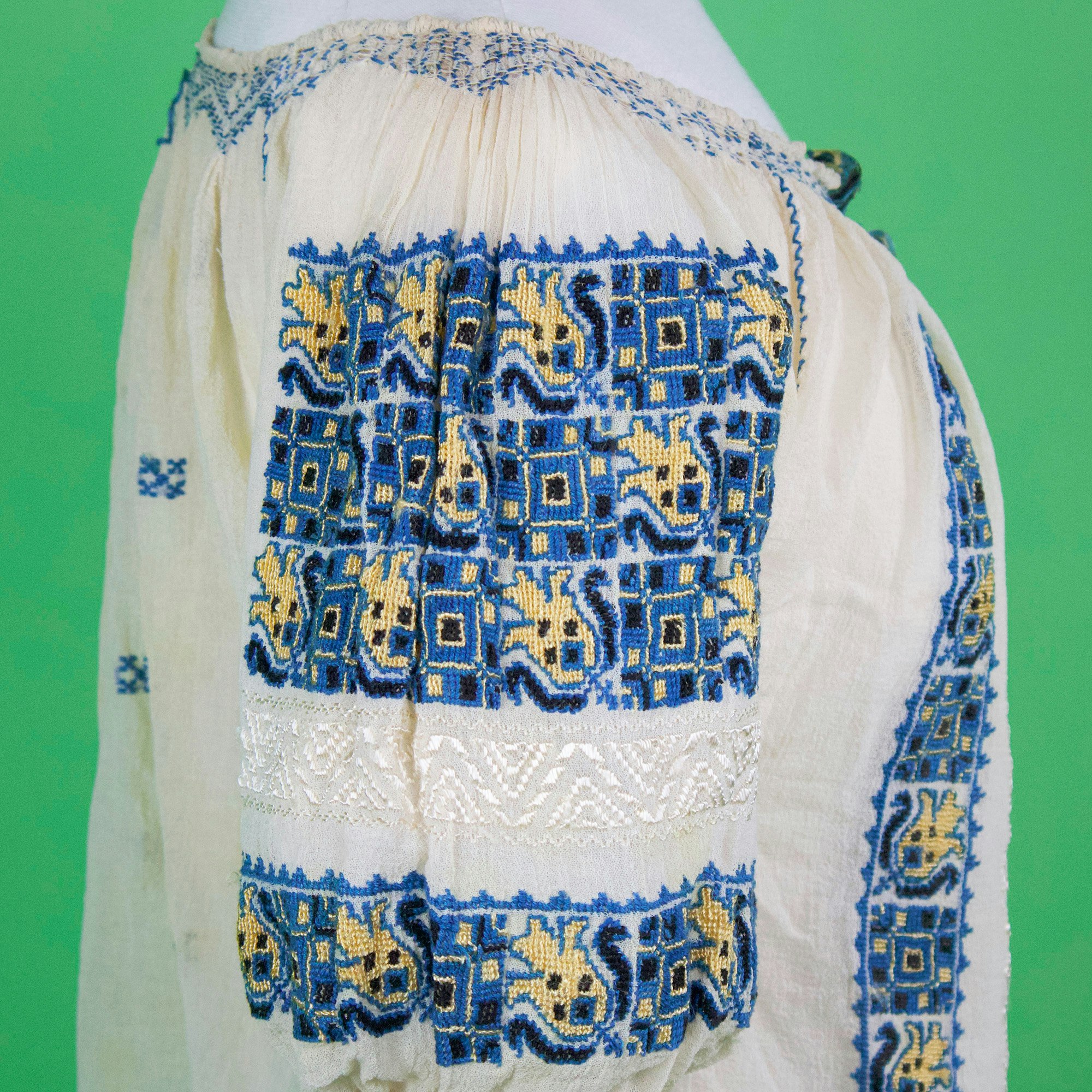
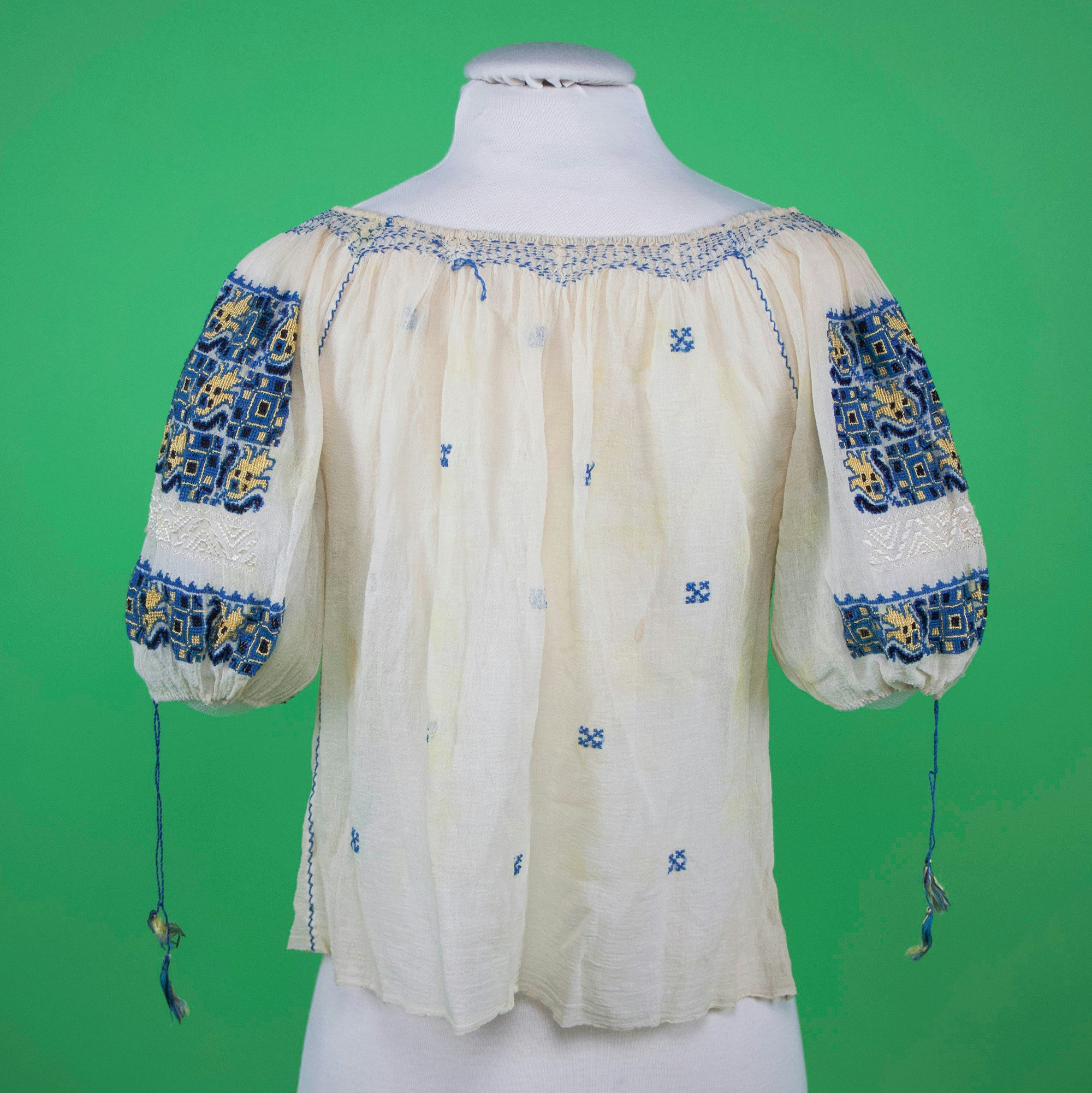
Folk Art at the Edge of War
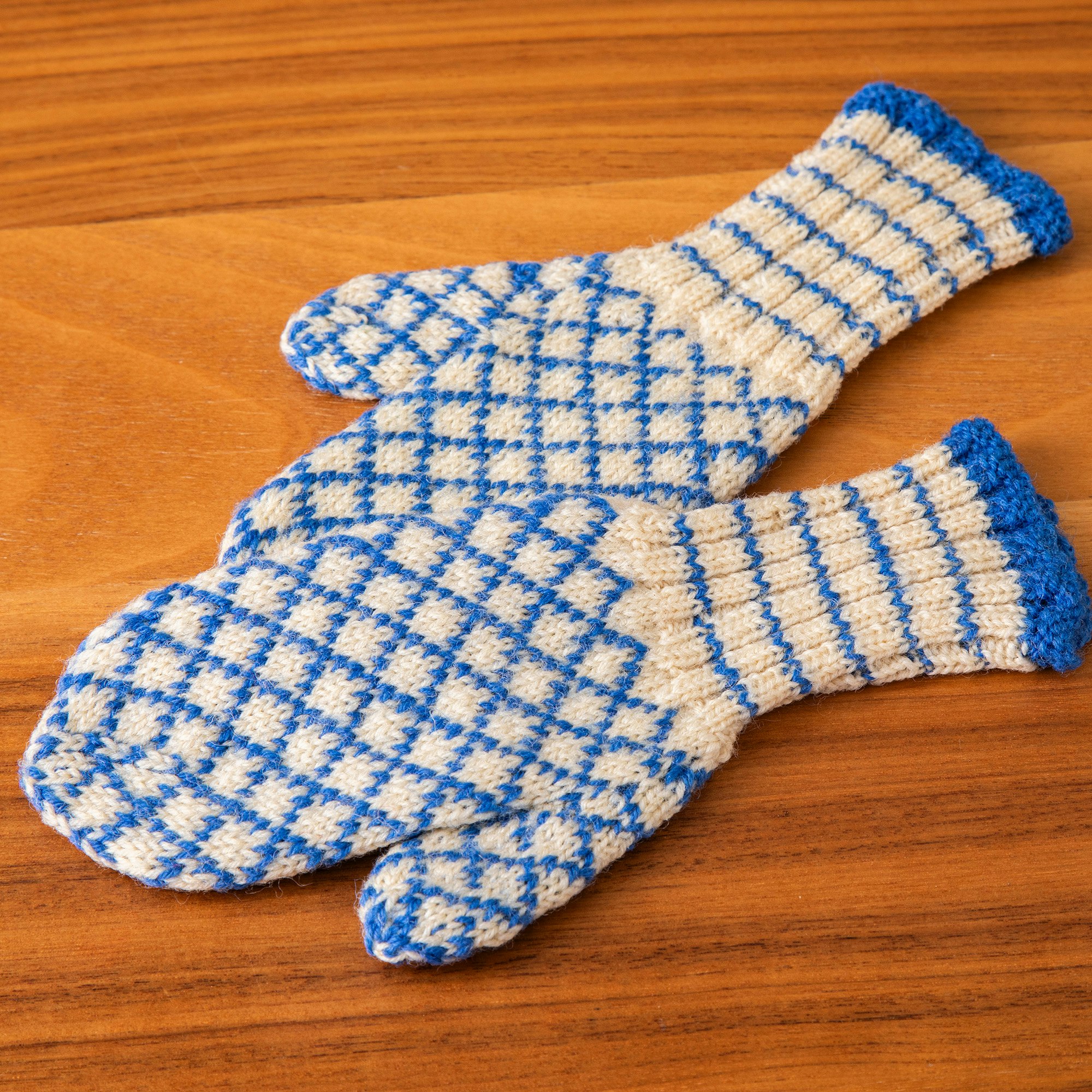
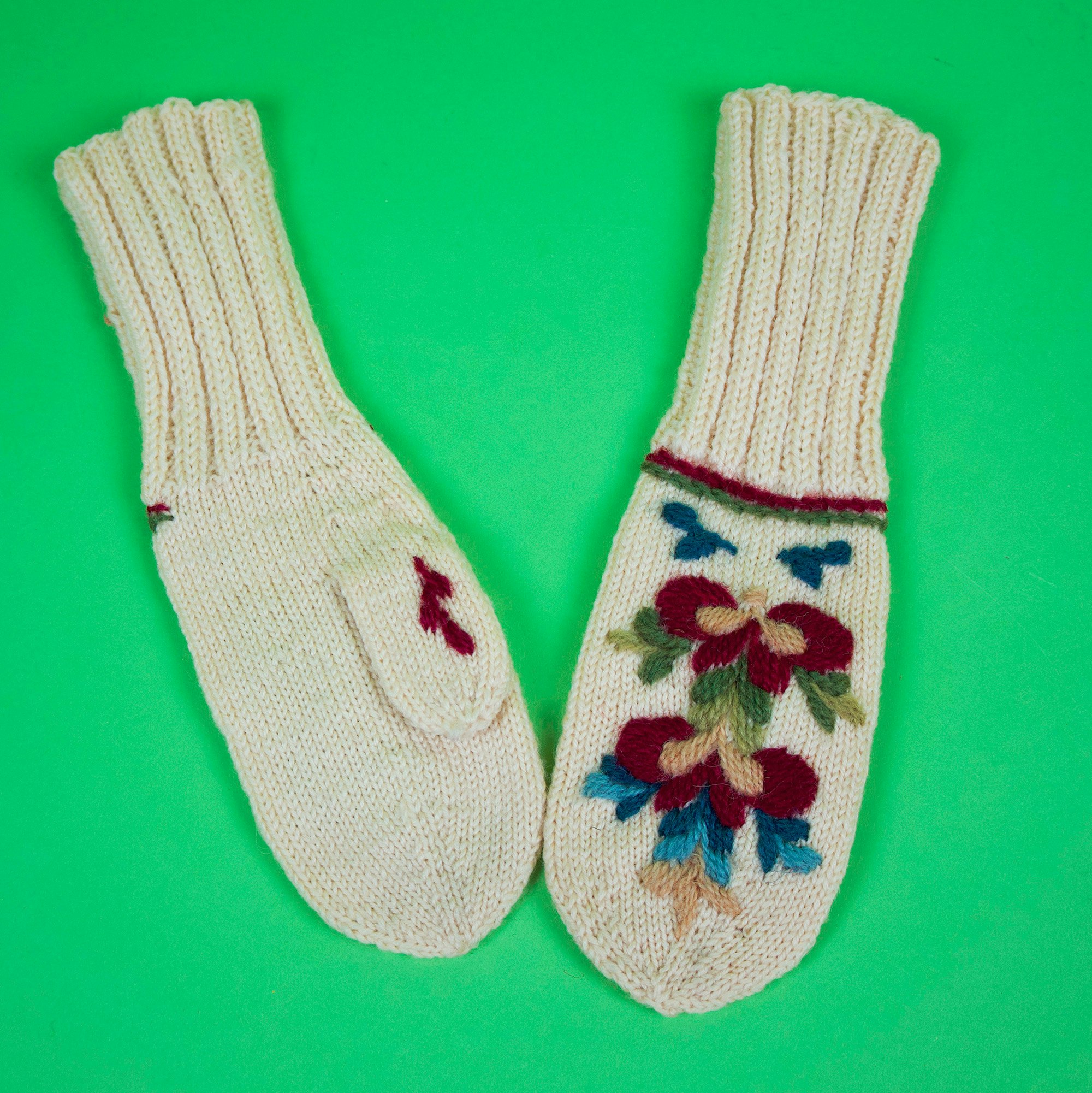
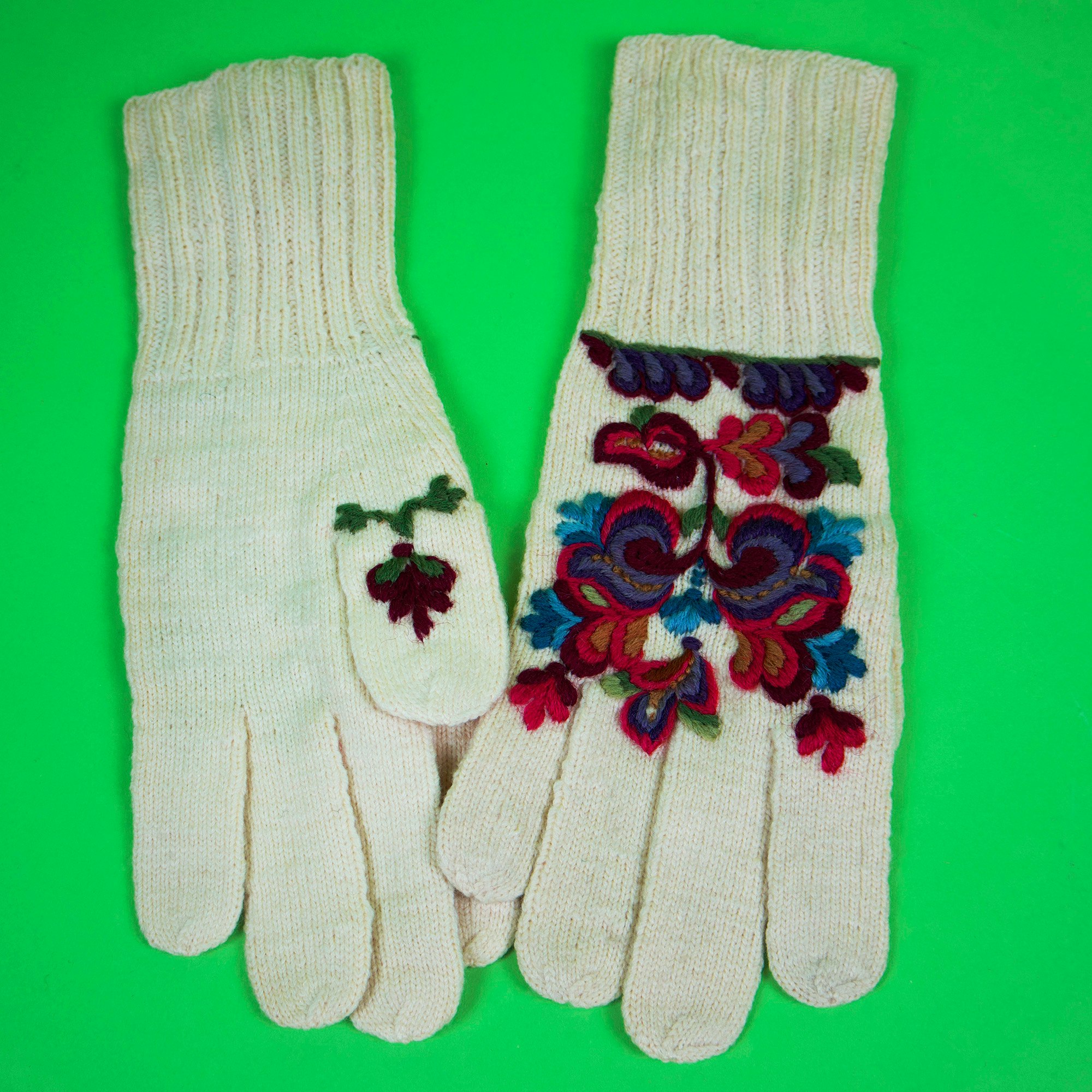
When she established her business, Phoebe had no way of knowing the clock was ticking in two ways that eventually forced her to close the shop’s doors. Indeed, women’s traditional gender roles and global politics collided almost simultaneously. Quietly at home on March 18, 1939, she married Ray W. Rugh Sr., a Boy Scout executive, and expectations that women fulfill a homemaking role provided the initial impetus for closing the shop. At the same time, the situation in Europe progressively deteriorated into open warfare that would have most certainly interfered with Phoebe’s supply lines. Germany had annexed Austria in March 1938 and had also staked its claim to the Sudetenland, a portion of Czechoslovakia with a large German population that Hitler claimed was being abused. The following September, Neville Chamberlain yielded to Hitler’s demands, famously declaring the agreement was “peace for our time.” Only the naive were fooled, and the infamous Kristallnacht occurred in November. While the war officially started with the September 1, 1939, invasion of Poland, where Phoebe’s European and business adventure began, military action had commenced years before. While Phoebe sold or gave away most of her stock, she retained items of sentimental value, including some folk costume items, but also several others. This included a pair of Finnish mittens and one pair each of Norwegian embroidered mittens and gloves.
Click on each image to see more!
The Finnish Mittens
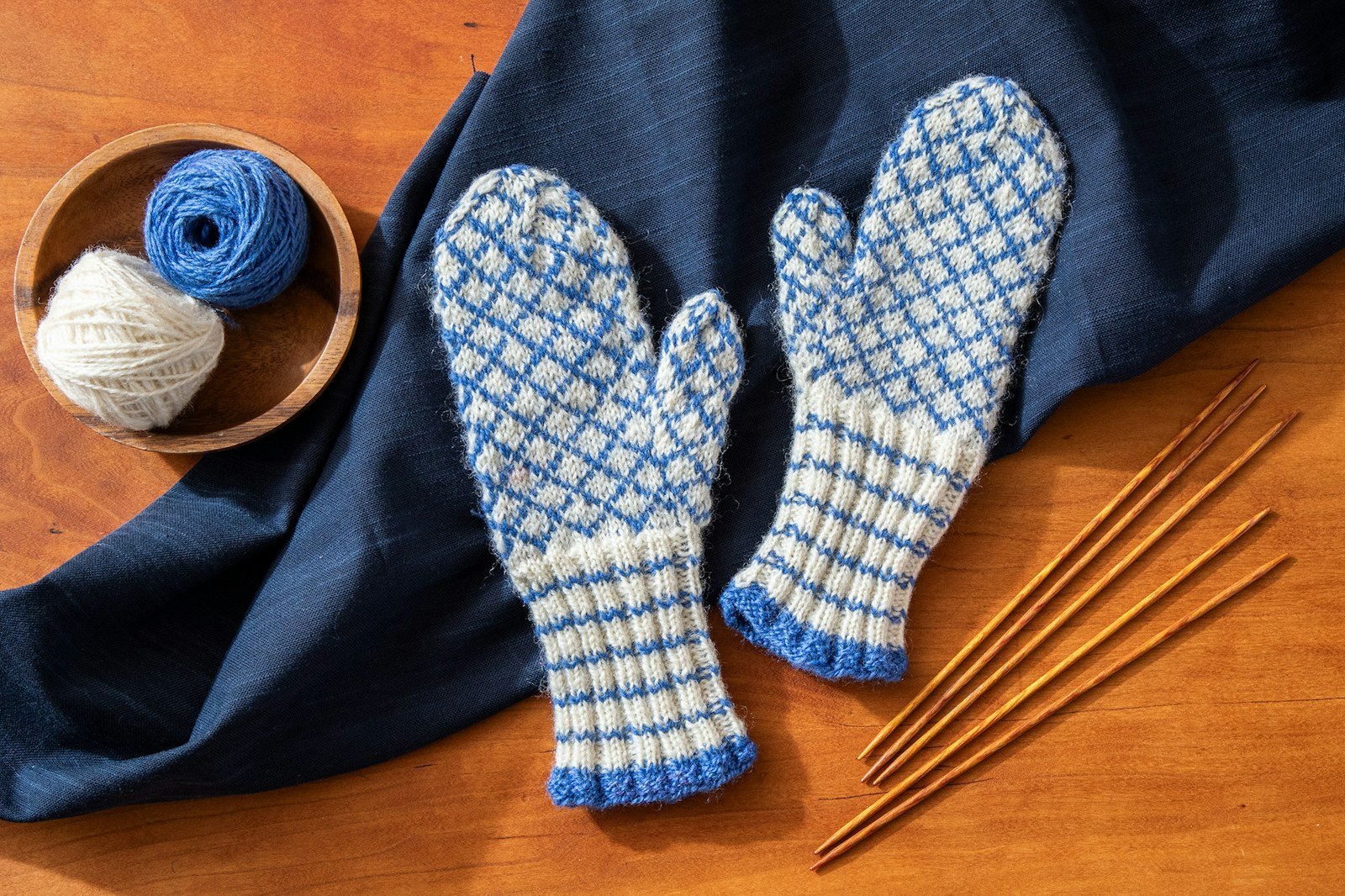
The Peasant Shop’s limited duration fixes these surviving artifacts in a narrow time frame, which is most helpful in dating items with designs often anchored in centuries-old traditions, but whose styles still subtly evolve. The Finnish mittens, whose exact arrival date in Pittsburgh is unknown, resonate within their contemporary context. On November 30, 1939, the Soviet Union invaded Finland with the intention of annexing it in what is now named the Winter War. Relations between the two countries had long been strained, and the Soviets had already been negotiating unsuccessfully regarding territories they wanted Finland to cede. Perhaps the rising tensions caused one Finnish knitter to express her patriotism through a pair of mittens in the colors of the Finnish flag, with its single cross transformed into a lattice pattern.
A Lifelong Maker
After her marriage, Phoebe relocated with her husband to Milton, Pennsylvania, where she remained the rest of her life. A flood in their home sometime in the 1940s destroyed most of her paintings; Phoebe resumed her artwork only in the 1960s. Tragedy struck her life again in 1948 when her husband’s sudden heart attack left her a widow with a daughter, Pat, to care for. To supplement her income, in 1953 or 1954, Phoebe took a clerical job in the Boy Scout office, which was her first paying job and the first organization to recognize that her deafness did not represent a reason to deny her the position. Subsequently, from approximately 1956 until her retirement in 1973, she worked as an acquisitions assistant at the Bucknell University library. She sewed and smocked dresses for both her daughter and granddaughter, and her knowledge of needlework and garment construction likely enhanced her appreciation of traditional needle arts and folk costume.
Despite the obstacles and hardships that she faced, Phoebe Henning Rugh never let them defeat her, and she continued to reinvent herself at every turn. She had her daughter, Pat, as well as her extended family and her artwork, and she surrounded herself with favorite folk-art items saved from her shop. They probably reminded her of not only her time in prewar Europe and the friendships she developed but also of the energies she poured into her import business. In this regard, she serves as a reminder of the healing qualities and opportunities that creative work and traditional needlework and art forms offer us all.
Notes
- I would like to thank Pat Mahan, Phoebe Henning Rugh’s daughter, for generously sharing the details of her mother’s life.
- Wikipedia, “Maria Werten,” last modified December 13, 2023, pl.wikipedia.org/wiki/Maria_Werten.
- Polk’s Pittsburgh City Directory, vols. 80–82 (R. L. Polk, 1936–1938).
- Anita Broda, “Highlander Dress from the Podhale Region,” Encyclopedia of World Dress and Fashion, vol. 9, East Europe, Russia, and the Caucasus, ed. Djurdja Bartlett (Oxford University Press, 2010), 219.
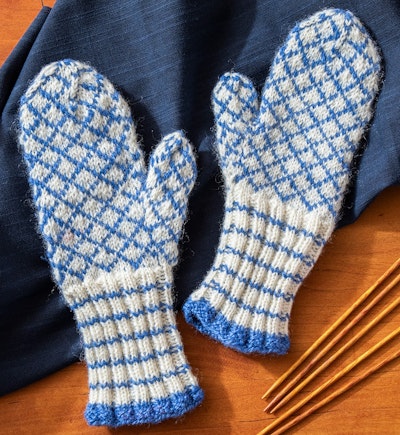
Would you like to knit a pair of Finnish mittens just like those in Phoebe's Peasant Shop collection? PieceWork's assistant editor Katrina King has created a pattern inspired by the originals.
All Access subscribers can log into the library to download the pattern here!