
Contents
Lace is genuinely having a moment right now, which pleases me no end. I especially love seeing a keen interest in bobbin lace and watching how more curious newcomers and lacemakers are embracing it. For all those bobbin lace fans, we’re sharing this article about Honiton lace from our July/August 2014 issue in its entirety. At the end of the article, you’ll learn more about the new Bobbin Lace Pattern Pack to help you explore the wonderful world of bobbin lace even further.
—Karen Elting Brock
Floral Bobbin Lace
Honiton lace is a noncontinuous floral bobbin lace that originated in Devonshire, England. Much of the lace made in Devonshire was collected and sent from the Honiton stop on the coach line to London for sale. Because the London dealers then asked for "boxes of Honiton lace" from the coach line, the name became associated with the lace.
Honiton lace is made on a cylindrical pillow densely stuffed with straw to form slightly domed top and bottom working surfaces. Lightweight bobbins with pointed tails are wound with fine cotton thread and manipulated over and under each other to form the stitches of the lace. Fine pins placed in the holes of a pattern (called a "pricking") under the work support and position the threads of the lace as it is worked.
Honiton lace was classified according to the method of joining motifs. Motifs were joined by varying amounts of bobbin- or needle-made mesh, depending on the time period. In Honiton Appliqué, bobbin-made motifs were sewn onto hand- or machine-made nets. Honiton Guipure was developed by connecting motifs with brides (bars) worked as bobbin-made plaits or narrow bands, sometimes picoted. In the early twentieth century, an attempt to mimic Honiton lace resulted in machine-made tapes joined by hand stitches; these were known as Ideal Honiton, Honiton Point Lace, or simply Honiton, thoroughly obfuscating the distinction between the original bobbin lace and the craft lace.
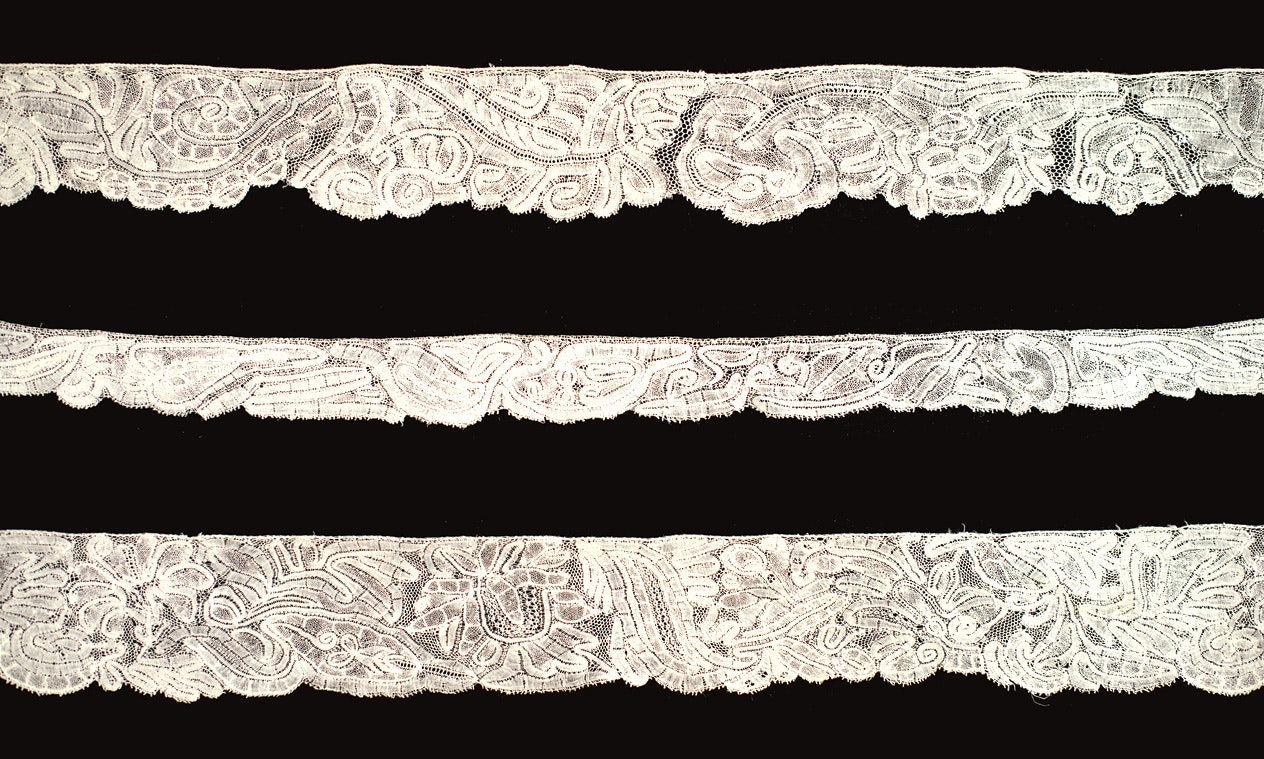
Early Devon lace was dense, with the net following the lines of the motifs. England. Early eighteenth century.
The Mysterious Origins of English Lacemaking
How or when lacemaking began in England is unknown. We know from portraiture that garments from about 1560 on were embellished increasingly with lace. Linen cutwork was popular, and narrow plaited bobbin laces were made of linen, silk, or precious metals following geometric designs. Bone lace appears often in the wardrobe accounts of Queen Elizabeth I (1533–1603), but whether the term refers to lace constructed with bobbins made of bone or to the use of fine fish bones as pins is uncertain.
The trade routes from Venice to London are well known, and techniques of the old Italian laces are noted in the seventeenth-century laces of England. Some writers theorize that lacemaking came to England with immigrants escaping religious persecution in Germany or Flanders, beginning in 1567, but the Devon historian H. J. Yallop disputes these claims, linking bobbin lacemaking with the established weaving industry of Honiton.
Whatever its origin, the lacemaking industry was well established in seventeenth-century England.
- In the 1620s, a note written by Elizabeth Isham (1609–1654) to her father in Northamptonshire included five samples of locally made narrow lace suitable for collars. Elizabeth's diary for 1629 records that she learned to make bone lace.
- An inscription on a tombstone for James Rodge (unknown–1617), a bone lace dealer in Devonshire, indicates that the Honiton lacemaking industry also was thriving. He was wealthy enough to leave 100 pounds (worth about $25,000 today) to the parish poor when he died.
- Sizable bequests by two other lace dealers, Mrs. Minifie (dates unknown) and Thomas Humpfrey (dates unknown), in 1617 and 1658, respectively, also support the notion that lace was profitable.
An increasing amount of lace imported into England from the Continent caused restrictions to be put in place in 1635 to protect English lacemakers.
Seventeenth Century
Later in the seventeenth century, lace made in Honiton evolved as a "pieced" lace, in which motifs were worked with the clothlike whole stitch and shading was done with the more open half stitch. The Art Institute of Chicago has two pieces of English lace dated 1661 with the inscription "Vive le Roy [Long live the King], Carolus Rex [King Charles], C.B. Baronet, and Cl661B." C.B. is likely Sir Copleston Bampfield (1638–1692), a supporter of King Charles II (1630–1685), who appointed Bampfield High Sheriff of Devon. The lace is thought to have been commissioned from local lacemakers for the sash that Bampfield wore in honor of his appointment.
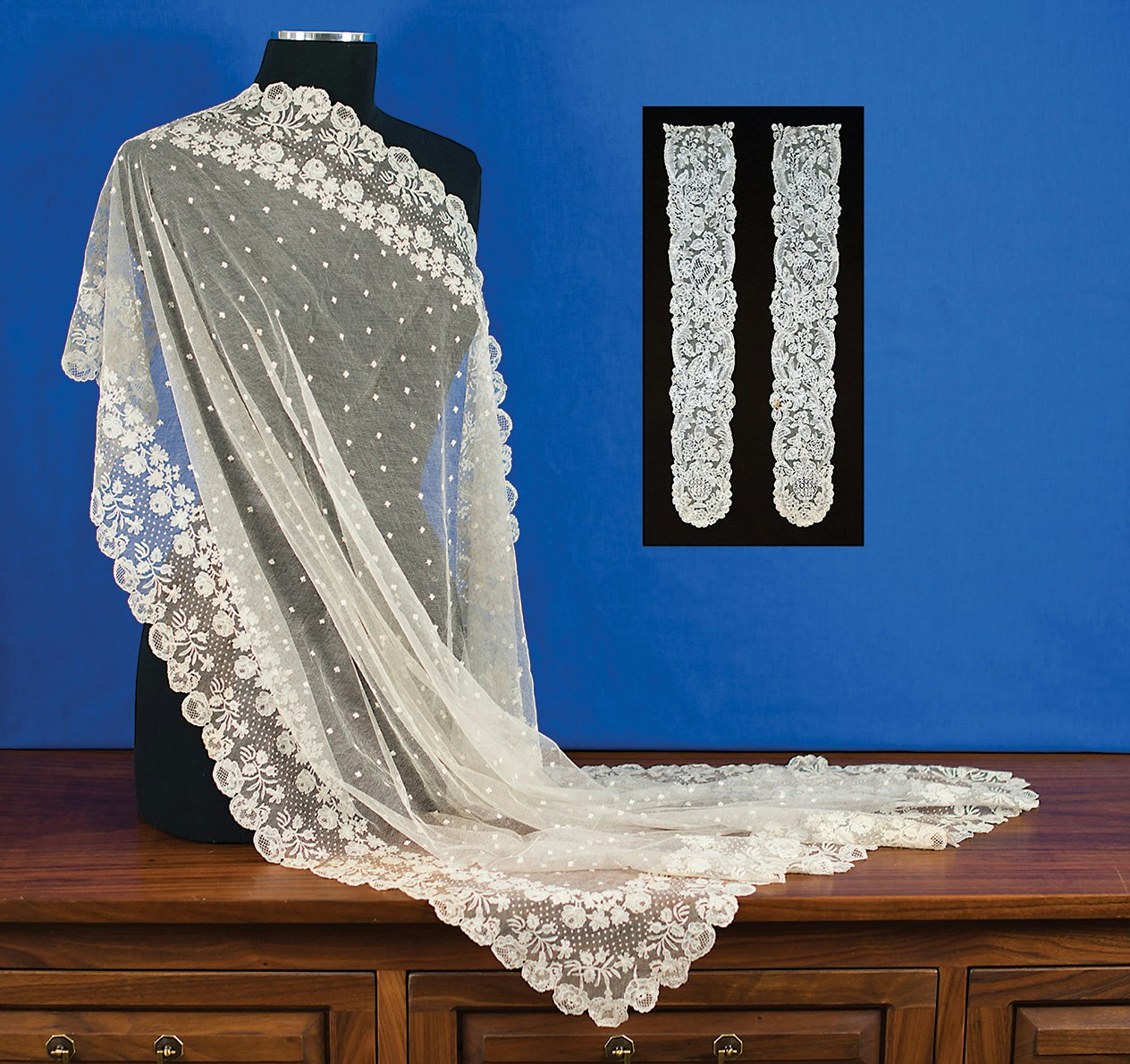
Two mid-eighteenth-century Honiton lace lappets (right) with straight Droschel ground and an appliqué veil (left) on handmade Droschel ground, purchased in London around 1840. It can be difficult to tell nineteenth-century English products from Belgian.
Eighteenth and Nineteenth Centuries
Designs for lace continued to evolve during the eighteenth century. Early Honiton pieces were dense, with little space between the motifs. As mesh grounds evolved, they initially followed the outline of the motifs. Later, like work done in Belgium, the mesh ground was made in straight lines along the length of the work, and motifs contained increasingly elaborate filling stitches. As the eighteenth century progressed, lace became light and airy with smaller motifs, in keeping with the fashion of the time. Appliquéd motifs on large pieces of handmade net appeared toward the end of the century.
At the beginning of the nineteenth century, bobbin-made net continued to be used to join the Honiton lace motifs, but it was costly. Lacemakers reportedly were paid as many shillings as would cover the net they produced. In 1800, an 18-inch (45.7-cm) square cost about 15 pounds ($1300 in today’s dollars). A shift from handmade net occurred in 1816, when John Heathcoat (1783–1861) established his factory in Devon and lacemakers began appliquéing the motifs to the new machine-made net. The last lace with bobbin-made net was produced in Devon in 1869.
The Honiton lace industry experienced an upswing in 1839 when Queen Victoria (1819-1901) started to patronize the industry. Jane Bidney of Beer supervised more than 200 lacemakers who worked for nine months to produce a flounce for the queen that measured ¾ yard (0.7 m) deep and 4 yards (3.7 m) long. The lace was bobbin-made sprigs mounted on machine net. After her engagement was announced in October 1839, the queen ordered a matching bertha (collar), sleeve flounces, and a veil to complete her wedding dress. These major pieces were finished in time for the February 10, 1840, wedding. The queen continued to wear her wedding laces at events throughout her life, including her Diamond Jubilee celebration in 1897.
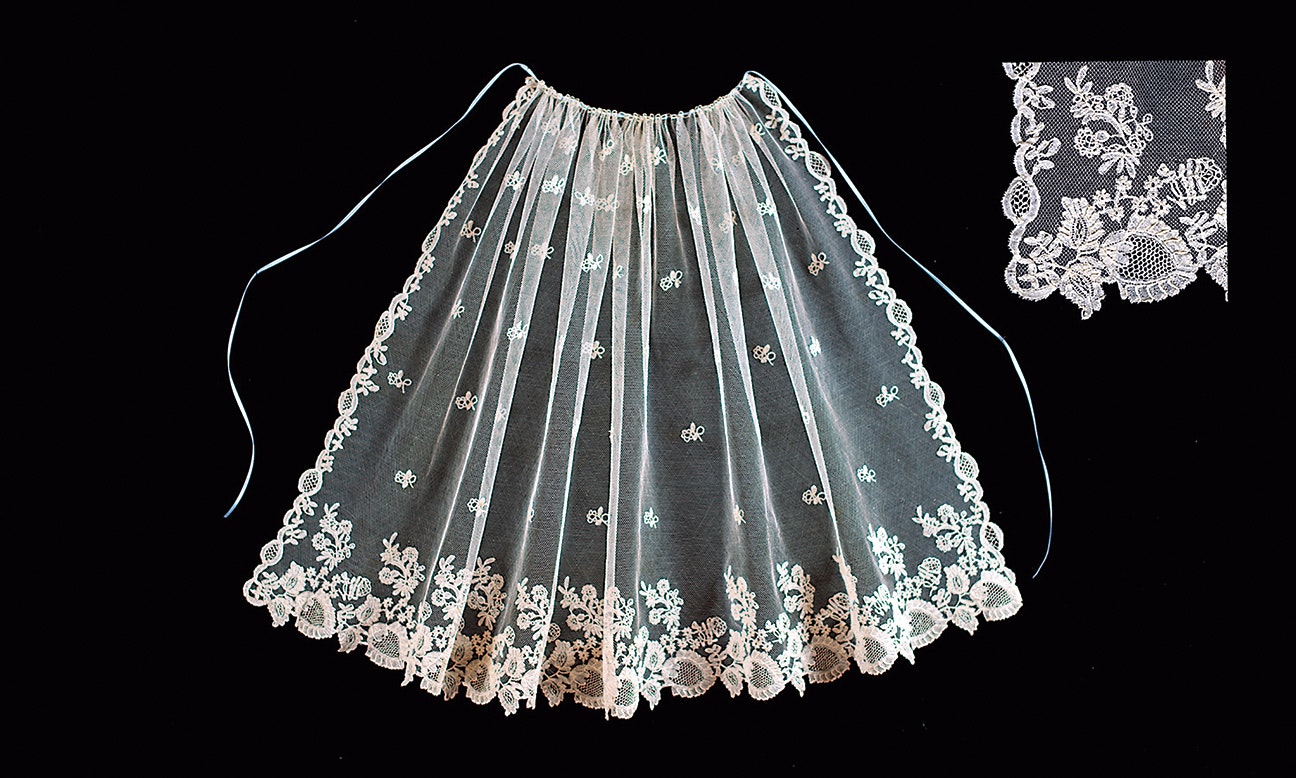
Honiton bonnet veil (left) and detail of the Honiton lace bonnet veil (upper right). Machine-made net was introduced in the early nineteenth century. Honiton motifs were appliquéd to the net to create light, airy lace. Nineteenth century. England.
Charlotte Elizabeth Treadwin (1821-1890) was a well-known lace dealer in Exeter, beginning in 1840. She, along with the Chick and Tucker families from Branscombe, was committed to producing exhibition-quality lace. She worked with design schools in an effort to improve Honiton design and received several royal orders and commissions for her award-winning work. In addition to making and selling lace, Mrs. Treadwin trained lacemakers and even patented ground stitches for the lace. She was possibly the most important influence on the nineteenth-century Devonshire lace industry.
During the mid-nineteenth century, the appliqué technique continued alongside the bride-grounded guipure form, which used bobbin- and occasionally needle-made grounds. A heavier "gimp" or "coarse thread" was introduced to outline the motifs. Raised work, using narrow bands of cloth stitch along the edge of motifs known as "ribs" or bundled threads known as "rolls" were introduced. Typical motifs of this period included roses, thistles, other flowers and leaves, birds, bees, and butterflies. Undulating shells that spiraled in the design also were common and related to the earlier eighteenth-century scrolls. Relief work with three-dimensional motifs, including flower petals and butterfly wings, was promoted in a book published in 1875 by a Miss E.W. Jones (dates unknown), writing under the pseudonym "Devonia." The demand for lace was strong in the mid-nineteenth century, and as lacemakers called for designs that could be executed quickly and easily, designs began to deteriorate and artistic quality diminished. Workers referred to the sloppy motifs as "turkey tails, frying pans, snails, or slugs.” Alan Cole (1846–1934), director of the South Kensington Museum (now the Victoria and Albert Museum) reported to the House of Commons in 1888 that Honiton lacemakers took their design ideas from "wall paper, table cloths, anything.”
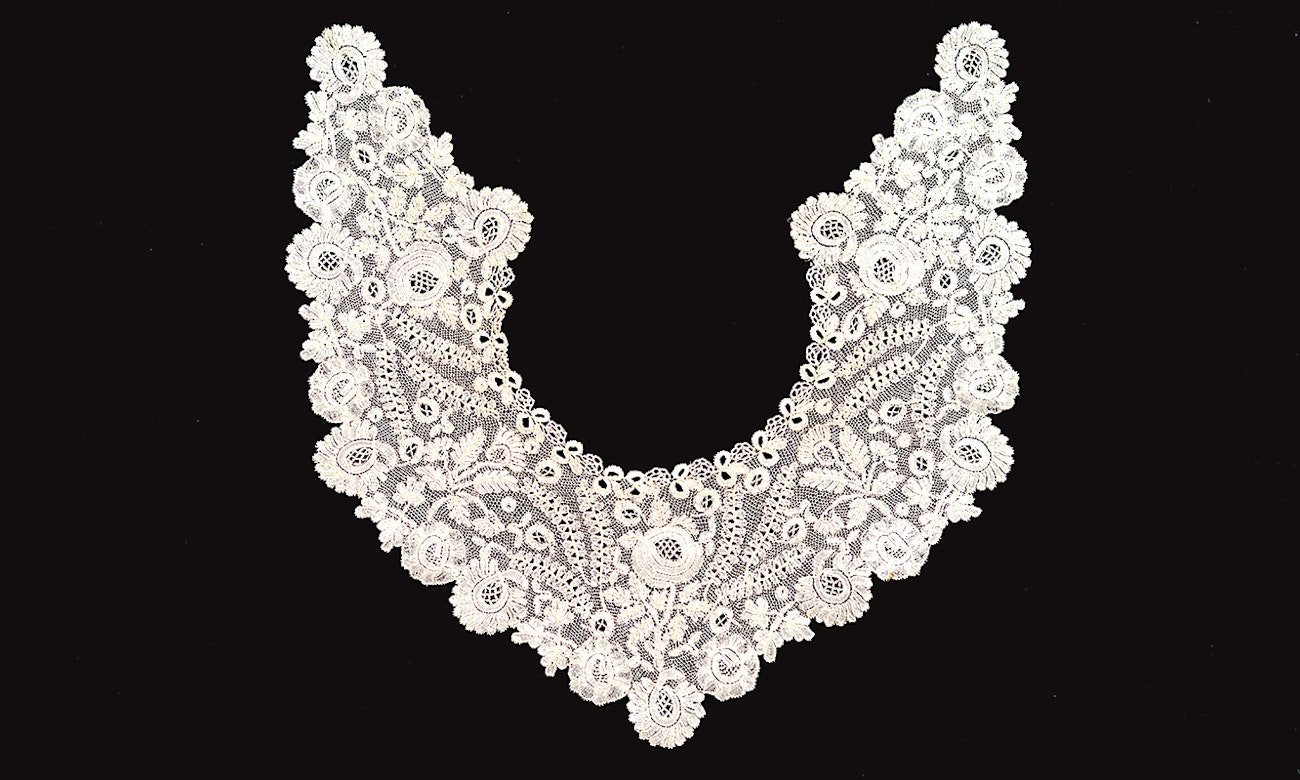
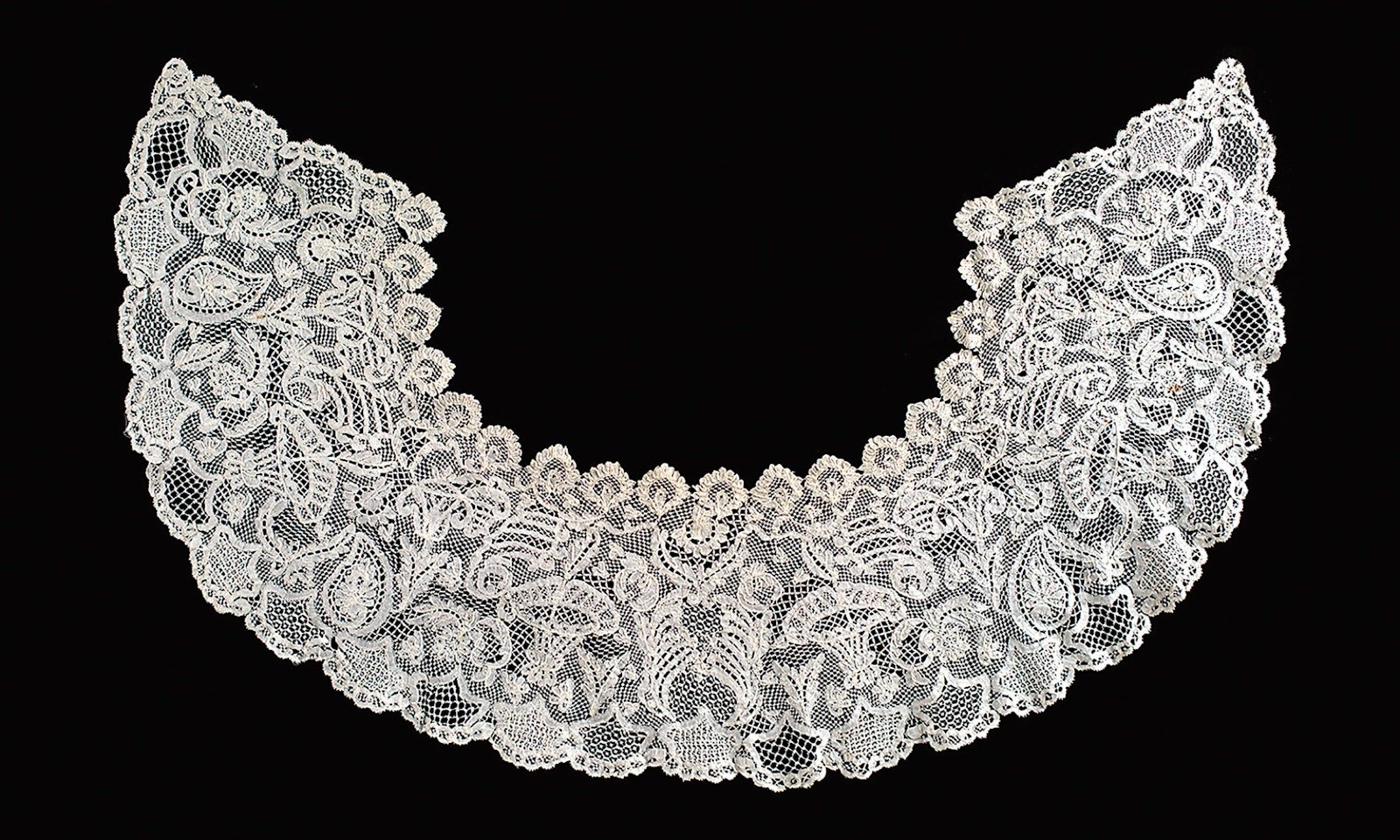
Naturalistic Honiton lace collar with a needle-made ground from the mid-nineteenth century.
The Honiton industry always was subject to the whims of fashion, and machine-made lace became increasingly competitive. By World War I (1914–1918), the handmade lace industry had come to a close, although various lace dealers continued to promote Honiton lace. Mrs. Ann Fowler (1839–1929), a well-known lacemaker, operated a shop in Honiton in the early twentieth century.
In the late twentieth century, Jonathan and Jane Page, owners of the Honiton Lace Shop, collaborated with historian H. J. Yallop, curator of the Allhallows Museum in Honiton, which opened in 1946 and has an extensive lace collection, to raise awareness of the importance of Honiton lace. Their work resulted in renewed interest in Honiton lace.
All Access subscribers can download the pattern pack from our library. The Honiton and Bucks Point Bobbin Lace Pattern Pack includes:
- Honiton Bobbin Lace Motif eBook + Project
- Bonus Deep-Dive: Bucks Point Lace Article
- A Bucks Point Bobbin-Lace Edging Project
Not yet a subscriber? Learn how to join the community here.
Resources
- Allhallows Museum
- "Devonia" Honiton Lace-making. 1875. Reprint, Charleston, South Carolina: BiblioBazaar, 2012.
- Dye, Gillan. The Isham Samples and Other Linen Edgings: Sixteenth & Seventeenth Century Lace, Book 2. Glasgow, Scotland: Cleveden Press, 2012.
- McFadzean, Carol. Mrs. Treadwin: Victorian Lace Maker, Designer & Historian. Exeter, England: Carol McFadzean, 2009.
- The Devon Lace Teachers. Honiton Lace: A Collection of Rediscovered Fillings. Exeter, England: Short Run Press, 2012.
- Yallop, H. J. The History of the Honiton Lace Industry. Exeter, England: University of Exeter Press, 1992.