
Contents
Most of us know George Washington Carver (about 1864–1943) as the famous African American agronomist from Tuskegee Institute (now Tuskegee University) who spent his career working to improve the lives of poor Southern farmers. But as a young man, Carver envisioned himself becoming a professional fine-art painter and enrolled in college as an art major in 1890. Because of his talent for painting flowers and plants and because of the well-established stereotype of a struggling artist, Carver’s art instructor convinced him to change his major to botany. Carver went on to dedicate his life to serving struggling rural families by teaching sustainable agricultural methods, introducing new crops and developing new markets for them. Still, Carver never abandoned his artistic interests, especially painting and crochet, continuing to pursue them as personal pastimes throughout his lifetime.
Beginnings
George Washington Carver had an unusual childhood. He was born near the end of the Civil War to Mary, an enslaved woman, whose owner, Moses Carver, didn’t approve of slavery (see note 1). Moses and three brothers had moved to Diamond Grove, Missouri, in 1838. It was near there that Moses and his wife, Susan, settled. When his widower brother Richard died shortly after arriving in Diamond Grove, Moses and Susan took in his three children, having none of their own. These children grew up helping with the farm work but by 1860 had moved out leaving an aging Moses and Susan with no help on a 240-acre farm. Hired help was scarce. Anyone with an interest in farming could just move a little farther west and homestead their own place. Moses was able to hire one man but couldn’t find help for Susan, so Moses resorted to buying Mary from a neighbor.
The Civil War was a lawless time in southwest Missouri. Shortly after George’s birth, raiders descended on the Carver farm and kidnapped Mary and George, probably with the intent of selling them to slave owners farther east. Moses hired John Bentley, a Union scout in nearby Neosho, to bring them back. Bentley found George abandoned by the kidnappers but didn’t find Mary. George had contracted whooping cough and was nearly dead when Bentley returned him. Susan nursed George back to health, but he was small and sickly throughout his childhood.
With the disappearance of Mary, Moses and Susan cared for the orphans—George and his half-brother, Jim. Jim, being older and of a rugged build, helped Moses with the heavier farm chores. George’s health concerns often left him confined to the house. He watched Susan do household chores and helped her when he could, becoming proficient in cooking, laundry, and needlework.
 George Washington Carver standing in a plowed field, likely at the Tuskegee Institute, holding soil in 1906. Photo by Frances Benjamin Johnson, Booker T. Washington Collection. Courtesy of the Library of Congress, Prints and Photographs Division
George enjoyed needlework and pursued it as a pastime. As he stated in a 1931 letter to Isabelle Coleman, “If I had leisure time from roaming the woods and fields, I put it in knitting, crocheting, and other forms of fancy work (see note 2).” All of these skills he picked up at a young age (he only lived with the Carvers until he was eleven years old) and sometimes in the most unorthodox ways. George watched Susan knitting and decided he wanted to try. Apparently, Susan’s needles were either all in use or he wasn’t permitted to use them, so he stripped the barbs from two turkey feathers, leaving a little tuft at the tips. Then, he raveled the tops of an old mitten and sock, and he began knitting a strip with colored stripes (see note 3).
George found crochet even more fascinating than knitting. The Carvers were frugal, buying little in town except sugar and coffee, but the boys were allowed to take turns accompanying Moses on his twice-yearly trips to Neosho. George might be given a little spending money, and on one trip, he bought a steel and bone crochet hook (see note 4). George could barely read and had no pattern books, but he must have had some brief instruction combined with experimentation. Mariah Watkins, with whom Carver would board from age eleven to twelve, commented, “He could walk uptown and see a set of collar and cuffs on a woman’s dress, come home, and crochet the same (see note 5).”
Education
George began his formal education at home. As George recalls in a 1922 letter, “Mr. and Mrs. Carver taught me to read, spell and write just a little” (see note 6) using a blue back speller, (see note 7) which was the only book in the Carver home. “From a child I had an inordinate desire for knowledge, and especially for music, painting, flowers and the sciences . . . Mr. and Mrs. Carver were very kind to me and I thank them so much for my home training. They encouraged me to secure knowledge helping me all they could, but this was quite limited. As we lived in the country no colored schools were available so I was permitted to go 8 miles to a school at town (Neosho)(see note 8).”
Stephen Frost, George’s Black teacher at the Neosho Colored School, had little more education than young George himself. George soon left Neosho seeking further education. For several years, he moved from one town to another through Missouri, Kansas, and Iowa, searching for schools with more advanced curriculums that would accept him. He supported himself and paid for school expenses with the domestic skills he had learned. “I had become more or less skilled in all kinds of homecrafts, such as cooking, laundrying [sic], and many kinds of fancy work. I found employment just as a girl (see note 9).”
The year 1889 found George Washington Carver, now a man in his late twenties, in Winterset, Iowa, opening a laundry. With the encouragement of friends in Winterset, Carver began saving money to once again enroll in school, this time at Simpson College in Indianola, Iowa, 25 miles away. Carver matriculated in 1890 studying art with the idea of becoming a fine-art painter, and his finest paintings were of flowers and plants. In spite of Carver’s obvious talent, Etta Budd, his painting instructor, was concerned about the challenges Carver would face in working as an artist. Etta’s father was Professor of Horticulture at Iowa Agricultural College (now Iowa State University), and the two of them convinced Carver to change his major to botany and enroll at Iowa Agricultural College, effectively ending Carver’s work as a professional domestic.
 Left: Carver’s crochet work exhibited at the George Washington Carver Museum in 2007. Photo by Curtis Gregory. Right: In 1941, the George Washington Carver Museum held an opening of Carver’s crochet and other needlework. These photos and others by P. H. Polk, a noted Black photographer who served as head of the Photography Department at Tuskegee Institute, remain in the collection of Tuskegee University. Photos by P. H. Polk, courtesy of Tuskegee University
By 1896, Carver had completed a master’s degree, was a member of the faculty, and intended to stay at Iowa Agricultural College. He turned down multiple offers to teach at southern colleges until he met Booker T. Washington, a leader in the African American community and president of Tuskegee Normal and Industrial Institute. A dynamic speaker, Washington sought to “help his people” through education and entrepreneurship. He convinced Carver to come to Tuskegee to head the Agricultural Department and use his position to further this work. Carver had never been to the cotton-growing region of the Deep South and was shocked at the conditions in which sharecroppers were living. When Carver arrived at Tuskegee Institute, it offered vocational and teacher training (two-year programs), but it also taught basic education and living skills to many of its students. Most of the teachers themselves had only normal-school training.
Carver managed to find time to continue his painting and crochet despite his busy teaching and research schedule. He struck up a friendship with fellow teacher Mrs. Adella Logan. Adella had graduated from Atlanta University with a university’s broader, more worldly education. Like Carver, she had an interest in the arts. Adella admired Carver’s paintings and encouraged his artistic talents. A few years later, Sarah Hunt, Adella’s sister, also graduated from Atlanta University and came to teach at Tuskegee. The three of them frequently met for lunch and needlework.
By the late 1930s, an aging Carver was thinking about his legacy. He had no immediate family. His research was unpublished except for 44 agricultural bulletins created for the Tuskegee Institute Experiment Station. Throughout his lifetime, he had freely shared his work without use of copyright, trademark, or patent; he wanted that to continue. An exhibit of his samples and copious specimens could continue Carver’s work. To help make this possible, industrialist Henry Ford, a friend and admirer of Carver, provided substantial funding for the George Washington Carver Museum, which opened in 1939 with displays of Carver’s agricultural work. On November 17, 1941, a second opening was held for art galleries displaying Carver’s paintings and textiles. The George Washington Carver Museum, now part of the Tuskegee Institute National Historic Site, was donated to the United States National Park Service in 1977.
Carver’s Crochet: A Closer Look
When looking at photographs taken of Carver’s 1941 crochet exhibit, we see crocheted items that consist mostly of elaborate edging swatches and a few doilies. In 2018, I had the opportunity to view Carver’s needlework collection located in the archives of the Tuskegee Institute National Historic Site. The crocheted pieces in the collection are those shown in the 1941 photos. About half of the pieces in the photos are still located in the archives. Nearly all of his crochet was thread/lace work.
 Examples of Carver’s crochet swatches remain in the George Washington Carver Museum in Tuskegee, Alabama. Photo by Curtis Gregory
For two reasons, I think all of these items were crocheted after Carver arrived at Tuskegee. First is the style. During the Victorian period (through 1901), crochet was commonly used for fashion accessories, such as miser purses, collar and cuff sets, gloves, and more. None of these items were in Carver’s collection. Second, doilies and elaborate edgings are always worked from a written pattern of some kind. There were few patterns before 1900, but by 1915, most women’s magazines included crochet patterns, and several needlework companies were producing copious numbers of pattern books. I have located at least a half dozen of the original patterns for Carver’s swatches in period publications.
Most of Carver’s extant crochet consists of swatches and doilies, but that doesn’t mean that’s all he created. He crocheted his own neckties from threads treated with dyes he created in order to test colorfastness. He kept a few doilies in his apartment, others were used as gifts. He gave an intricate Irish crochet collar to a student. From objects including a filet swatch with the word “Baby” and another with little ducks, we can assume he crocheted baby gifts for expecting friends.
Beyond Fancy Work
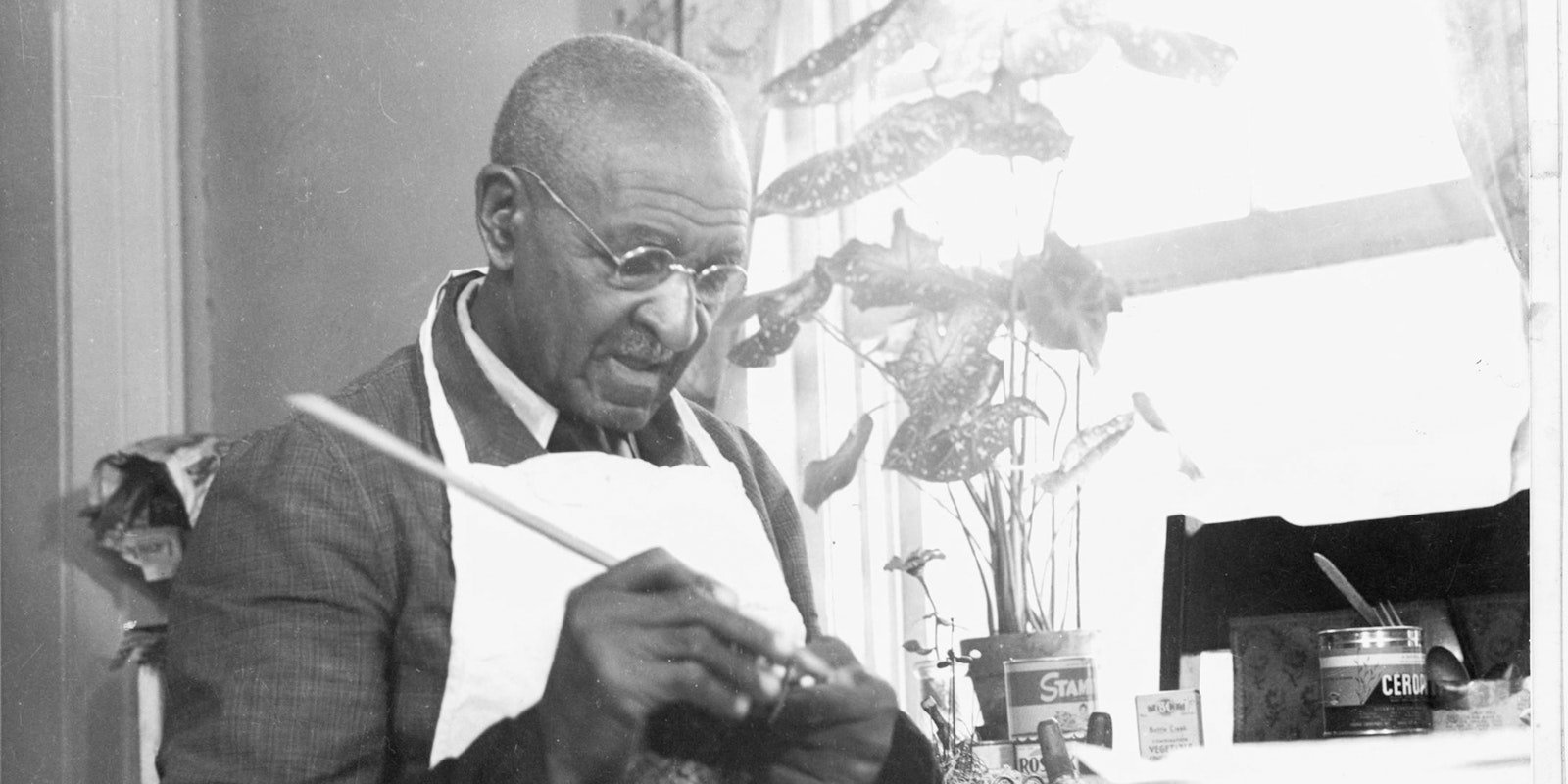
While most of Carver’s crochet was for his personal enjoyment, he did create some crocheted pieces, such as the rag rug he is crocheting on page 18, as models for his rural outreach programs at the Tuskegee Institute’s agricultural experiment station. Carver’s experiment-station research focused on helping poor farming families establish alternative crops, improve health and nutrition, and boost household economics. Textiles in his experiment-station work relied on discarded materials, such as rags, old burlap bags, and waste plant fibers. Carver used these accessible materials to create useful and beautiful textiles. I look forward to sharing more about this work in an upcoming PieceWork article.
Author’s Note: This article would not have been possible without the assistance of Curtis Gregory, Park Ranger, George Washington Carver National Monument, and Robyn Green Harris, Museum Specialist, Tuskegee Institute National Historic Site—and I thank them.
 Nancy Nehring re-created some of Carver’s swatches in the Spring 2021 issue of PieceWork. Photo by Matt Graves
Interested in trying some of George Washington Carver’s patterns? Visit the PieceWork library for a free pdf!
Notes
- For a discussion of slavery in southwest Missouri, see Krahe, Diane L., and Theodore Catton. Walking in Credence: An Administrative History of the George Washington Carver National Monument (National Park Service, 2014), 21–23.
- Kremer, Gary R., ed., George Washington Carver in His Own Words (Columbia, Missouri: University of Missouri Press, 1987), 128.
- Holt, Rackham, George Washington Carver: An American Biography (New York City: Doubleday, 1950), 9–10.
- Holt, George Washington Carver: An American Biography, 14–15.
- Holt, George Washington Carver: An American Biography, 29.
- Kremer, George Washington Carver in His Own Words, 50 .
- Also known as A Grammatical Institute of the English Language, Vol. 1 or, later, The American Spelling Book by Noah Webster.
- Kremer, George Washington Carver in His Own Words, 20.
- Kremer, George Washington Carver in His Own Words, 149.