
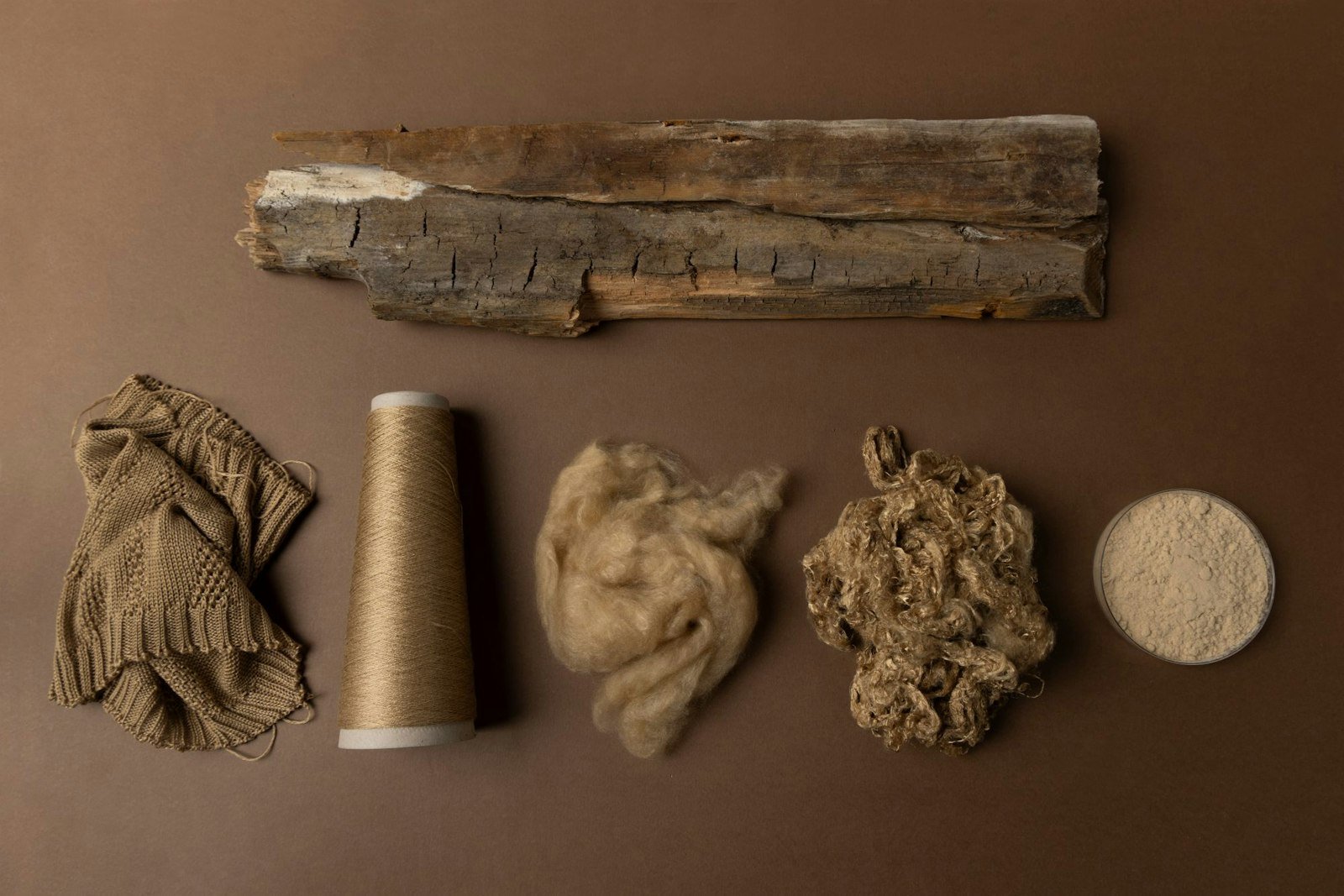
“If something this beautiful can be made from centuries-old wood, why do we keep throwing away materials that could still be circulated and reused?” Pirjo Kääriäinen, Professor of Practice, Aalto University.
From September 1 to October 30, 2026, Aalto University, Finland will host Designs for a Cooler Planet, a combination of exhibits, workshops, and guided tours focused on bold ideas that can improve our world. One of the many highlights of these exhibits is a dress knitted from wood salvaged from a historic shipwreck.
Finnish archaeologists, chemists, artists, and forestry experts worked together with computer science students to give new life to the otherwise unsalvageable remains of the oldest known boat in northern Finland. Using Ioncell®, an innovative process developed through a collaboration between Aalta University Bioinnovation Center and the University of Helsinki, wood from the wreck was converted into a naturally soft, brown yarn that was then knitted into two identical high-fashion dresses evoking the spirit of the 600-year-old wooden boat.
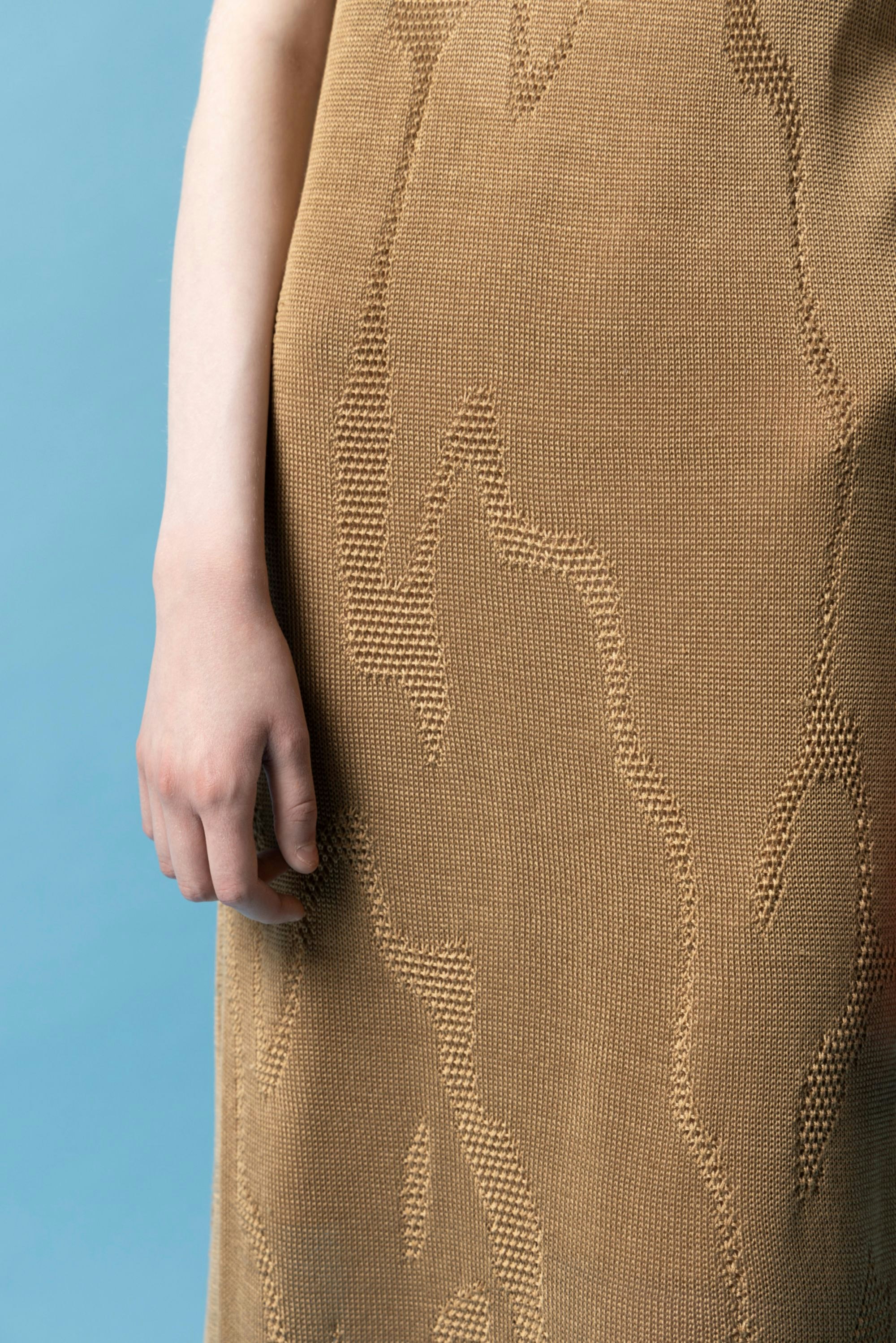
 One of the dresses knitted from reclaimed wood. The color of the dress comes directly from the Hahtiperä wreck. Dress designer Anna-Mari Leppisaari says that sustainability thinking has increased interest in using undyed naturally colored yarns in the textile industry. Photo by Esa Kapila. All photos courtesy of Allto University
17th-Century Finland
The story of these dresses begins in the pine forests of Ostrobothnia in the seventeenth century when trees were harvested to build a lodja, a Finnish cargo vessel. Below the waterline, the boat was constructed with overlapping boards clinched with iron nails (clinker built), which provided watertightness and flexibility to the hull. Above the water, the planks were butted together (carvel built), which allowed for increased carrying capacity and size. Seams were filled with moss (Warnstorfia trichophylla) and pitch. Over 60 feet (20 meters) in length, she would have had a single mast and sail—a coastal boat capable of ocean travel.
By 1640, Finland was a major exporter of pine tar, a valuable commodity for sealing wooden boats during the age of sail. Crewed by family members and neighbors, Finnish barges transported timber across the Gulfs of Finland and Bothnia as well as hauling dried or salted fish and grain for local consumption. Work aboard a barge would typically start at dawn, the hours often long and cold, since dusk could last past midnight in summer.

The Finnish ship is discovered during contstruction of a parking lot. Photo by Minna Koivikko
The Excavation
Fast forward to 2019: During construction of a parking lot next to the Radisson Blu Hotel in Oulu, workers unearthed wooden planks. At first, the archaeologists thought they had struck an old pier, now silted in and buried; however, further investigation proved that this was the remains of a boat, older than any other found in northern Finland. The bow, stern, rigging, mast, and mast-step were missing, along with any identifying artifacts or name, so the find was named Hahtiperä, after the first and oldest harbor in Oulu, Finland, where the boat was found.
 Transporting the shipwreck. UNESCO recommends that underwater archaeological cultural heritage should be left at its discovery site. However, wrecks may be raised and conserved for justified reasons. The Hahtiperä wreck was conserved because it is the oldest shipwreck discovery in Northern Finland. Photo by Minna Koivikko
Normally wrecks are left in place, but the location of the Hahtiperä wreck threatened to cause dangerous subsidence under the construction. Although incomplete, the entire wreck was documented, and a section 23 feet wide and 65 feet long was removed for preservation, study, and display. Archaeologist, Minna Koivikko wondered if the remaining fragments could be reused instead of discarded and asked researchers at the Aalto Bioinnovation Center to give the wood “new life.”
21st-Century Innovation
Together with the University of Helsinki, the team at the Bioinnovation Center had already developed a patented process, Ioncell®, to sustainably convert discarded textiles and cellulosic waste into textiles. Previous projects included a scarf knitted from old jeans in 2018 and a gown for Jenni Haukio, the First Lady of Finland, woven from yarn made from silver birch (Betula pendula), the national tree of Finland. Creating a textile from Hahtiperä wreck fragments would be both a test and a challenge.
 Inge Schlapp-Hackl oversaw the reclamation process and explained that "this wonderful project brought together a large group of Aalto researchers from different research groups and schools.” Photo by Anna Berg
The reclamation process was overseen by bioengineer Inge Schlapp-Hackl. The reclaimed wood was cleaned, dissolved into a pulp, then extruded as flat sheets of cellulose, which were shredded. The shredded cellulose was dissolved with a nontoxic ionic solution developed by Ilkka Kilpeläinen at the University of Helsinki; the resulting liquid was then formed into spinnable fibers for knitting and weaving. Without dyeing or bleaching, the wood from the Hahtiperä wreck yielded soft durable fibers with a rich brown coloring and a natural silk-like sheen.
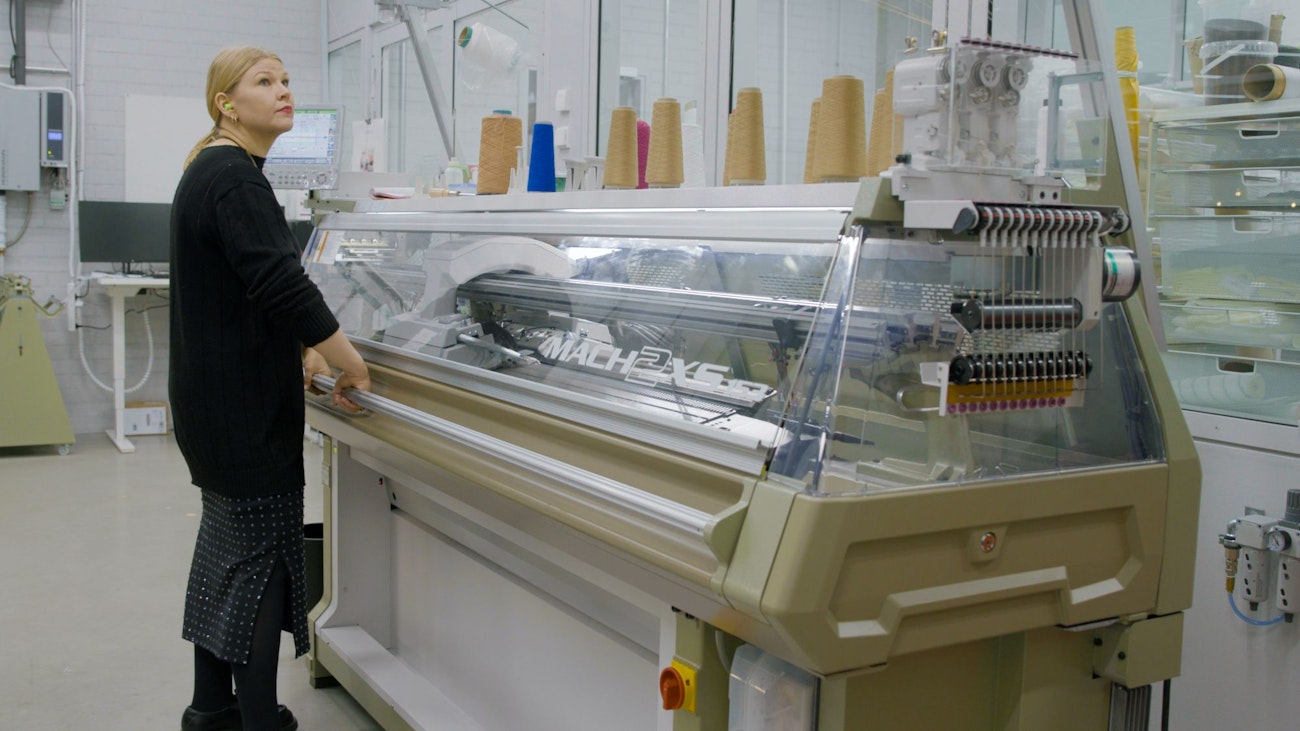
Anna-Mari Leppisaari knitting the dress on the Shima Seiki knitting machine. The dress is completely seamless and weighs around 350 grams. Photo by Anna Berg
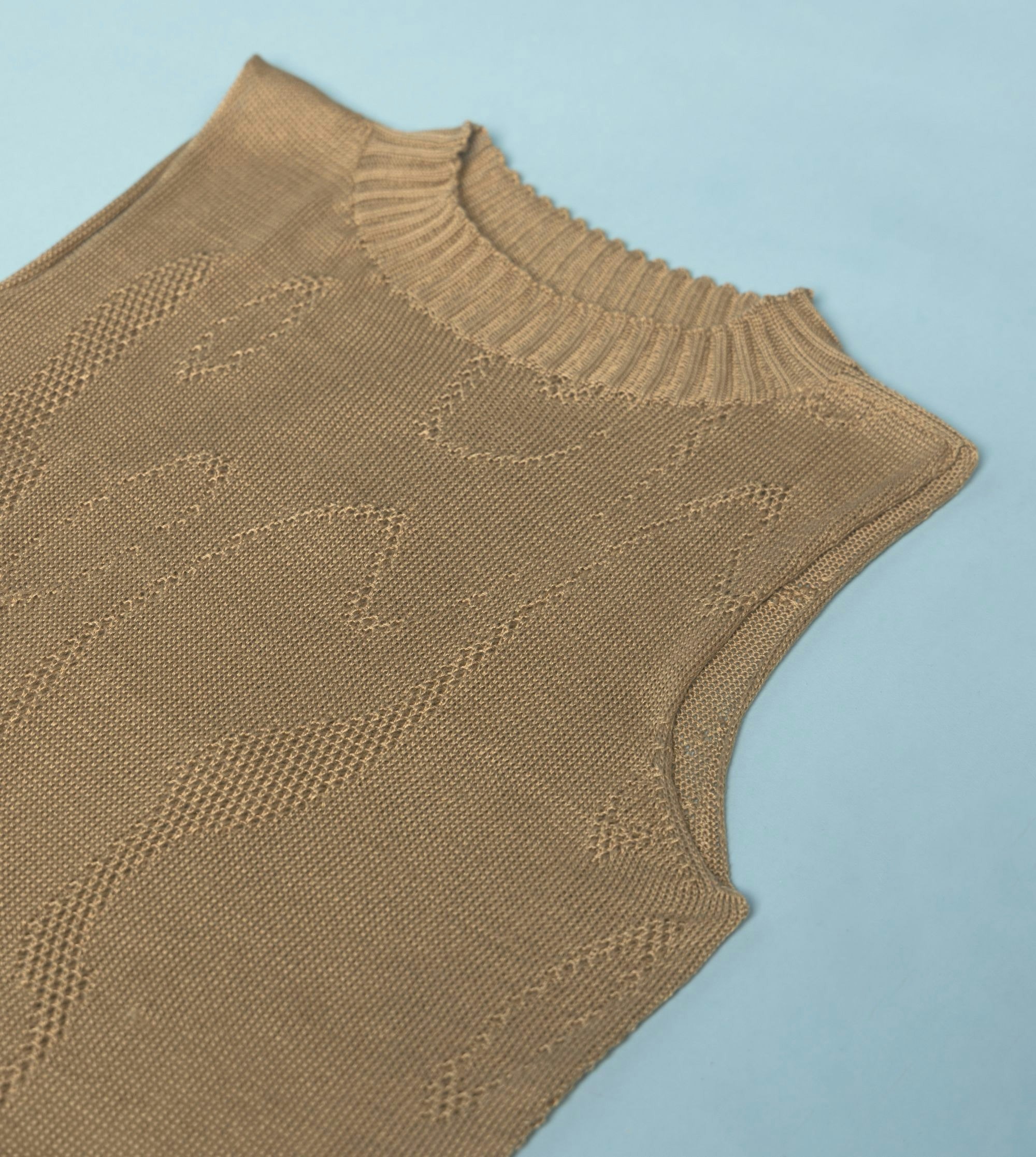
Once the yarn was ready, Aalto University textile artist Anna-Mari Leppisaari created two identical seamless knit dresses with a textured design, using a Shima Seiki knitting machine. The finished dresses had a linear silhouette evoking Finland's native pines, their deep brown color drawn naturally from the wood, aged in the salt and mud of the ancient harbor. The dresses forge a connection to Finnish maritime history, culture, and to the land itself.
Designs for a Cooler Planet is open from September 1 to October 30, 2026 on Aalto University’s campus in Otaniemi, Finland.
Resources
Hölttä, Mina. “The journey of a 17th-century shipwreck continues as a unique knitted dress.” A! Sign of Change Aalto, University, Finland, 2026.
Scholl, Lars U. "Sail and Steam: Selected Maritime Writings of Yrjö Kaukiainen," Research in Maritime History, No. 27. Liverpool, United Kingdom: Liverpool University Press,2--4, 1-20.
Further Exploration
Designs for a Cooler Planet
From Forest to Fabric: A video of the Ioncell® process
Hahtiperä Blog