
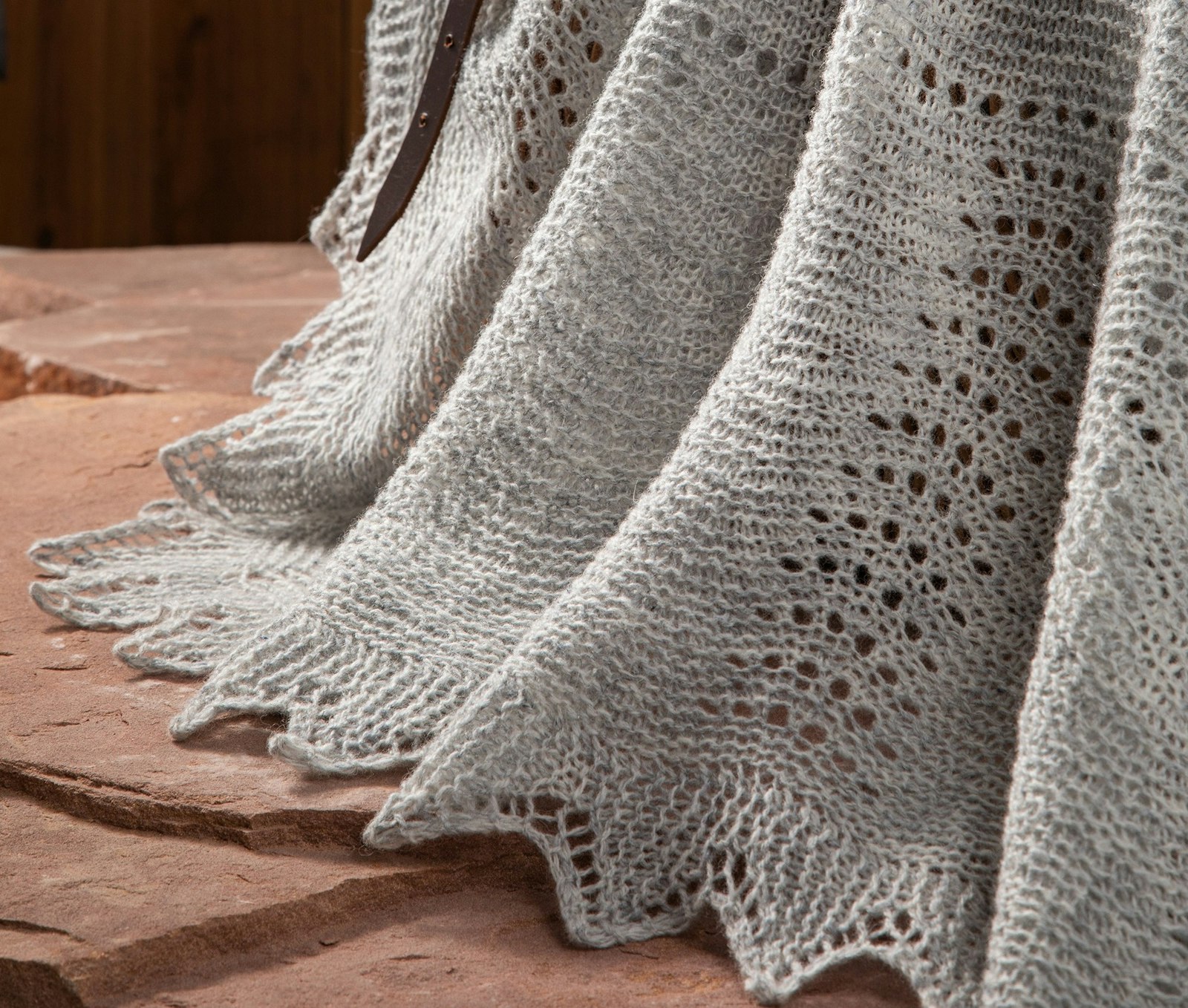
The hap is a warm, knitted textile created by generations of Shetland knitters before me and, hopefully, many generations to come. Exactly when haps were first knitted and used in Shetland is unknown. We do not know what the early knitted shawls may have looked like, but they have evolved into the classic hap we have today. Haps are sometimes referred to as a “retro” garment, but if it needs a tag at all, “historic” would be a better descriptor. However, the hap is still in use today, so neither word is really correct. It is a historic garment, yet its design and its uses have changed through time. The design we have now has become, for the meantime, our classic hap. In Shetland today, a hap is used to wrap round a baby to keep warm. And that is what the word means—to wrap up warmly. However, until about 100 years ago, a hap was a typical woman’s outdoor garment—in fact, worn in place of a jacket. Its use as such began to diminish as more clothes were available in shops and households had more cash money to spend.
Speaking of Haps
In Shetland dialect, the archaic meaning of the word hap as a noun is “a covering of some kind”; as a verb it means “to cover up” or “wrap up warmly.” On Shetland today, the meaning has not changed. Various resources tell us that hap is perhaps of Norse origin. This fits perfectly for a Shetland word as the Shetland dialect originates from Norn, which traces its roots back to Old Norse. The word hap has become somewhat synonymous with the word shawl. However, haps and shawls are used differently, and the words originate in very different parts of the world. This is why Shetlanders would not use the term hap shawl, as is often used outside of Shetland.
 This classic hap is knitted from the outside inward in a single fluid piece. Stitches picked up from one section are used to work the next section, with no cast-ons or bind-offs.
Today the word shawl describes any shape of garment used to wrap round the shoulders. The original shawls were squares of woven cloth, and the word comes from the Persian word shāl. They would have been similar to cashmere shawls, pashminas, and Paisley shawls. Over time, a knitted square of fabric has also become a shawl. From a square, it has evolved to be a wrap of any shape. That is just evolution. The construction of a Shetland shawl is the same as a hap; the only difference is that our shawl is knitted with more complicated patterns in the design and is not—and never has been—an everyday outdoor garment.
Subscribers can enjoy the rest of this in-depth article, complete with Shetland knitting terms, in PieceWork’s Winter 2022 issue, AND download Elizabeth Johnston's pattern for the Shetland Old Shell Hap and Half Hap.
Not yet a subscriber? Learn how to join the community here.
Just for fun, check out this wonderful Gallery of Handspun Haps with our sister magazine Spin off.