
Contents
The Weldon’s Practical Crochet series is a treasure trove of design ideas. Originally published starting in 1885, each issue contains anywhere from 15 to over 40 illustrations (patterns). The patterns are often ingenious, and many of the objects transcend the century, while others are a bit more quirky. And with 28 issues available in the PieceWork library, there are well over 600 designs to choose from among their pages.
So, when I needed inspiration for a new project, I headed straight to Weldon’s. I struck gold in the eighth series eBook. On page 4, I found the instructions for the trinity stitch.
Meet the Trinity Stitch
Weldon’s says, “This stitch is prettier when actually worked than it appears in the illustration. If the Floss wool of the Providence Mills Company, Bradford, be used, and a No. 7 Bone crochet needle, it makes a lovely scarf shawl.”
 The original diagram for the trinity stitch from Weldon’s.
When the pattern says a stitch is even prettier when worked, you know it’s worth sampling.
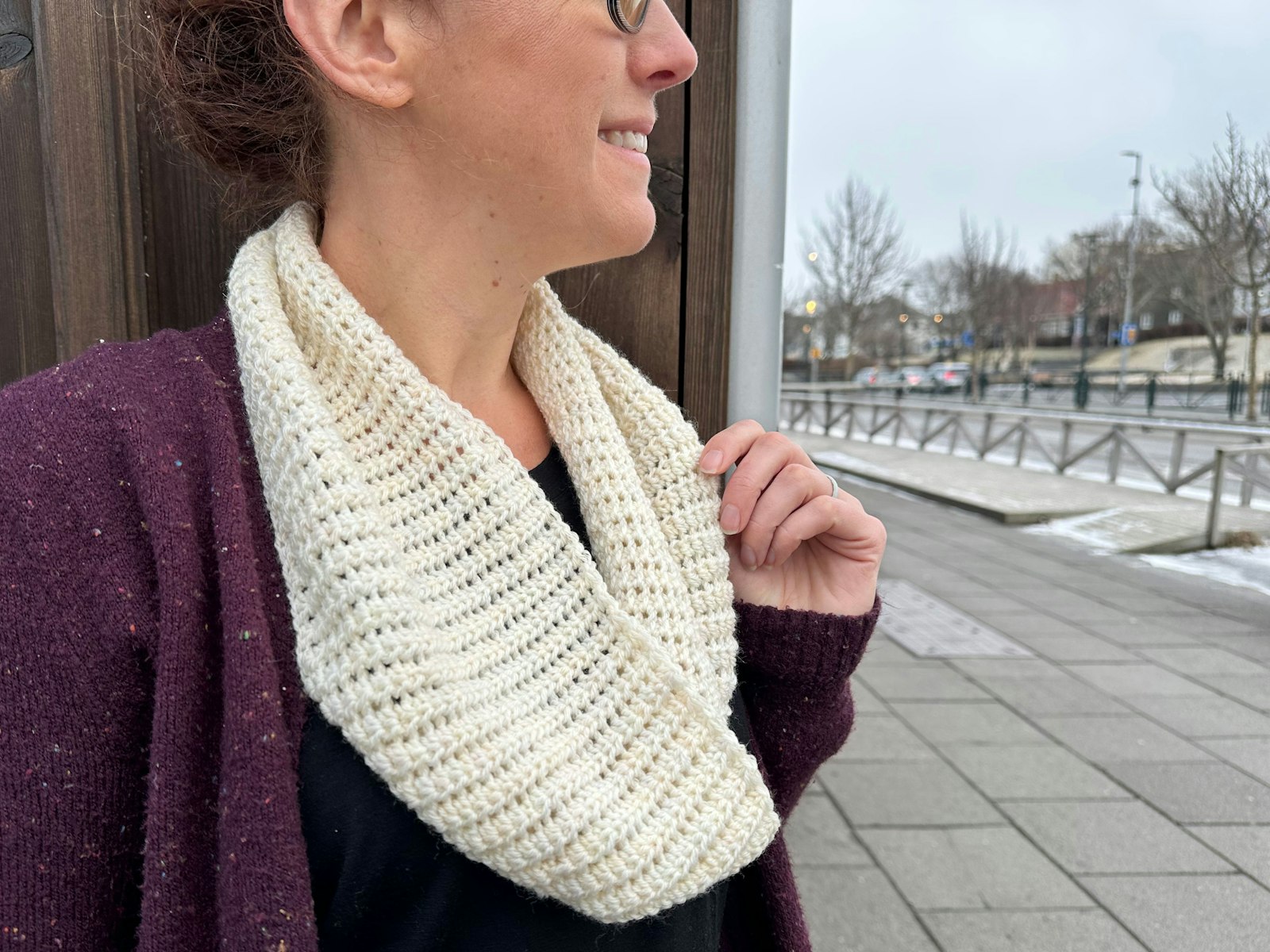
I had already reserved a special skein of superwash Merino wool for this project, so I knew I’d be sampling with that yarn. After testing the pattern with the gauge suggested and a 4.0 mm hook, I decided to see if it would hold up with a larger 5.5 mm hook. The winner was clear. The larger hook created a lacier, airier fabric, and it had much better drape for a cowl or scarf.
 I started with 20 chains and worked 7 rows of the pattern in my sportweight wool, and each sample has been blocked. The top sample used a 5.5 mm hook, and the bottom sample used a 4.0 mm hook.
You’ll also notice tails at the end of each row in my samples. The pattern calls for starting at the right, working to the left, and breaking the yarn at each row so you can work right to left again (rather than turning at each row).
As much as I love (don’t love) weaving in ends, I decided to write my new pattern as a cowl worked continuously in the round. You join each row, then chain up to start the next row—reducing the number of ends to a whopping two. Happiness!
Let’s jump into the pattern instructions, and I’ll share a few more of the tricks I learned along the way.
All Access subscribers can log in to get the adapted and original pattern instructions below. Not a subscriber? Learn more about all the perks.
Trinity in Time Cowl Pattern
I adapted this design from the Trinity Stitch pattern from Weldon’s Practical Crochet Eighth Series.