
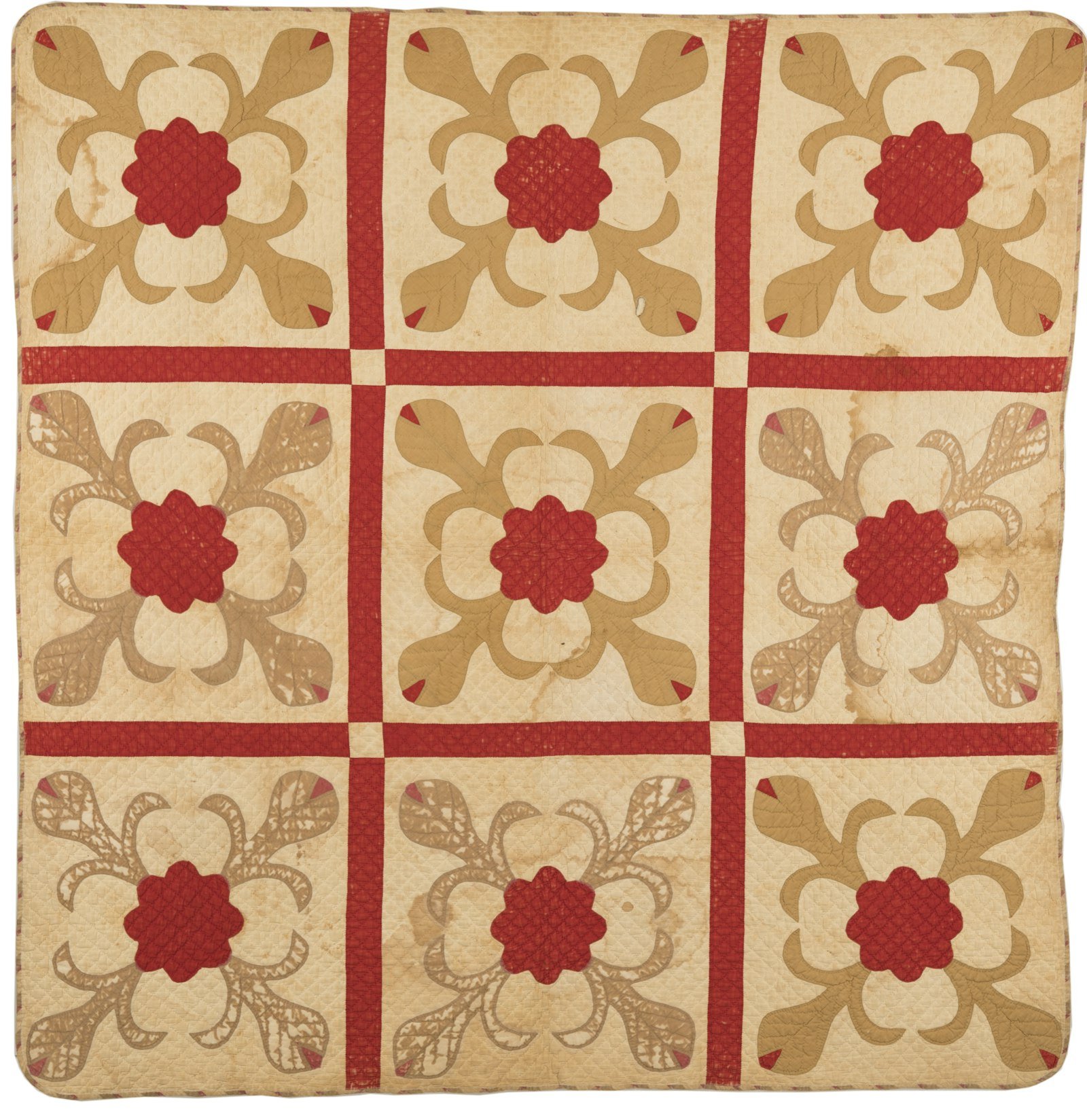
In this excerpt from "Chain-Pieced: Quilts Made by Enslaved Women in Nineteenth-Century America" from PieceWork Spring 2026, Mary Fons explores the history of enslaved needleworkers and their significant contributions to the world of quilting. —PieceWork editors
Chain-Pieced
Early-nineteenth-century American quilts hold a particular fascination for many quilt scholars. Whether the quilt is a worn Southern linsey or a flawless chintz appliqué out of New England, the attraction might be that it represents a time when the American quilt began to come into its own. In the decades leading up to the nineteenth century, textiles produced on an industrial scale began flooding the country, which made fabric suitable for quilts both affordable and accessible to many American quiltmakers who began enthusiastically experimenting with materials and methods. Quilt by quilt, early-nineteenth-century women gave shape to a rapidly developing American art form. Whenever this prolific period of quilt history is considered, it is inevitably the textile mill, cotton gin, sewing machine, and rapidly expanding national rail-road system that is given the credit for igniting this profusion of quilts. Equally critical, though rarely addressed, is the system of labor in place at the time which made such technological advances possible.
Between 1750 and 1850, an era that historians generally agree was the Industrial Revolution’s most consequential, every stage of cloth production, from planting to harvesting, processing to distribution, involved the labor of enslaved people. It can be said, therefore, that enslaved people’s involvement in building and maintaining the country’s textile supply chain made them indirect participants in the creation of every quilt made in America at that time. In addition, countless slaves with sewing skills were tasked with creating quilts. Hardly limited to the South, every state in the Union (with the exception of Vermont) enslaved African Americans at one time. It is reasonable to suggest that any quilt made in the United States before 1863 was made possible, either directly or indirectly, because of slave labor.
 Winding Rose quilt by Eliza McKenzie, enslaved by the Marler family; Meigs Co., Tennessee; circa 1860; 93 × 78 inches (236 × 198.1 cm). From The Quilts of Tennessee: Images of Domestic Life Prior to 1930 by Bets Ramsey and Merikay Waldvogel, 1986. Photo courtesy of Merikay Waldvogel
“African Americans,” wrote quilt scholar Cuesta Benberry, “have made quilts in this land continuously from the late eighteenth century to the present.”1 As infrequent as it may be to encounter a quilt with provenance traceable to an enslaved person, Benberry was able to identify quilts made by slaves in every former slaveholding state, with the earliest known example dating to around 1800. The quilts known to have been made in whole or in part by slaves exhibit extraordinary variety. From simple-use quilts pieced with scraps of osnaburg and kersey to masterpieces in delicate chintz appliqué, slave-made quilts reflect the flexibility of the quilt as an art form and inspire questions about the lives of their creators.
A quilt’s design and construction depended only in part on the quiltmaker’s personal taste and style. Arguably more consequential to the finished product is the quiltmaker’s motivation and what materials, tools, and time she had available. Quilts made in the “big house” for or with plantation mistresses were constructed with the aid of tools quilters today would view as indispensable, such as scissors, pins, and fabric suitable for quiltmaking. Quilts made by slaves for their personal use, however, would rarely have been made using such supplies.
Notes 1. Cuesta Benberry, Always There: The African-American Presence in American Quilts (Louisville, KY: Kentucky Quilt Project, 1992), 13.
Would you like to learn more about the lives of enslaved quilters? Read the full article in PieceWork's Spring 2026 issue.
Also, remember that if you are an active subscriber to PieceWork magazine, you have unlimited access to all the issues. See our help center for information on how to find them as well as other articles and projects in the PieceWork library. Not yet a subscriber? Learn how to join the PieceWork family here.